Comic-Con Started in a Hotel Basement
and Its First Year Had Two Beginnings

Greg Ross
CEO / Owner - Nancy's Vacation Rentals
San Diego Weird History
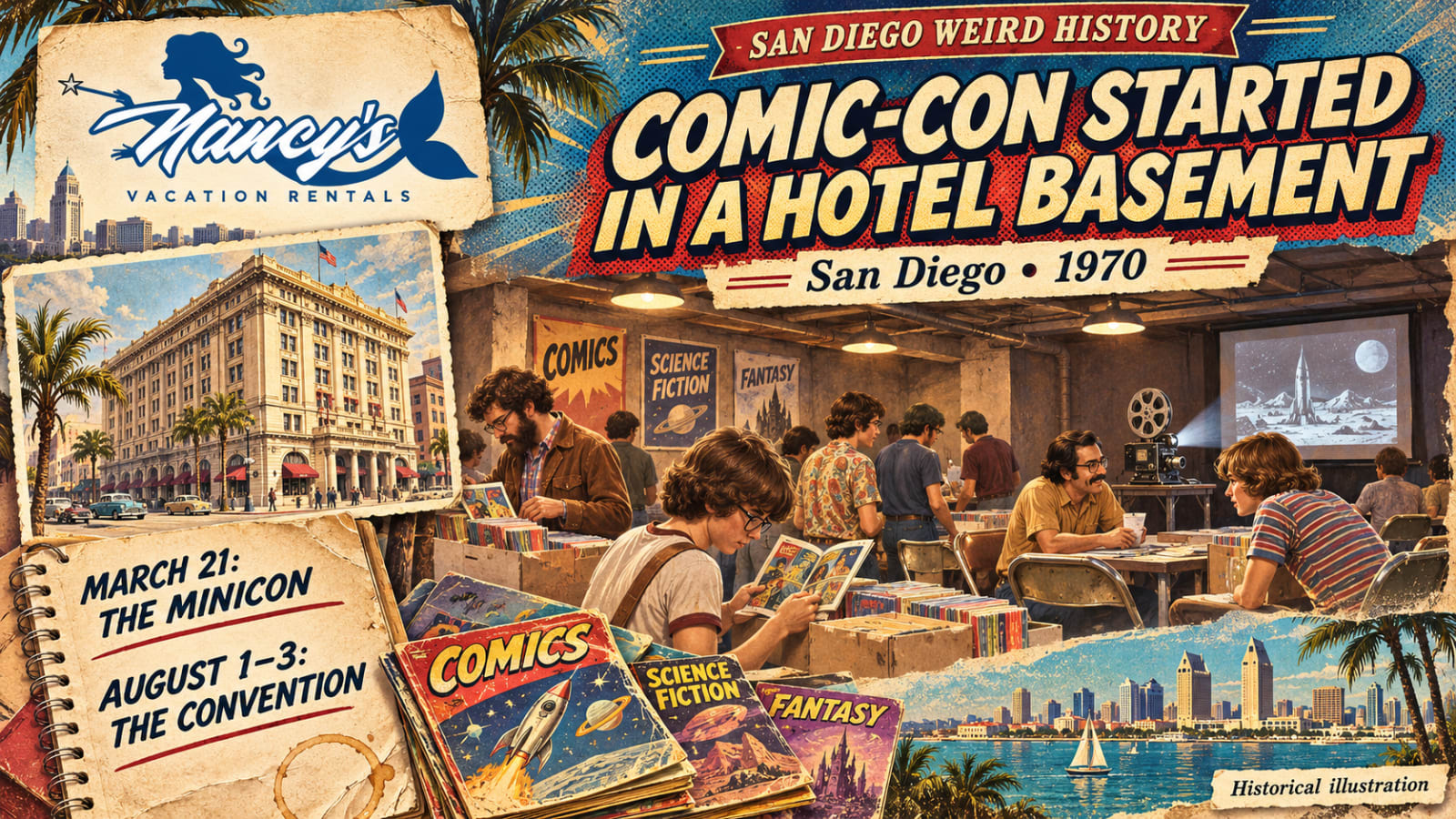
Comic-Con Started in a Hotel Basement—and Its First Year Had Two BeginningsBefore Comic-Con became one of the events most closely associated with San Diego, its organizers had a smaller problem to solve: how to get a convention started at all. Their answer included a downtown hotel basement, a one-day gathering and enough enthusiasm to attempt something bigger a few months later.
The hotel was the U.S. Grant. The year was 1970. And the detail that makes this San Diego Weird History story especially interesting is that there were two events that year. The March minicon helped make the August convention possible.
That distinction gets blurred when the entire beginning is reduced to a story about 300 people in a basement. The small fundraiser and the first full convention were connected, but they were separate steps.
First came a one-day experiment
Comic-Con’s own archive dates the minicon to March 21, 1970. Its purpose was to help finance the larger convention planned for August 1–3. Both events took place at the U.S. Grant in downtown San Diego.
The San Diego History Center’s account places the March gathering in the hotel basement and gives attendance as 100. In a 2010 KPBS interview, co-founder Mike Towry also remembered roughly that scale, while acknowledging that numbers vary. Other published accounts use a different tally; the safest conclusion is that this was a very small gathering, not the roughly 300-person August event.
A hundred people can sound unimpressive when viewed backward through decades of growth. For organizers trying to find an audience and fund a larger undertaking, however, the important question was whether people would come together around the idea. The March event gave them a practical beginning.
Some of the organizers were still teenagers
The KPBS interview with Towry and fellow co-founder Richard Alf adds a human dimension to the familiar origin story. Alf recalled being 17 when he began working with Shel Dorf; Towry was younger. Their recollections describe young comic collectors being introduced to the possibility of organizing a convention, rather than an established institution planning its next annual show.
Towry remembered the Convention and Visitors Bureau helping connect the organizers with the U.S. Grant. In his account, use of the basement for the minicon was tied to holding the longer August convention there. This is a participant’s later recollection, and it helps explain how the two events fit together.
It also changes the picture. The basement was part of an arrangement the organizers had to make work. The story involves finding a venue, making contacts and taking a chance on an audience.
The surviving program makes the day feel real
Comic-Con has reproduced the March program online, and it is worth exploring. The cover used a Convention and Visitors Bureau stock sheet showing Balboa Park’s California Tower, with the event’s information added to it. That modest piece of printing is an unusually direct connection to the first gathering.
The program featured Forrest J Ackerman and artist Mike Royer. Its schedule included film screenings, cartoonist presentations, a guest session and repeated opportunities to visit the dealers’ room. The films included the silent version of The Lost World and Rocket Ship, drawn from the Flash Gordon serial.
Those details reveal how much was already present at the beginning: meeting creators, watching films, finding things to buy and spending time with people who shared your interests. The scale was small, but the mixture is recognizable.
Even the reproduced pages bear coffee-cup stains. Comic-Con’s archive does not identify whose cup left them. It is a minor, wonderfully ordinary trace of an event whose later importance could not yet be measured.
Then came the August convention
The March fundraiser was followed by the three-day gathering on August 1–3, 1970. The History Center describes an audience of about 300 for that larger event. It is this second gathering that Comic-Con’s archive distinguishes as the first full convention.
Keeping both dates in view makes the story more satisfying. Comic-Con did not simply appear one summer in its finished form. The organizers first held a smaller event, then moved ahead with the longer one they had been working toward.
The connection between comics, films and science fiction also belonged to the early identity. Comic-Con’s official history says its founders intended to include those related interests from the start. Film’s presence was part of the original idea, long before today’s large-scale entertainment presentations.
The familiar waterfront home came much later
The U.S. Grant was a beginning, not Comic-Con’s permanent home. The organization’s history identifies the El Cortez Hotel as its main location during the 1970s, followed by the Convention and Performing Arts Center in 1979. The move to the waterfront San Diego Convention Center came in 1991.
That timeline is useful when walking around downtown. The building most closely associated with the convention today is not the building where its first San Diego gatherings happened. Different places preserve different chapters.
Connecting the story with San Diego today
The U.S. Grant remains an operating hotel. Its official history dates its opening to October 15, 1910, so it was already a long-established downtown landmark when the comic fans arrived in 1970. Seeing the building gives the story a geographic anchor, but does not establish access to the original event space.
Do not assume there is a public basement exhibit or a walk-in Comic-Con tour. The hotel currently advertises a history-and-culture tour specifically for overnight hotel guests. Ask the property directly about any visit or access arrangements.
For a separate public-facing stop devoted to popular arts, consider the Comic-Con Museum at 2131 Pan American Plaza in Balboa Park. Check its current exhibits, admission and opening hours before visiting. It is a museum experience, not the original convention venue.
At Nancy’s Vacation Rentals, more than 25 years of welcoming guests have reinforced how much San Diego offers beyond its best-known views. This story is a reason to look at downtown differently: a world-famous event began with people willing to organize one small day, then try again on a larger scale.
Explore Nancy’s San Diego vacation rentals as you plan your stay, and leave room for the city’s unexpected beginnings.
Browse Nancy’s San Diego vacation rentals.
Sources
- Comic-Con: The first minicon program
- San Diego History Center: Comic-Con’s early years
- San Diego History Center: 2013 historical exhibition
- KPBS: Interview with co-founders Mike Towry and Richard Alf
- Comic-Con: Official history
- The U.S. Grant: Current hotel information
- Comic-Con Museum: Visitor information