
From Navy Boot Camp to San Diego Hidden Gem
he Incredible Transformation of Liberty Station

Greg Ross
CEO / Owner - Nancy's Vacation Rentals
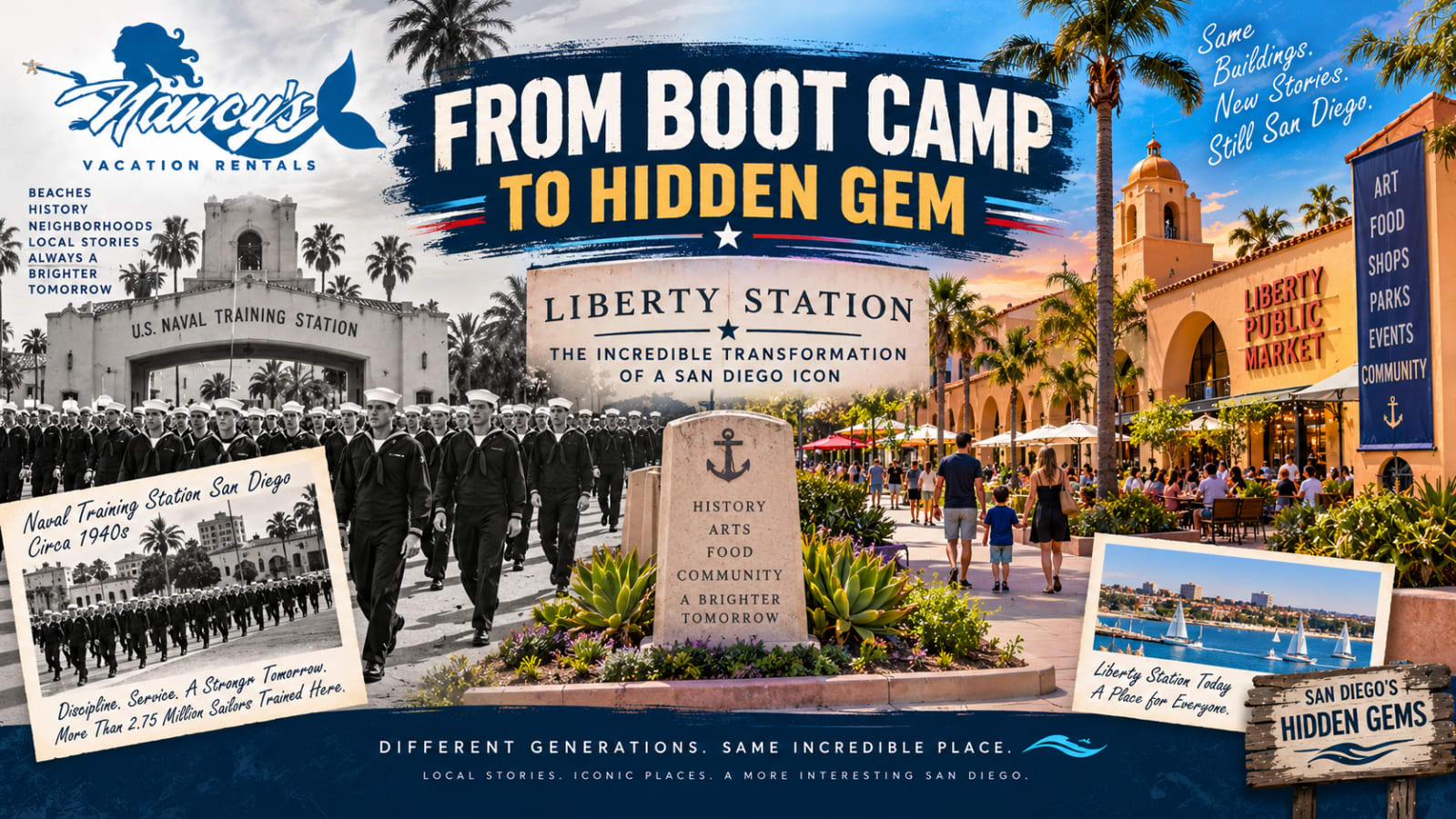
Today, Liberty Station is filled with restaurants, art galleries, markets, parks and families enjoying the waterfront. But for more than 70 years, this sprawling Point Loma complex had a very different purpose: turning civilians into United States Navy sailors.
Walk through Liberty Station today and it can be difficult to imagine what this place once sounded like.
Instead of restaurant patios and art studios, there were shouted commands.
Instead of weekend markets, there were military formations.
Instead of families relaxing on the grass, thousands of young recruits marched across the grounds preparing for life in the United States Navy.
From 1923 until 1997, the property we now call Liberty Station was the Naval Training Center San Diego.
And during those decades, more than 1.75 million Navy recruits passed through its training programs, along with approximately 1 million sailors attending specialized A and C schools. :contentReference[oaicite:0]{index=0}
Today, the same historic buildings have been transformed into one of San Diego's most unusual destinations.
It's one of the best examples in the city of old military infrastructure being given an entirely new life.
Before Liberty Station, There Was Almost Nothing Here
In the early 20th century, San Diego was rapidly becoming an important Navy town.
Its natural harbor, mild climate and location on the Pacific made the city an obvious location for expanded naval operations.
One person who recognized the potential was Franklin D. Roosevelt.
Long before he became President of the United States, Roosevelt served as Assistant Secretary of the Navy.
In 1915, he visited San Diego and evaluated the area as a possible location for a new naval training station. :contentReference[oaicite:1]{index=1}
Local leaders enthusiastically supported the idea.
San Diego wanted the Navy.
And the Navy increasingly wanted San Diego.
Construction Begins
Land for the future training station was assembled with help from prominent San Diego families and local political leaders.
Construction began in 1921.
The first buildings included barracks, a dispensary, a fire station, a mess hall and four training schools. :contentReference[oaicite:2]{index=2}
The architecture was intentionally distinctive.
Many of the buildings incorporated Spanish Colonial Revival influences similar to the architecture that had made Balboa Park famous during the Panama-California Exposition.
That architectural consistency is one reason Liberty Station still feels so cohesive today.
October 27, 1923: The Naval Training Station Opens
The new Naval Training Station San Diego was formally dedicated on October 27, 1923.
According to Liberty Station's historical records, approximately 4,000 people attended the dedication.
A group of 100 local children reportedly sang the national anthem while the American flag was raised over the station for the first time. :contentReference[oaicite:3]{index=3}
At first, the facility was relatively modest.
That would not last long.
Thousands of Young Men Arrived for Boot Camp
For generations of Navy recruits, San Diego became their first introduction to military life.
Young men arrived from cities, farms and small towns across the country.
Many had never been to California.
Some had never seen the Pacific Ocean.
Within hours, their civilian lives began disappearing.
Haircuts.
Uniforms.
Inspections.
Physical training.
Marching.
Seamanship.
Discipline.
Military routine.
The goal was to transform civilians into sailors capable of serving aboard Navy ships around the world.
Boot Camp Was Not a Vacation in San Diego
Today's Liberty Station may feel relaxed.
Boot camp certainly did not.
Recruits lived in barracks and followed tightly controlled schedules.
Days often began early.
Training involved physical conditioning, classroom instruction, drills, inspections and learning basic Navy procedures.
Failure to meet standards could mean extra instruction, additional physical training or repeating portions of the program.
For many recruits, the experience was the first time they had lived away from home.
It was intentionally demanding.
Then World War II Changed Everything
The attack on Pearl Harbor in December 1941 transformed the United States Navy almost overnight.
The military suddenly needed enormous numbers of trained sailors.
Naval Training Station San Diego expanded rapidly.
By 1942, the population at the station reached approximately 33,000 personnel. :contentReference[oaicite:4]{index=4}
Temporary barracks appeared.
Schools expanded.
Training programs multiplied.
At its wartime height, the installation included dozens of schools, medical facilities, churches and support buildings. :contentReference[oaicite:5]{index=5}
The once relatively quiet training facility had become a military city.
Women Arrive at the Training Center
Another major change took place during World War II.
Women began serving at the station in May 1943. :contentReference[oaicite:6]{index=6}
This reflected the Navy's expanding wartime personnel needs and the growing role women were playing across military support and administrative operations.
San Diego's training center was evolving along with the Navy itself.
It Became More Than Boot Camp
In 1944, the Navy officially changed the name from Naval Training Station to Naval Training Center San Diego.
The change reflected the fact that the facility had become much more than a basic recruit-training base.
It now included numerous specialized technical schools where sailors learned specific Navy occupations. :contentReference[oaicite:7]{index=7}
These were known as A schools and C schools.
Over the life of the base, approximately 1 million sailors received specialized training there in addition to the 1.75 million recruits who went through basic training. :contentReference[oaicite:8]{index=8}
The Base Kept Growing
The original installation occupied only a few hundred acres.
Over the decades, the Navy expanded it repeatedly.
Land was added through exchanges with the City of San Diego and by using dredged material from San Diego Bay to create additional usable land.
By the 1990s, the Naval Training Center covered approximately 550 acres and contained roughly 300 buildings. :contentReference[oaicite:9]{index=9}
It had become one of the defining military installations in San Diego.
Camp Nimitz Expands Recruit Training
During the Korean War era, recruit demand increased again.
The Navy temporarily reactivated Camp Elliott for basic recruit training.
More than 150,000 sailors were trained there during its early-1950s use. :contentReference[oaicite:10]{index=10}
Then, in 1955, the Navy completed Camp Nimitz, expanding training capacity at Naval Training Center San Diego. :contentReference[oaicite:11]{index=11}
For thousands of Navy veterans, the words "NTC San Diego" or "Camp Nimitz" still bring back very specific memories.
The Sounds of the Training Center
Imagine standing in what is now Liberty Station on a weekday morning in the 1960s.
The scene would have been almost unrecognizable.
Companies of recruits marched across drill fields.
Commands echoed between the buildings.
Sailors moved between classrooms.
Vehicles crossed the base.
Aircraft from nearby Lindbergh Field flew overhead.
Thousands of people lived, trained and worked inside the installation every day.
Today, many visitors stroll through those same courtyards without realizing that entire generations of Navy recruits once marched across them.
Even Entertainment Had a Military Connection
Life at NTC was not entirely drills and inspections.
The training center also had recreational and entertainment facilities.
Luce Auditorium hosted performers and entertainers over the years.
Historical accounts associated with the property mention performers including Bob Hope, Tommy Dorsey and Nat King Cole. :contentReference[oaicite:12]{index=12}
For recruits far from home, entertainment provided a welcome break from military routine.
Then the Cold War Ended
By the early 1990s, America's military needs were changing.
The Cold War had ended.
The Department of Defense began closing and consolidating military installations across the country.
In 1993, the Navy announced that Naval Training Center San Diego would close as part of the federal Base Realignment and Closure process. :contentReference[oaicite:13]{index=13}
The announcement raised an enormous question:
What do you do with hundreds of acres and hundreds of buildings in the middle of San Diego?
The Last Boot Camp Class
Recruit training ended before the entire base closed.
The final recruit class graduated in November 1993.
Recruit Training Command was formally decommissioned in March 1994. :contentReference[oaicite:14]{index=14}
For the first time in roughly 70 years, new Navy recruits were no longer arriving in San Diego for boot camp.
April 30, 1997: NTC Closes
On April 30, 1997, active military operations at Naval Training Center San Diego officially ended. :contentReference[oaicite:15]{index=15}
The gates closed on an era that had lasted nearly three-quarters of a century.
More than 2.75 million sailors had received some form of training there. :contentReference[oaicite:16]{index=16}
Now the enormous property sat waiting for its next chapter.
San Diego Inherits a Small City
The City of San Diego took ownership of much of the former base in 2000. :contentReference[oaicite:17]{index=17}
The challenge was enormous.
Hundreds of buildings.
Historic structures.
Roads.
Parks.
Utilities.
Waterfront property.
And a location only a few miles from downtown San Diego.
Demolishing everything and starting over would have erased one of the city's most important military landmarks.
Instead, San Diego chose a more complicated path.
Preserve the Buildings, Change Their Purpose
The redevelopment strategy focused heavily on adaptive reuse.
Historic military buildings would be restored rather than simply demolished.
Barracks could become offices.
Training buildings could become art studios.
Mess halls could become restaurants or markets.
Drill fields could become parks.
The former Naval Training Center was ultimately listed on the National Register of Historic Places, helping preserve its architectural character. :contentReference[oaicite:18]{index=18}
And the New Name Was Brilliant
The redeveloped community received a new name:
Liberty Station.
The name has a deeper Navy connection than many visitors realize.
In Navy terminology, "liberty" means authorized time away from duty.
"Station" references the property's original identity as the Naval Training Station.
So Liberty Station essentially means:
the place sailors left when they were finally allowed some free time.
That's a much more fitting name than a generic reference to freedom. :contentReference[oaicite:19]{index=19}
A 361-Acre New Neighborhood Emerges
Approximately 361 acres of the former training center became the Liberty Station redevelopment project. :contentReference[oaicite:20]{index=20}
The massive project incorporated:
- Parks and open space
- Historic buildings
- Restaurants
- Retail shops
- Hotels
- Offices
- Homes
- Schools
- Arts organizations
- Entertainment
Instead of building a completely new neighborhood, developers effectively inserted modern life into the bones of the old Navy base.
The Former Mess Hall Becomes a Food Hall
One of the best examples of Liberty Station's transformation is today's Liberty Public Market.
The building traces its history back to the Naval Training Center era, when the area served functions connected with feeding and supplying sailors.
In 2016, Liberty Public Market opened as San Diego's first major modern food hall. :contentReference[oaicite:21]{index=21}
Today, visitors move between food vendors, specialty shops and communal seating.
Decades earlier, Navy recruits moved through the same general complex under very different circumstances.
The Arts District Takes Over Former Navy Buildings
Another major piece of the transformation is the Arts District Liberty Station.
Former military buildings now contain:
- Artist studios
- Galleries
- Dance organizations
- Music programs
- Theater groups
- Creative workshops
- Design businesses
The irony is wonderful.
Buildings once designed around discipline and uniformity are now filled with creativity and individual expression.
The Arts District remains one of the largest concentrations of creative organizations at Liberty Station today. :contentReference[oaicite:22]{index=22}
The Drill Fields Became Parks
Some of the most dramatic changes occurred outdoors.
Fields once used for military formations and physical training became broad public lawns.
Today visitors picnic there.
Children play.
Dogs run.
Outdoor concerts take place.
Festivals fill the grass.
The redevelopment includes approximately 125 acres of parks and open space. :contentReference[oaicite:23]{index=23}
It's difficult to imagine a more complete reversal of purpose.
The Buildings Still Tell You What They Used to Be
One of the best things about exploring Liberty Station is that the past has not been completely polished away.
Look carefully at building numbers.
Old architectural details.
Courtyards.
Arched walkways.
Former barracks.
Military-era signage.
The overall arrangement of the property still feels like a military base because, underneath the restaurants and galleries, that's exactly what it is.
A Hidden Gem in Plain Sight
Liberty Station isn't hidden geographically.
Thousands of people visit every week.
But its history is hidden in plain sight.
Someone can eat lunch at Liberty Public Market, visit an art gallery, walk along the waterfront and never realize that more than a million Navy recruits once trained on the same property.
That's why it belongs in our San Diego Hidden Gems series.
The hidden part isn't the destination.
It's the story underneath it.
What to Look for When You Visit Liberty Station
Don't just come for lunch.
Walk.
Start near the historic main entrance around Sellers Plaza and Gate One, one of the oldest parts of the original Naval Training Station. :contentReference[oaicite:24]{index=24}
Then wander through the historic core.
Look at the long barracks-style buildings.
Imagine recruits marching between them.
Visit the Arts District.
Walk through Liberty Public Market.
Head toward the waterfront.
Stand on the lawns.
And remember that the relaxed public park surrounding you once held tens of thousands of sailors during World War II.
Why Liberty Station Works
There are plenty of examples around the country where old military bases were simply demolished.
Liberty Station took a different approach.
It preserved enough of the architecture and layout that the history remains visible.
But it also gave the property a reason to remain useful.
People don't visit because it is frozen as a museum.
They visit because they can:
Eat.
Shop.
See art.
Walk.
Attend events.
Meet friends.
And experience history without necessarily realizing they're standing inside it.
From Orders to Art
The transformation is almost poetic.
For decades:
Recruits came here because they were ordered to.
Today:
People come because they want to.
Once, young sailors waited for liberty call so they could leave the base.
Now San Diegans spend their free time coming back in.
Nearly 3 Million Sailors Later
That may be the most remarkable statistic of all.
More than 2.75 million sailors received training at NTC San Diego over its operational history. :contentReference[oaicite:25]{index=25}
Those sailors served throughout the world.
Some fought in World War II.
Others served during Korea.
Vietnam.
The Cold War.
The Persian Gulf era.
For countless Navy veterans, San Diego was where military life began.
And the History Is Still Here
The Navy left in 1997.
But it never completely disappeared.
Look at Liberty Station from above and the old military geometry is still obvious.
Walk through the courtyards and the architecture remains.
Stand beside an old barracks and imagine hundreds of recruits living inside.
The buildings have new occupants.
The lawns have new purposes.
The signs have changed.
But Liberty Station is still telling the story of Naval Training Center San Diego.
You just have to know how to read it.
Frequently Asked Questions
What was Liberty Station before it became Liberty Station?
Liberty Station was formerly Naval Training Center San Diego, one of the United States Navy's major West Coast training facilities from 1923 until 1997. :contentReference[oaicite:26]{index=26}
When did the Navy boot camp open?
The Naval Training Station was formally dedicated on October 27, 1923. :contentReference[oaicite:27]{index=27}
How many sailors trained there?
Approximately 1.75 million recruits went through recruit training, while roughly another 1 million sailors attended specialized Navy schools. :contentReference[oaicite:28]{index=28}
How many people were stationed there during World War II?
The facility reached a peak population of approximately 33,000 personnel in 1942. :contentReference[oaicite:29]{index=29}
When did Navy boot camp in San Diego end?
The final recruit class graduated in November 1993. Recruit Training Command was decommissioned in March 1994. :contentReference[oaicite:30]{index=30}
When did Naval Training Center San Diego close?
Active military use ended on April 30, 1997. :contentReference[oaicite:31]{index=31}
When did the City of San Diego take over the property?
The City accepted transfer of much of the former NTC property in 2000. :contentReference[oaicite:32]{index=32}
Why is it called Liberty Station?
"Liberty" is Navy terminology for authorized time away from duty, while "Station" references the property's original Naval Training Station identity. :contentReference[oaicite:33]{index=33}
Is Liberty Station historically protected?
Yes. The historic portion of the former Naval Training Center is listed on the National Register of Historic Places, and many individual buildings have additional local historic protections. :contentReference[oaicite:34]{index=34}
What is there to do at Liberty Station today?
Visitors can explore restaurants, Liberty Public Market, art galleries and studios, shops, parks, waterfront areas, museums, entertainment venues and special events throughout the year.
Why Liberty Station Is One of San Diego's Best Hidden Gems
Liberty Station is unusual because it works on two completely different levels.
If you know nothing about its history, it's still a great place to spend an afternoon.
Eat at the market.
Visit the galleries.
Walk along the water.
Have a picnic.
But once you know what happened here, the entire place changes.
Those aren't simply old buildings.
They're former Navy barracks and classrooms.
Those aren't simply open lawns.
They're former military training grounds.
And those quiet courtyards once held thousands of young sailors preparing to leave San Diego for destinations around the world.
Discover San Diego's Hidden Gems
Some of San Diego's most interesting places are hiding right in front of us.
At Nancy's Vacation Rentals, we've spent more than 25 years helping visitors explore San Diego beyond the usual tourist stops.
Our San Diego Hidden Gems series explores local places, unusual history and overlooked experiences that reveal another side of America's Finest City.
Liberty Station is a perfect example.
It isn't hidden.
Its past is.
Explore More of San Diego
Stay near the coast and use San Diego as your home base for discovering historic neighborhoods, hidden gems, local restaurants and unforgettable experiences throughout the city.
Explore Nancy's Vacation Rentals
SEO Details
SEO Title:
Liberty Station History: From Navy Boot Camp to San Diego Hidden Gem
Meta Description:
Discover the incredible history of Liberty Station, from its 1923 beginnings as Naval Training Center San Diego and Navy boot camp to today's restaurants, arts district, public market, parks and waterfront destination.
Suggested URL Slug:
/blog/liberty-station-san-diego-history-naval-training-center
Suggested Keywords:
Liberty Station history, Naval Training Center San Diego, San Diego Navy boot camp, NTC San Diego history, Liberty Station Naval Training Center, San Diego military history, Liberty Public Market history, Liberty Station hidden gems, Point Loma history, San Diego Hidden Gems


