
How a Polynesian Voyaging Canoe Helped Create America's Largest Pacific Islander Festival
Right Here in San Diego

Greg Ross
CEO / Owner - Nancy's Vacation Rentals

San Diego Hidden Gems | A Local Guide
This weekend, something extraordinary happens on the shores of Mission Bay.
Drums begin beating.
Dancers take the stage.
The smell of island food drifts across Ski Beach.
Thousands of people gather to celebrate cultures stretching across an enormous portion of the Pacific Ocean.
Hawaiian.
Samoan.
Chamorro.
Tongan.
Tahitian.
Fijian.
Marshallese.
And many more.
It's the Pacific Islander Festival of San Diego.
Organizers describe it as the largest Pacific Islander festival in the United States.
But here's the part most visitors probably don't know:
The festival's story traces back to a legendary Polynesian voyaging canoe and a gathering that showed San Diego's Pacific Islander community just how powerful it could be when it came together.
First, “Pacific Islander” Doesn't Describe Just One Culture
One of the most important things to understand before attending the festival is the enormous diversity represented there.
The Pacific Ocean covers roughly one-third of Earth's surface.
Across it are thousands of islands and numerous distinct cultures, languages and traditions.
They are commonly grouped geographically into three broad regions:
Polynesia.
Micronesia.
Melanesia.
Those categories encompass communities with their own languages, foods, dances, navigation traditions, histories and identities.
So the Pacific Islander Festival isn't really celebrating one culture.
It's bringing many cultures together in one place.
Why San Diego?
At first glance, you might wonder why such a major Pacific Islander celebration takes place in San Diego.
Look at a map and the connection begins to make sense.
San Diego faces directly toward the Pacific.
More importantly, the city has been one of America's most important Navy and Marine Corps communities for more than a century.
That military connection helped bring families from across the Pacific to Southern California.
San Diego's relationship with the Navy expanded dramatically during the early 20th century, and by the 1920s the city was firmly developing its identity as a Navy town.
Over generations, military service became one of several important threads connecting Pacific Island communities with San Diego.
San Diego's Filipino Community Has Especially Deep Naval Roots
One fascinating example comes from the Philippines.
San Diego History Center records show Filipino students arriving in San Diego as early as 1903.
But another major connection soon emerged:
The United States Navy.
Filipino sailors who enlisted in the Navy became an important part of San Diego's early Filipino migration story.
As San Diego's naval presence expanded, families established roots here.
Neighborhoods, restaurants, businesses, churches and community organizations followed.
Over time, San Diego became home to one of America's significant Filipino communities.
But the Pacific Islander story here extends far beyond any single community.
Then a Canoe Arrived
Now we get to the beginning of the festival.
And this is where the story becomes remarkable.
The Pacific Islander Festival Association traces its origins to the arrival of Hōkūleʻa.
Hōkūleʻa isn't an ordinary boat.
It's a traditional-style Polynesian double-hulled voyaging canoe that became internationally famous for helping revive the ancient art of Polynesian wayfinding.
That means navigating huge stretches of open ocean without modern instruments.
No GPS.
No electronic chartplotter.
No modern navigation system telling you where to turn.
Instead, traditional navigators learn to read the natural world.
The stars.
The sun.
Ocean swells.
Wind.
Clouds.
Birds.
And other environmental clues.
Imagine Crossing the Pacific Without GPS
This is one of the great misconceptions about ancient Pacific history.
The people who settled remote Pacific islands weren't simply drifting around the ocean until they accidentally found land.
Polynesian navigators developed sophisticated systems of wayfinding that allowed people to voyage extraordinary distances across open water.
Knowledge was passed from navigator to navigator over generations.
Hōkūleʻa became a modern symbol of the revival of that knowledge.
And when the canoe visited San Diego, something happened on shore.
San Diego's Pacific Islander Community Came Together
According to the Pacific Islander Festival Association, Hōkūleʻa's visit inspired a memorable community gathering.
Pacific Islander families and cultural groups came together to welcome and celebrate the voyaging canoe.
There was music.
Dance.
Food.
Culture.
Community.
And something became obvious:
San Diego needed a celebration like this of its own.
The Pacific Islander Festival Association Is Born
That gathering ultimately helped inspire the creation of the Pacific Islander Festival Association—PIFA.
What began as a community celebration grew.
And grew.
And kept growing.
More than three decades later, PIFA describes its annual San Diego gathering as the largest Pacific Islander festival in the United States.
And it's still free.
Today, More Than 900 Entertainers Take Part
The scale of today's festival is impressive.
For 2026, organizers say the weekend will include:
900+ entertainers.
60+ craft vendors.
30+ community organizations.
20+ food booths.
Performances represent cultures from across Melanesia, Micronesia and Polynesia.
There are traditional dances.
Live music.
Cultural demonstrations.
Arts and crafts.
Community organizations.
And a lot of food.
Come Hungry
For many visitors, one of the best ways to begin exploring Pacific cultures is through food.
Depending on the vendors participating, you may encounter dishes and flavors influenced by Hawaii, Samoa, Guam, the Philippines and other Pacific communities.
Expect everything from grilled meats and island-style barbecue to rice dishes, baked goods, tropical desserts and other specialties.
Our advice?
Don't eat before you go.
Part of the fun is walking the festival and trying something you've never had before.
This Year's Theme Says a Lot
The theme of the 2026 festival is:
“Grounded by Roots; Woven by Culture.”
It's meant to recognize the ancestors and traditions that anchor Pacific Island identities while celebrating the connections between today's communities.
And that idea fits the festival remarkably well.
Different islands.
Different languages.
Different histories.
Different traditions.
One enormous gathering beside the Pacific Ocean.
It's More Than a Weekend Festival
PIFA operates throughout the year.
The organization supports cultural workshops, community events, leadership programs and educational initiatives.
One of its major efforts is the PIFA Scholarship Program.
Its Taste of the Pacific fundraiser reports that the scholarship program has awarded more than $150,000 to students.
The organization also operates the Miss Pacific Islander leadership program, designed around leadership, cultural pride, education and community service.
So attending the festival isn't simply attending an event.
It's supporting an organization working year-round to preserve culture and invest in the next generation.
2026 Pacific Islander Festival
This year's festival takes place:
Saturday, September 26
and
Sunday, September 27, 2026
at:
Ski Beach
Mission Bay
San Diego, California
The festival opens to the public at 7:30 a.m. both days.
And here's one of the best parts:
Admission is completely FREE.
Before You Go: Know the Rules
Because the event attracts a large crowd, organizers have several important restrictions.
No coolers.
No outside food or drinks.
No pop-up tents or umbrellas.
No alcohol.
No smoking or vaping.
No drones.
No pets other than qualifying service animals.
Security screening is conducted at the entrance.
Bring lawn chairs or blankets instead and settle in for the performances.
Parking May Be the Hardest Part
Ski Beach is a fantastic festival location.
It also has one obvious problem.
Parking.
Organizers warn that parking directly around Ski Beach is extremely limited.
Rideshare is strongly recommended.
If you're staying around Mission Beach, Pacific Beach or Mission Bay, plan your transportation before heading over rather than circling the island hoping a parking spot magically appears.
Why We Think Visitors Should Go
San Diego has plenty of festivals.
But this one feels particularly connected to the city.
You're sitting beside Mission Bay.
Looking toward the Pacific.
Watching cultures whose ancestors became some of history's greatest ocean navigators.
And you're doing it in a city whose own modern history has been profoundly shaped by the Navy, migration and the Pacific Ocean.
That's a much deeper San Diego experience than simply checking another tourist attraction off a list.
From a Voyaging Canoe to America's Largest Pacific Islander Festival
Think about the journey.
For centuries: Pacific navigators cross enormous distances using knowledge of the stars, ocean and natural world.
1970s: Hōkūleʻa helps revive and demonstrate traditional Polynesian voyaging and wayfinding.
Years later: Hōkūleʻa's arrival helps bring San Diego's Pacific Islander community together.
That gathering helps inspire PIFA.
More than three decades later: hundreds of performers and thousands of visitors gather beside Mission Bay for an enormous celebration of Pacific Island cultures.
All connected by the Pacific Ocean.
San Diego Hidden Gems
Sometimes the best way to experience San Diego isn't by visiting the places everyone already knows.
It's by discovering the communities, traditions, food and stories that make this city unlike anywhere else.
That's what our San Diego Hidden Gems — A Local Guide series is all about.
And this weekend, one of those experiences is waiting at Ski Beach.
Come hungry. Stay curious. And enjoy San Diego like a local.
Nancy's Vacation Rentals — Changing the way you vacation.
Keep reading
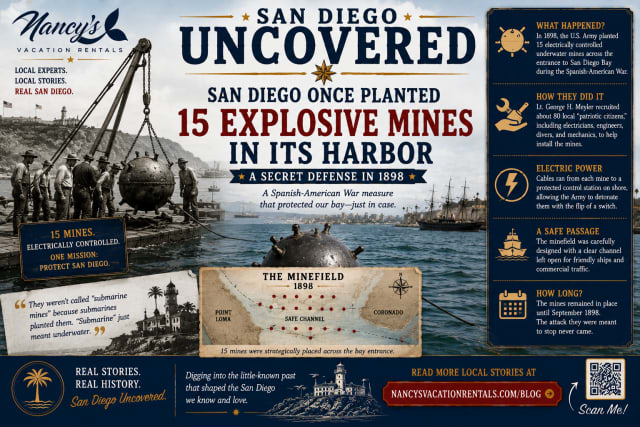
San Diego Once Planted 15 Explosive Mines in Its Harbor
During the Spanish-American War in 1898, the U.S. Army planted 15 electrically controlled explosive mines across the entrance to San Diego Bay. Here's the forgotten story of the harbor's underwater defenses.

Why Is There an Oktoberfest in El Cajon?
The 200-Year Journey From Bavaria to San Diego

What Happens to Your Airbnb Listing When You Change Property Managers?
Changing vacation rental managers? Learn what can happen to your Airbnb listing, reviews, reservations, photos, pricing, co-host access and guest communication during the transition.