Mission Beach Short-Term Rental Rules Explained
A 2026 Guide for Owners & Investors

Greg Ross
CEO / Owner - Nancy's Vacation Rentals
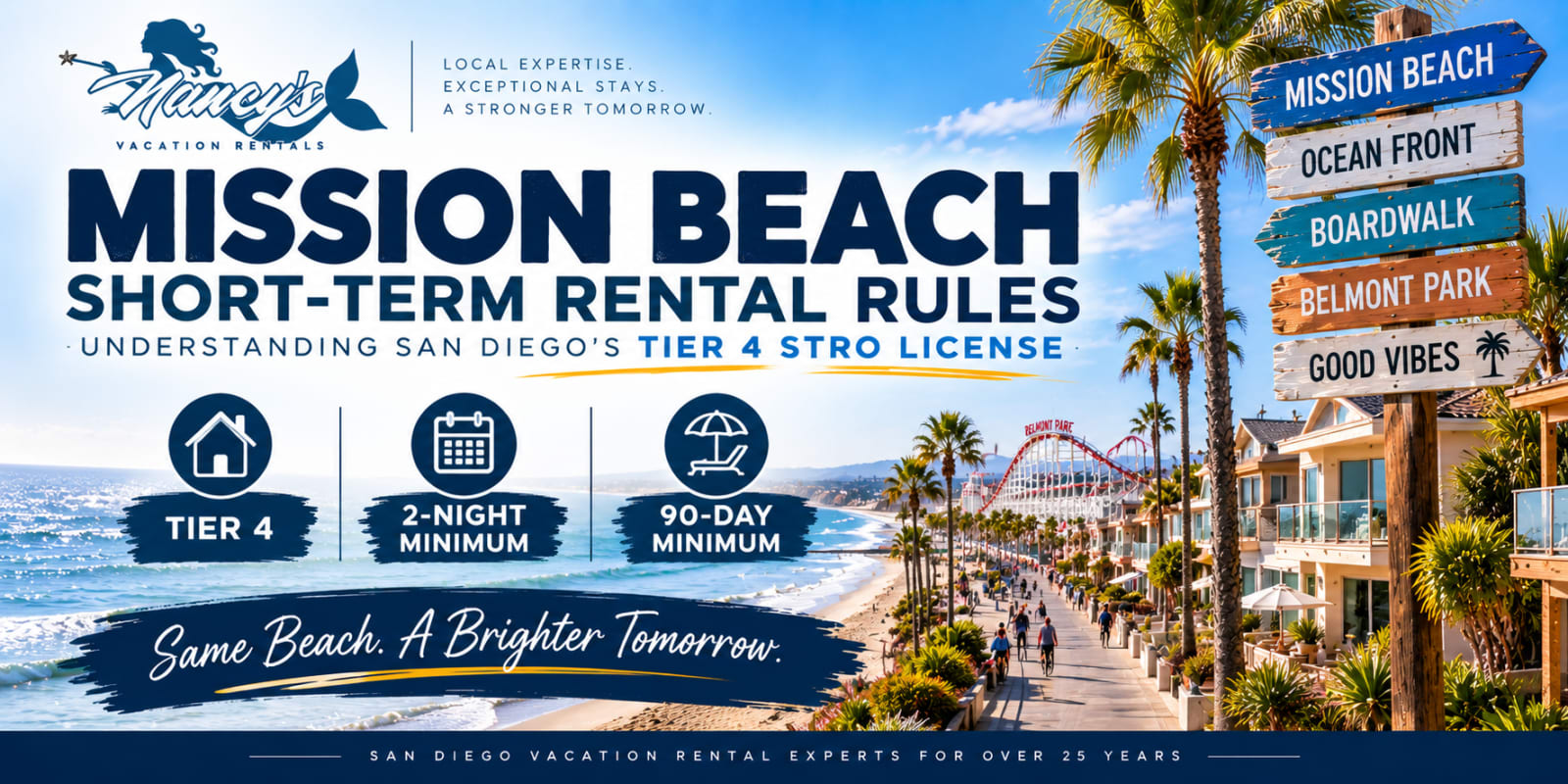
Mission Beach has been one of San Diego's most popular vacation rental destinations for decades. Its beachfront location, boardwalk, Mission Bay access and walkable neighborhood make it a natural fit for short-term vacation rentals.
But owning property in Mission Beach does not automatically give you the right to operate it as a year-round Airbnb, Vrbo or vacation rental.
Mission Beach has its own category within the City of San Diego's Short-Term Residential Occupancy (STRO) licensing system: Tier 4.
And there's an especially important issue for buyers: STRO licenses do not simply transfer to a new owner when a property is sold.
Nancy's Vacation Rentals has managed San Diego coastal vacation homes for more than 25 years. Here's what Mission Beach owners, sellers and prospective investors should understand about the current rules.
Why Does Mission Beach Have Its Own Short-Term Rental Tier?
San Diego's STRO ordinance divides short-term rentals into four license categories.
- Tier 1: Part-time STRO use of 20 days or fewer per year.
- Tier 2: Home sharing involving a qualifying primary residence.
- Tier 3: Whole-home STRO outside Mission Beach.
- Tier 4: Whole-home STRO within the Mission Beach Community Planning Area.
Tier 3 and Tier 4 generally apply to whole-home vacation rentals operating more than 20 days per year where the host does not reside onsite.
The important distinction is geography.
A qualifying whole-home vacation rental in Pacific Beach, La Jolla or another area of the City outside Mission Beach generally falls under Tier 3.
Move that same type of operation into the Mission Beach Community Planning Area and it generally requires Tier 4.
What Is a Tier 4 Mission Beach STRO License?
A Tier 4 license generally applies when:
- The property is within the Mission Beach Community Planning Area;
- The entire dwelling is offered for short-term occupancy;
- The host does not reside onsite during the guest stay; and
- The property operates as an STRO for more than 20 days per year.
This is the license category associated with many traditional Mission Beach vacation rental investment properties.
Important: Not every property commonly described as "Mission Beach" should automatically be assumed to require Tier 4. Verify the property's actual location relative to the Mission Beach Community Planning Area.
Why Are Mission Beach Tier 4 Licenses Different?
Mission Beach historically has had a much higher concentration of vacation rentals than most San Diego neighborhoods.
When San Diego created its current STRO licensing framework, the City therefore established a separate cap for Mission Beach.
Tier 4 licenses are capped at no more than 30% of the total dwelling units within the Mission Beach Community Planning Area.
Tier 3 licenses outside Mission Beach are subject to a different citywide cap.
That distinction makes Tier 4 availability an important part of evaluating a Mission Beach property for vacation rental use.
Are New Tier 4 Mission Beach Licenses Available?
License availability can change and should always be verified directly with the City of San Diego before making a purchase or investment decision.
At the City's August 28, 2026 update, San Diego reported:
- 1,099 Tier 4 licenses issued
- 0 Tier 4 licenses available
- The Tier 4 application period closed
This is one of the most important facts for anyone evaluating a Mission Beach property specifically as a vacation rental investment.
A home may have fantastic guest demand and an impressive rental history, but that doesn't automatically mean a new buyer can obtain the license necessary to continue the same operation.
Does a Tier 4 License Transfer When a Mission Beach Property Is Sold?
This is where prospective buyers need to be particularly careful.
San Diego STRO licenses are not transferable between hosts, ownership or dwelling-unit locations.
In practical terms, you should not assume that buying a Mission Beach home with an existing Tier 4 license means you automatically acquire that license at closing.
Consider This Example
Imagine a Mission Beach property is offered for $1.8 million.
The listing advertises:
"Successful vacation rental generating $150,000 annually."
That historical revenue is useful information.
But it doesn't answer the most important investment question:
"Can I legally reproduce that vacation rental income after I purchase the property?"
If continued operation requires a Tier 4 license and the seller's license does not transfer, the property's historical Airbnb or Vrbo revenue should not automatically be treated as revenue available to the buyer.
Historical Airbnb Revenue Is Not the Same as Future STR Eligibility
This distinction is important enough to repeat.
A real estate listing may advertise:
- Historical vacation rental revenue
- Existing reservations
- Airbnb reviews
- Superhost status
- Vacation rental furnishings
- An existing Tier 4 STRO license
Those items may demonstrate that the property has historically been a successful vacation rental.
They do not necessarily establish that a buyer can continue operating the property under the same circumstances.
For buyers: Separate the property's historical vacation rental performance from its future vacation rental eligibility.
Tier 4 Vacation Rentals Have a Two-Night Minimum Stay
Tier 4 whole-home STROs require the same guest to stay for at least two consecutive nights.
That means a Tier 4 property cannot simply accept a one-night reservation to fill an isolated opening in the calendar.
This matters for revenue management.
Imagine one reservation checks out Saturday and the next guest arrives Monday.
The Saturday-to-Monday opening may work perfectly as a two-night stay.
But if your existing reservations create only a single vacant night, that night can become difficult or impossible to sell under the Tier 4 minimum-stay requirement.
Over the course of a year, poor calendar-gap management can add up to meaningful lost revenue.
Both Tier 3 and Tier 4 Have a 90-Day Minimum Annual Utilization Requirement
This is one of the most misunderstood parts of San Diego's STRO ordinance.
The 90-day minimum utilization requirement is NOT unique to Mission Beach.
It applies to both Tier 3 and Tier 4.
In other words:
- Tier 3: Whole-home STRO outside Mission Beach — minimum 90 days of STRO utilization per year.
- Tier 4: Whole-home STRO within Mission Beach — minimum 90 days of STRO utilization per year.
The City requires Tier 3 and Tier 4 hosts to demonstrate that their licenses are actually being utilized for at least 90 days each year during the license term.
This isn't simply a requirement to make the home available for 90 nights. The City's guidance focuses on actual STRO utilization.
Important: A Tier 3 or Tier 4 license isn't intended to be obtained simply so an owner can hold onto a scarce license while barely operating the property.
What Happens If You Don't Reach 90 Rental Days?
Owners should take the utilization requirement seriously.
The City's guidance specifically addresses situations where an owner intended to achieve 90 days but failed because of cancellations or other circumstances.
The ordinance does not provide a general exception simply because the owner intended to reach the required utilization.
Failure to satisfy the Tier 3 or Tier 4 utilization requirement can potentially place the license at risk.
That makes maintaining sufficient booking activity a compliance issue as well as a revenue-management issue.
What About Operating a Whole-Home Rental for Only 21 to 89 Days?
This creates one of the stranger gaps in San Diego's licensing structure.
Tier 1 covers STRO activity of 20 days or fewer per calendar year.
Tier 3 and Tier 4 whole-home licenses require at least 90 days of annual utilization.
As a result, an owner of a non-primary-residence whole-home vacation rental cannot simply decide to operate 40, 50 or 75 nights per year and assume there is a special middle-tier license for that use.
The City's current guidance confirms that the 21-to-89-day range does not create a separate whole-home STRO category.
Tier 2 is different because it involves a qualifying primary residence and has its own home-sharing and host-absence rules.
Tier 3 and Tier 4 Owners Also Have Quarterly Reporting Requirements
The similarities between Tier 3 and Tier 4 don't end with the 90-day utilization requirement.
Both Tier 3 and Tier 4 hosts must submit quarterly reports to the City.
These reports document STRO activity and help establish compliance with the annual utilization requirement.
Tier 1 and Tier 2 are not currently subject to that same quarterly reporting requirement.
How Much Does a Tier 4 License Cost?
Under the City's current published fee schedule, Tier 4 carries:
- Application fee: $41
- License fee: $1,129
STRO licenses expire two years after issuance and may be renewed subject to the City's requirements.
Fees and regulations can change, so owners should confirm current amounts directly with the City when applying or renewing.
What If I Rent My Mission Beach Home 20 Days or Fewer?
Not every Mission Beach short-term rental falls under Tier 4.
If the dwelling is used for STRO for an aggregate total of 20 days or fewer during a calendar year, Tier 1 may apply.
This can be useful for someone who primarily owns a Mission Beach property for personal use but wants to rent it during a limited number of high-demand dates each year.
Tier 1 does not require the host to reside onsite during the guest stay.
What If Mission Beach Is My Primary Residence?
A qualifying primary residence may instead fall under Tier 2.
Under Tier 2, the host must generally occupy the dwelling as their primary residence for at least 275 days during the calendar year.
Tier 2 allows qualifying home sharing and also permits the host to be absent while renting the entire primary residence for a limited number of days during the year.
This is why the correct STRO tier depends on more than the property's address.
How you use the property matters too.
Does My Mission Beach HOA Allow Vacation Rentals?
City licensing is only one part of the analysis.
Many Mission Beach properties are condominiums or are otherwise subject to CC&Rs and private restrictions.
A City STRO license does not automatically override an HOA's private rental restrictions.
Likewise, an HOA permitting vacation rentals does not eliminate the requirement to comply with the City's STRO ordinance.
Before purchasing a Mission Beach property for short-term rental use, review:
- CC&Rs
- HOA rules and regulations
- Minimum rental periods
- Rental registration requirements
- Recent HOA meeting minutes
- Pending amendments
- Fines and enforcement policies
City approval + HOA permission.
One should not be assumed to replace the other.
Mission Beach Vacation Rentals Also Need a TOT Certificate
STRO licensing isn't the only City requirement.
Hosts must also have an active Transient Occupancy Tax (TOT) Certificate as required by the City.
San Diego's TOT rates now vary geographically rather than using one universal rate throughout the city.
Owners should verify the applicable rate for the property's specific location and ensure that registration, collection, reporting and remittance obligations are being handled correctly.
Don't simply assume Airbnb, Vrbo or another booking platform eliminates every tax responsibility of the owner or host.
Rental Unit Business Tax May Also Apply
San Diego also requires qualifying rental properties to maintain the appropriate Rental Unit Business Tax account.
An active and paid account is part of the City's STRO application requirements when applicable.
Vacation rental compliance therefore involves several interconnected requirements rather than one simple "Airbnb license."
Mission Beach Hosts Have Good-Neighbor Responsibilities
Operating a legal vacation rental also means managing what happens after guests arrive.
San Diego's STRO program includes operational requirements involving:
- Noise
- Parking
- Trash and recycling
- Guest behavior
- Good Neighbor Guidelines
- Required property information
- A designated local contact
- Timely response to reported complaints
In a dense neighborhood like Mission Beach, these responsibilities are particularly important.
A noisy group of guests isn't simply a customer-service problem.
Repeated or serious violations can become a compliance problem that potentially threatens the owner's ability to continue operating.
A Host Generally Cannot Hold Unlimited STRO Licenses
San Diego generally limits a host to one STRO license at a time and one dwelling unit operated for STRO at a time.
This becomes particularly relevant for investors considering multiple San Diego vacation rental properties.
Ownership of several properties does not automatically mean the same individual can obtain an STRO license for each one.
There can be circumstances involving another qualifying natural person with a legal right to occupy the dwelling, but multi-property structures should be evaluated carefully rather than created simply to work around the licensing system.
Buying a Mission Beach Vacation Rental? Do the Regulatory Analysis First
Vacation rental buyers understandably want to know:
"How much will this property make?"
We think there is a question that should come first:
"Can I legally operate it the way this revenue projection assumes?"
Before valuing a Mission Beach property based on short-term rental income, investigate:
- The property's exact jurisdiction and location.
- The STRO tier required for your intended use.
- Current Tier 4 license availability.
- Whether the seller's current license survives the transaction.
- HOA and CC&R restrictions.
- The 90-day annual utilization requirement.
- The two-night minimum stay.
- TOT and business-tax requirements.
- Historical rental performance.
- Realistic future revenue under your ownership.
Don't Pay for Vacation Rental Income You May Not Be Able to Reproduce
This is where regulation becomes a real estate valuation issue.
Suppose a Mission Beach property historically generates $140,000 annually as a vacation rental.
That income may understandably influence the asking price.
But if a buyer cannot legally continue the same vacation rental operation, the historical revenue may have substantially less value to that buyer.
That's why we recommend separating three questions:
- What has this property historically earned?
- Can I legally operate it the same way?
- If I can, what should it realistically earn under current market conditions?
Only after answering all three do you have a meaningful vacation rental investment analysis.
Frequently Asked Questions About Mission Beach Short-Term Rentals
Are vacation rentals legal in Mission Beach?
Yes. Qualifying short-term rentals can legally operate in Mission Beach when they comply with the appropriate City of San Diego STRO licensing, tax and operating requirements and any applicable private restrictions.
What is a Tier 4 STRO license?
Tier 4 generally applies to whole-home short-term rentals operating more than 20 days per year within the Mission Beach Community Planning Area where the host does not reside onsite.
Is the 90-day minimum only for Tier 4?
No. Both Tier 3 and Tier 4 have a minimum annual STRO utilization requirement of 90 days.
Does Tier 3 also require quarterly reporting?
Yes. Both Tier 3 and Tier 4 hosts are subject to quarterly reporting requirements.
Can a Tier 4 vacation rental accept a one-night reservation?
Tier 4 whole-home STROs require a minimum stay of two consecutive nights by the same guest.
Can I buy a Mission Beach home that already has a Tier 4 license?
You can purchase the property, but you should not assume that the seller's STRO license automatically transfers to you. San Diego states that STRO licenses are not transferable between hosts, ownership or dwelling-unit locations.
Does a Tier 4 license override my HOA?
No. City licensing and private HOA restrictions are separate issues and both should be investigated.
How long is a San Diego STRO license valid?
STRO licenses expire two years after issuance and may be renewed subject to the City's requirements.
Mission Beach Can Be an Exceptional Vacation Rental Market
There is a reason vacationers have been coming to Mission Beach for generations.
Guests can walk to the Pacific Ocean, Mission Bay, Belmont Park, restaurants, shops and miles of beachfront boardwalk.
Few San Diego neighborhoods offer that combination in such a compact area.
That can make a properly licensed Mission Beach property an extremely compelling vacation rental.
But strong demand doesn't eliminate regulatory risk.
Today's Mission Beach vacation rental owner needs to understand licensing, HOA restrictions, taxes, compliance and revenue management together.
After more than 25 years managing San Diego vacation rentals, Nancy's Vacation Rentals has seen both the market and the regulatory environment change dramatically.
Understanding both is increasingly important to making a good investment decision.
Considering a Mission Beach Vacation Rental?
Whether you already own a Mission Beach property or you're considering purchasing one, don't evaluate it solely from an Airbnb revenue estimate.
Nancy's Vacation Rentals can help evaluate the property's historical performance, competitive market, location, property characteristics, HOA considerations and realistic vacation rental revenue potential.
Licensing rules can change, and owners and buyers should verify definitive licensing and legal questions directly with the City of San Diego and appropriate legal counsel.
Request a complimentary property analysis and let us help you understand the complete Mission Beach vacation rental opportunity.
SEO Information
SEO Title:
Mission Beach Short-Term Rental Rules | 2026 Tier 4 Guide
Meta Description:
Learn the 2026 Mission Beach short-term rental rules, including Tier 4
licensing, the 90-day requirement, 2-night minimum, HOA restrictions,
license transfers and rules for buyers.
Suggested URL:
/blog/mission-beach-short-term-rental-rules
Primary Keyword:
Mission Beach short-term rental rules
Secondary Keywords:
Mission Beach Airbnb rules, Tier 4 STRO license, Mission Beach vacation
rental license, Mission Beach Airbnb, San Diego STRO rules, Mission Beach
vacation rentals, San Diego short-term rental regulations
Suggested Internal Links
- Understanding San Diego STRO License Tiers
- Can I Legally Airbnb My San Diego Property?
- The Complete Guide to San Diego Short-Term Rental Regulations
- Pacific Beach Short-Term Rental Rules Explained
- HOA Rules vs. San Diego STR Regulations
- Can You Transfer a San Diego STRO License When You Sell?
- Buying a San Diego Property Specifically for Airbnb
- How Much Can a San Diego Vacation Rental Really Make?
Featured Image Concept
A bright Mission Beach image featuring the ocean, boardwalk, palm trees and coastal vacation homes using Nancy's Vacation Rentals branding.
Main Headline:
MISSION BEACH
SHORT-TERM RENTAL RULES
Supporting Line:
Understanding San Diego's Tier 4 STRO License
Visual Callouts:
TIER 4 • 2-NIGHT MINIMUM • 90-DAY MINIMUM