Pacific Beach Short-Term Rental Rules Explained:
A 2026 Guide for Owners & Investors

Greg Ross
CEO / Owner - Nancy's Vacation Rentals
Pacific Beach has nearly everything travelers look for in a San Diego vacation: beaches, restaurants, nightlife, walkability, Mission Bay access and easy access to many of the city's most popular attractions.
Not surprisingly, it has also been one of San Diego's most established vacation rental markets.
But if you own—or are considering buying—a Pacific Beach property for Airbnb, Vrbo or other short-term rental use, there is an important regulatory distinction to understand:
A qualifying whole-home vacation rental in Pacific Beach generally falls under San Diego's Tier 3 STRO license—not Mission Beach's Tier 4.
That difference matters because Tier 3 and Tier 4 have separate license caps and currently have very different license availability.
Nancy's Vacation Rentals has managed San Diego coastal vacation homes for more than 25 years. Here's what Pacific Beach owners and prospective investors should understand about the current rules.
Are Short-Term Rentals Legal in Pacific Beach?
Yes. Short-term vacation rentals can legally operate in Pacific Beach when they comply with the City of San Diego's Short-Term Residential Occupancy, or STRO, ordinance and other applicable requirements.
The City requires an STRO license when a qualifying dwelling unit, or portion of one, is rented for periods of less than one month.
The correct license depends on how the property is being used.
San Diego currently has four STRO license tiers:
- Tier 1: Part-time STRO activity of 20 days or fewer per year.
- Tier 2: Home sharing involving a qualifying primary residence.
- Tier 3: Whole-home STRO outside the Mission Beach Community Planning Area.
- Tier 4: Whole-home STRO within the Mission Beach Community Planning Area.
Pacific Beach Is Generally Tier 3—Not Tier 4
This is one of the most important distinctions for coastal San Diego vacation rental owners.
Pacific Beach and Mission Beach sit directly next to each other and are often grouped together when people talk about San Diego's beach communities.
But they are not treated the same way under the STRO licensing system.
A qualifying whole-home vacation rental located within Pacific Beach generally falls under:
Tier 3 — Whole Home, Excluding Mission Beach.
A qualifying whole-home property within the Mission Beach Community Planning Area generally falls under:
Tier 4 — Mission Beach Whole Home.
Why this matters: Tier 3 and Tier 4 are subject to different license caps and currently have dramatically different license availability.
What Is a Tier 3 STRO License?
Tier 3 generally applies when:
- The property is within the City of San Diego;
- The property is outside the Mission Beach Community Planning Area;
- The host does not reside onsite during the guest stay;
- The entire dwelling is being operated as an STRO; and
- The property operates for more than 20 days per year.
This is the category that applies to many traditional Pacific Beach vacation rental investment properties.
Are Tier 3 Licenses Available in 2026?
At the City of San Diego's August 28, 2026 update, Tier 3 applications were open.
The City reported:
- 4,853 Tier 3 licenses issued
- 808 Tier 3 licenses remaining
That's a major difference from Mission Beach.
At the same update, the City reported zero Tier 4 licenses available for Mission Beach and the Tier 4 application period was closed.
This means a prospective vacation rental buyer evaluating Pacific Beach may currently have a licensing path that is not available to a buyer evaluating a comparable whole-home property in Mission Beach.
Important: License availability changes. Never purchase a property based solely on today's availability. Verify the current status and the property's eligibility before making an investment decision.
Tier 3 Licenses Are Capped
The fact that Tier 3 licenses are currently available does not mean the supply is unlimited.
San Diego limits Tier 3 licenses to no more than 1% of the City's total housing units outside the Mission Beach Community Planning Area.
That is fundamentally different from Tier 1 and Tier 2, which do not have the same numerical license cap.
It also means today's Tier 3 availability shouldn't be interpreted as a guarantee that licenses will always remain readily available.
Tier 3 Requires at Least 90 Days of Annual STRO Utilization
One of the most important—and frequently misunderstood—Tier 3 rules is the annual utilization requirement.
A Tier 3 license must be utilized for at least 90 days each year during the license term.
This is the same minimum-utilization rule that applies to Tier 4 properties in Mission Beach.
The City requires actual STRO utilization rather than simply making the property available for 90 nights.
Tier 3 hosts must demonstrate their utilization through required quarterly reporting.
Owner Tip: Don't obtain a Tier 3 license simply as a backup plan for a property you rarely intend to rent. The license carries an ongoing utilization requirement.
What If You Don't Reach 90 Rental Days?
The City specifically addresses this issue in its STRO guidance.
An owner may intend to rent the property for more than 90 days but fall short because of cancellations, weak demand or other circumstances.
However, the City's guidance states that the ordinance does not provide a general exception to the 90-day utilization requirement for those circumstances.
Failure to meet the requirement can put the license at risk of revocation.
That makes professional revenue management important for two reasons:
- Generating income for the owner; and
- Maintaining sufficient STRO utilization for license compliance.
Can I Operate a Pacific Beach Vacation Rental for Only 30, 50 or 75 Days?
This is where San Diego's STRO system becomes somewhat counterintuitive.
Tier 1 permits STRO activity for an aggregate total of 20 days or fewer per calendar year.
A non-primary-residence whole-home rental operating beyond that level generally moves into Tier 3 outside Mission Beach.
But Tier 3 requires at least 90 days of annual STRO utilization.
Therefore, there isn't a separate whole-home investment-property license designed for someone who simply wants to operate 40 or 60 nights each year.
The City's current guidance specifically states that STRO activity of 21 to 89 days per year is not permitted under that structure.
Tier 2 is different because it involves a qualifying primary residence.
Tier 3 Has a Two-Night Minimum Stay
Tier 3 whole-home rentals also require the same guest to stay for at least two consecutive nights.
In other words, you cannot simply accept a one-night reservation to fill a small gap between bookings.
This makes calendar management especially important.
Here's an Example
Imagine your current reservations leave Thursday night open between two existing bookings.
That isolated night may become effectively unsellable under the Tier 3 minimum-stay requirement.
One orphan night doesn't sound significant.
But create 15 or 20 of them over the course of a year and the lost revenue becomes meaningful.
Good revenue management therefore isn't simply about changing nightly prices. It also involves controlling minimum stays, arrival patterns and booking gaps.
Tier 3 Requires Quarterly Reporting
Tier 3 hosts must submit quarterly reports to the City of San Diego.
Tier 4 hosts have the same requirement.
Tier 1 and Tier 2 hosts are not currently required to submit these quarterly reports.
Among other things, reporting helps document whether the Tier 3 property is satisfying its annual utilization requirement.
This is another reason owners should think of STRO compliance as an ongoing operating responsibility rather than something completed when the initial license is issued.
How Much Does a Tier 3 License Cost?
Under the City's current published fee schedule, Tier 3 fees are:
- Application fee: $41
- License fee: $1,129
The City states that these fees are non-refundable.
STRO licenses expire two years from the date of issuance and may be renewed in accordance with the City's requirements.
Owners should always verify current fees when applying or renewing because fee schedules can change.
Does a Tier 3 License Transfer When You Sell the Property?
No—not automatically.
San Diego states that STRO licenses are not transferable between hosts, ownership or dwelling-unit locations.
This is particularly important when evaluating a Pacific Beach property that is already operating successfully on Airbnb or Vrbo.
Consider This Example
A Pacific Beach condo is offered for sale and the listing advertises $110,000 in historical annual vacation rental revenue.
The property also has an active Tier 3 license.
A buyer should not simply assume:
"I'm buying a licensed vacation rental producing $110,000 per year."
Instead, the buyer should separately establish:
- What the property historically earned;
- Whether the buyer can obtain the required Tier 3 license; and
- What the property can realistically earn after the transaction.
Those are three different questions.
Pacific Beach Has an Advantage Over Mission Beach Right Now
For a prospective vacation rental buyer, this is an important current distinction.
As of the City's August 28, 2026 update:
- Tier 3: 808 licenses remained available.
- Tier 4: 0 licenses remained available.
That doesn't automatically make Pacific Beach a better investment than Mission Beach.
Mission Beach and Pacific Beach can have different property values, nightly rates, guest demand, property types and operating economics.
But from a regulatory due-diligence standpoint, current Tier 3 availability can be a significant consideration for someone purchasing a property with the specific intention of operating it as a whole-home vacation rental.
What If Pacific Beach Is My Primary Residence?
You may not need Tier 3 simply because your property is in Pacific Beach.
If the property qualifies as your primary residence and you meet the City's requirements, Tier 2 may instead apply.
Tier 2 generally requires the host to occupy the dwelling as their primary residence for at least 275 days per calendar year.
It permits qualifying home sharing and allows the host to rent the entire residence while absent for up to 90 days during the calendar year.
That's very different from buying a Pacific Beach condo solely as a vacation rental investment.
What If I Only Rent My Pacific Beach Property Occasionally?
If STRO activity totals 20 days or fewer per calendar year, Tier 1 may apply.
Tier 1 does not require the host to reside onsite during the STRO.
This can make sense for someone who primarily uses a Pacific Beach property personally but wants to rent it during a few high-demand periods each year.
Your HOA Can Still Say No
This is one of the biggest mistakes prospective condo buyers can make.
Eligibility for a City of San Diego Tier 3 license does not necessarily mean your HOA allows short-term rentals.
A Pacific Beach condominium association may have its own rental restrictions contained in its CC&Rs or rules.
For example, an HOA might require:
- 30-day minimum leases;
- Six-month leases;
- Tenant registration;
- Rental caps; or
- Other restrictions affecting vacation rental use.
If the HOA prohibits rentals shorter than 30 days, the fact that Tier 3 licenses are available doesn't solve the problem.
Conversely, an HOA allowing vacation rentals does not eliminate the need to comply with the City's STRO requirements.
For condo buyers: Check both the City rules and the HOA documents before relying on projected short-term rental revenue.
What Should You Review in the HOA Documents?
Before buying a Pacific Beach condo for vacation rental use, review more than the listing agent's statement that "short-term rentals are allowed."
Investigate:
- CC&Rs;
- Rules and regulations;
- Minimum lease periods;
- Rental caps;
- Registration requirements;
- Recent HOA meeting minutes;
- Pending amendments;
- Enforcement history; and
- Applicable fines.
Rules can change, and current owners sometimes describe historical practices rather than the association's current governing documents.
Pacific Beach Vacation Rentals Also Need a TOT Certificate
STRO licensing is only one part of operating legally.
Qualifying short-term rentals within the City of San Diego must also have an active Transient Occupancy Tax (TOT) Registration Certificate.
San Diego now uses geographically based TOT rates.
Effective May 1, 2025, the City's three TOT zones carry rates of:
- 11.75%
- 12.75%
- 13.75%
The applicable rate depends on the property's specific location.
Owners should therefore verify the property's tax zone rather than relying on older information stating that San Diego's TOT is universally 10.5%.
Rental Unit Business Tax May Apply Too
The City also assesses Rental Unit Business Tax on qualifying residential rental property.
According to the City, property owners who rent all or part of their property for more than six days during a calendar year are responsible for the applicable Rental Unit Tax.
An active and paid Rental Unit Business Tax account is also part of the City's STRO licensing process when applicable.
Tier 3 Hosts Have Ongoing Good-Neighbor Responsibilities
Getting the license is only the beginning.
San Diego requires STRO hosts to comply with ongoing operating rules designed to reduce impacts on surrounding residents.
These include requirements involving:
- Noise;
- Parking;
- Trash and recycling;
- Guest conduct;
- Good Neighbor Guidelines;
- Required signage and information;
- A designated local contact; and
- Response to reported complaints.
The City's guidance requires the designated local contact to respond to reported complaints in person or by telephone within one hour and take action to resolve the issue.
For owners, that means guest screening and responsive local management are not merely hospitality concerns.
They can also be part of protecting the property's continued ability to operate.
Can One Owner Have Multiple Pacific Beach Vacation Rentals?
Owning multiple properties and holding multiple STRO licenses are not the same thing.
San Diego generally allows a host to hold only one STRO license at a time and prohibits a host from operating more than one dwelling unit for STRO at a time.
If an owner has multiple STRO properties, the City's rules contemplate situations in which another qualifying person with the legal right to occupy the dwelling may serve as host.
Investors considering multiple properties should understand those requirements before assuming one individual can simply hold licenses for an unlimited portfolio.
Buying a Pacific Beach Airbnb? Do This Before Looking at the Revenue
Pacific Beach can be an excellent vacation rental market.
But a beautiful revenue projection shouldn't be the first step in your investment analysis.
Before relying on projected Airbnb or Vrbo income, investigate:
- Is the property actually within the City of San Diego?
- Is it outside the Mission Beach Community Planning Area and therefore potentially Tier 3?
- Are Tier 3 licenses currently available?
- Does the HOA permit short-term rentals?
- Are there other private rental restrictions?
- Can you satisfy the 90-day utilization requirement?
- Can your operation accommodate the two-night minimum?
- Are the TOT and business-tax requirements understood?
- What has the property historically earned?
- What can it realistically earn under today's competitive conditions?
Don't Confuse "Airbnb Allowed" With "Good Airbnb Investment"
This is an important distinction.
A Pacific Beach property might legally qualify for short-term rental use and still be a mediocre vacation rental investment.
Another property might have:
- Better walkability;
- Ocean or bay views;
- Dedicated parking;
- Better sleeping capacity;
- Outdoor space;
- Air conditioning;
- A more desirable building;
- Better guest amenities; or
- A substantially stronger historical rental record.
Those characteristics can materially affect revenue.
Legal eligibility tells you whether the vacation rental can potentially operate. It doesn't tell you whether it will perform well.
Frequently Asked Questions About Pacific Beach Short-Term Rentals
Are Airbnbs legal in Pacific Beach?
Yes. Qualifying short-term rentals can operate legally in Pacific Beach when they meet the City of San Diego's STRO licensing, tax and operating requirements and any applicable private property restrictions.
What STRO tier is Pacific Beach?
A qualifying whole-home vacation rental outside the Mission Beach Community Planning Area generally falls under Tier 3. Tier 4 applies specifically to qualifying whole-home STROs within the Mission Beach Community Planning Area.
Are Tier 3 licenses currently available?
As of the City's August 28, 2026 update, Tier 3 applications were open, with 4,853 licenses issued and 808 remaining. Owners and buyers should verify current availability before making decisions.
Does Tier 3 require 90 rental days?
Yes. Tier 3 and Tier 4 licenses require at least 90 days of annual STRO utilization during the license term.
Does Tier 3 require quarterly reporting?
Yes. Both Tier 3 and Tier 4 hosts are required to submit quarterly reports to the City.
Can a Pacific Beach Tier 3 rental accept one-night stays?
No. Tier 3 requires a minimum stay of two consecutive nights by the same guest.
Can I rent my investment property for 60 nights per year?
The City's current STRO guidance states that STRO activity of 21 to 89 days per year is not allowed for this type of whole-home operation. Tier 3 requires at least 90 days of annual utilization.
Does the seller's Tier 3 license transfer when I buy the property?
No. San Diego states that STRO licenses are not transferable between hosts, ownership or dwelling-unit locations. Buyers should independently verify their licensing path.
Does a Tier 3 license override my Pacific Beach HOA?
No. City licensing and private HOA restrictions are separate matters. Both need to permit the intended use.
Pacific Beach Can Be a Fantastic Vacation Rental Market
Pacific Beach offers something relatively rare in Southern California: a true beach neighborhood where guests can walk or bike to the ocean, Mission Bay, restaurants, coffee shops, nightlife and recreation.
That combination can create excellent vacation rental demand.
But the difference between owning a property near the beach and owning a successful vacation rental near the beach can be substantial.
Licensing, HOA rules, property selection, pricing, marketing, guest experience and professional operations all matter.
After more than 25 years managing San Diego vacation rentals, Nancy's Vacation Rentals has seen Pacific Beach evolve through changing markets, regulations and traveler expectations.
Understanding all three is increasingly important for owners and investors.
Considering a Pacific Beach Vacation Rental?
Whether you already own a Pacific Beach property or you're considering purchasing one, don't evaluate the opportunity based solely on an Airbnb revenue estimate.
Nancy's Vacation Rentals can help evaluate the property's location, historical performance, competitive market, property characteristics, HOA considerations and realistic vacation rental revenue potential.
Regulations and license availability can change. Owners and buyers should confirm definitive licensing and legal questions directly with the City of San Diego and appropriate professional advisors.
Request a complimentary property analysis and let us help you understand the complete Pacific Beach vacation rental opportunity.
SEO Information
SEO Title:
Pacific Beach Short-Term Rental Rules | 2026 Tier 3 Guide
Meta Description:
Learn Pacific Beach short-term rental rules for 2026, including Tier 3
STRO licensing, the 90-day minimum, 2-night stays, HOA restrictions,
license availability and rules for buyers.
Suggested URL:
/blog/pacific-beach-short-term-rental-rules
Primary Keyword:
Pacific Beach short-term rental rules
Secondary Keywords:
Pacific Beach Airbnb rules, Pacific Beach vacation rental license,
Tier 3 STRO license, Pacific Beach Airbnb license, San Diego STRO,
Pacific Beach vacation rentals, San Diego short-term rental regulations
Suggested Internal Links
- Mission Beach Short-Term Rental Rules Explained
- Understanding San Diego STRO License Tiers
- Can I Legally Airbnb My San Diego Property?
- The Complete Guide to San Diego Short-Term Rental Regulations
- HOA Rules vs. San Diego STR Regulations
- Can You Transfer a San Diego STRO License When You Sell?
- Buying a San Diego Property Specifically for Airbnb
- How Much Can a San Diego Vacation Rental Really Make?
Featured Image Concept
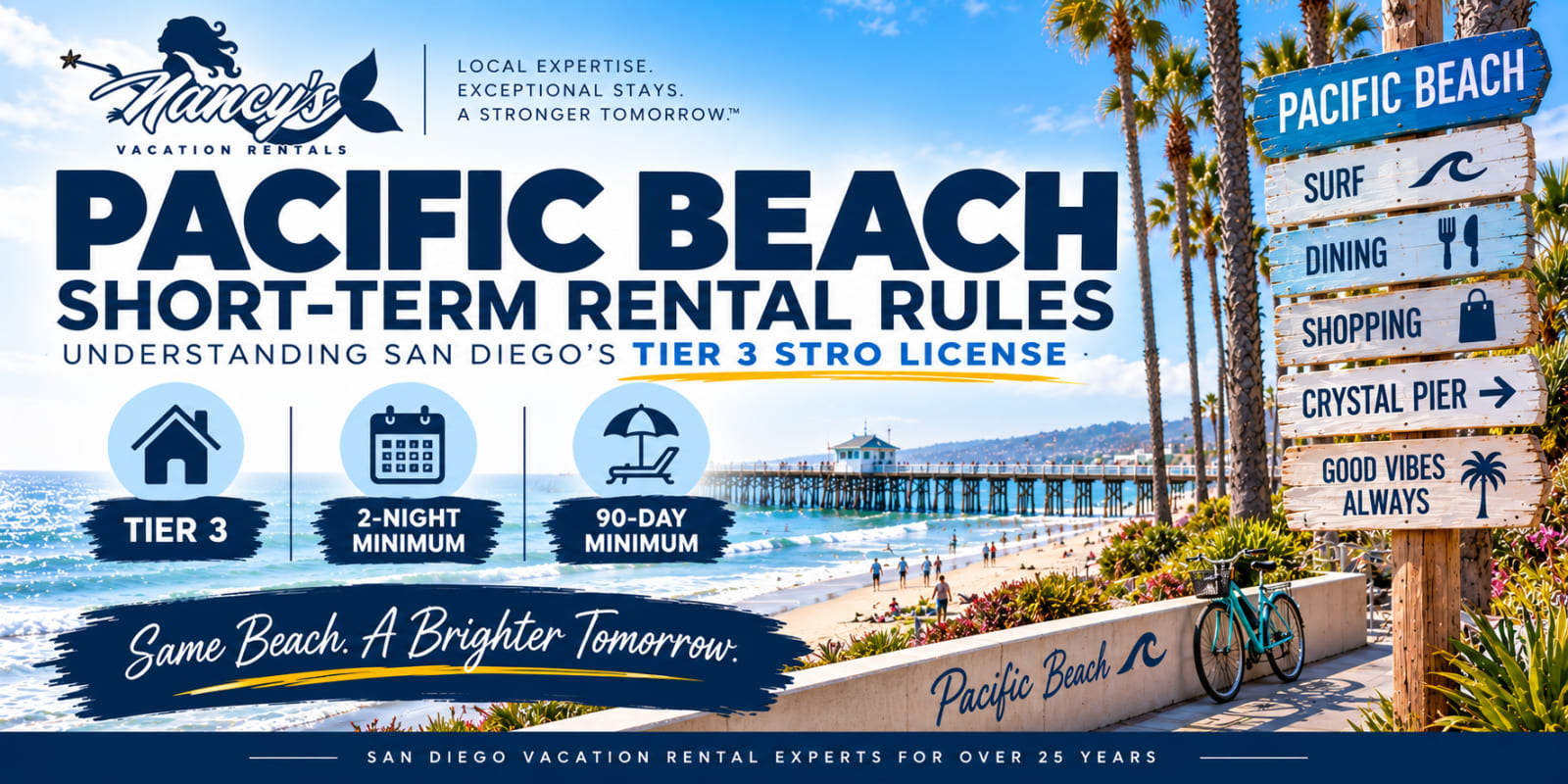
A bright, upscale Pacific Beach coastal scene featuring Crystal Pier, the beach, boardwalk, palm trees and coastal homes using Nancy's Vacation Rentals branding.
Main Headline:
PACIFIC BEACH
SHORT-TERM RENTAL RULES
Supporting Line:
Understanding San Diego's Tier 3 STRO License
Visual Callouts:
TIER 3 • 2-NIGHT MINIMUM • 90-DAY MINIMUM