
Pacific Beach Was Supposed to Be a College Town
Before Pacific Beach became a beach neighborhood, developers imagined it as a seaside college community. The San Diego College of Letters opened in 1888—and helped sell the dream of PB.

Greg Ross
CEO / Owner - Nancy's Vacation Rentals
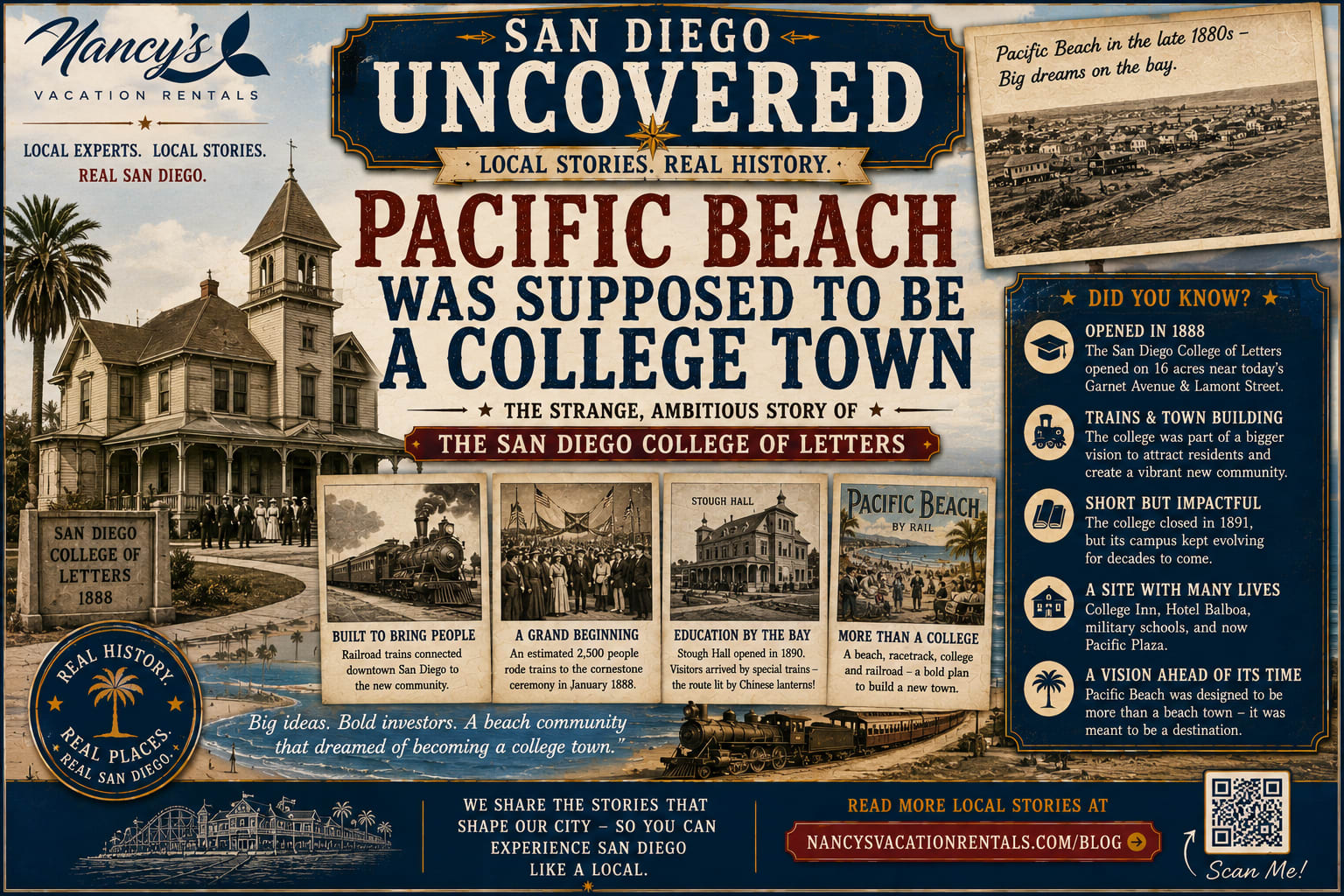
SAN DIEGO UNCOVERED
Pacific Beach Was Supposed to Be a College TownImagine Pacific Beach without the beach bars, surf shops and Garnet Avenue traffic.
Now replace them with professors, students, lecture halls and a college campus.
That wasn't a fantasy.
In 1888, the San Diego College of Letters opened near what is now Garnet Avenue and Lamont Street.
For Pacific Beach's early developers, the college wasn't merely a school.
It was part of the plan for creating the neighborhood itself.
Pacific Beach Needed a Reason to Exist
Pacific Beach was founded during San Diego's extraordinary real-estate boom of the late 1880s.
At the time, the land north of False Bay was largely undeveloped and far removed from downtown.
Developers could draw streets on a subdivision map, but that didn't automatically make people want to move there.
Like many boom-era developments, Pacific Beach needed attractions.
It ended up with several: the ocean, a horse racetrack, a railroad—and a proposed college.
The College Was a Real-Estate Amenity
The Pacific Beach Company designated a large tract near the center of the new subdivision as a college campus.
Historical accounts place the campus on roughly 16 acres around today's Pacific Plaza shopping center, near Garnet Avenue and Lamont Street.
Promoters imagined an educational institution that could attract students, faculty, families and investors to their new coastal community.
The concept feels surprisingly modern: anchor a new development with an institution that creates identity and demand.
Then They Built a Railroad to It
Distance from downtown was Pacific Beach's biggest problem.
So developers helped create the San Diego & Pacific Beach Railway.
Construction pushed north from Morena in late 1887, curving around the new horse racetrack before reaching the future college area.
On January 28, 1888, trains carried an estimated 2,500 people to Pacific Beach for the laying of the cornerstone of the college's first building.
Thousands of potential buyers suddenly had a reason to see the new subdivision for themselves.
Pacific Beach Was Selling an Entire Lifestyle
Think about the package being offered to prospective residents in 1888.
A beach.
A racetrack.
A college.
A railroad connecting it all to downtown San Diego.
This wasn't simply selling empty lots.
Developers were selling a vision of what Pacific Beach might become.
The San Diego College of Letters Opened in 1888
The college opened its doors in September 1888.
Contemporary city directories listed Frank P. Davidson, C. S. Sprecher and Harr Wagner among its managing figures.
Harr Wagner was already connected to San Diego's literary world through the Golden Era magazine.
The school also attracted one of the best-known literary figures to live in early Pacific Beach: poet Rose Hartwick Thorpe.
Rose Hartwick Thorpe Was a Celebrity
Thorpe had become nationally famous for her poem Curfew Must Not Ring Tonight, written when she was a teenager.
Her association with the college gave the fledgling institution—and Pacific Beach itself—a recognizable literary name.
Her family became part of the early community, and historical accounts identify her as one of Pacific Beach's best-known residents.
Garnet Avenue Was Once College Avenue
The educational vision became embedded in Pacific Beach's geography.
Today's Garnet Avenue was originally known as College Avenue, reflecting the importance developers placed on the campus.
Even after the school disappeared, the neighborhood continued evolving around the streets and transportation corridors created during that first development boom.
The College Became the Center of Early PB Life
For a brief period, the college was more than a marketing device.
Students and faculty lived on campus or nearby. Others commuted by train from San Diego.
The railroad brought visitors to ceremonies, public programs and “elocution contests.”
When a second college building, Stough Hall, opened in 1890, special trains reportedly carried visitors from the city while Chinese lanterns illuminated the route from the train to the campus.
For a neighborhood only a few years old, the college provided something essential: community.
Then the Boom Collapsed
Pacific Beach had been born during a speculative land boom.
When Southern California's boom faded, ambitious developments across San Diego struggled.
The San Diego College of Letters was one of them.
Financial problems overwhelmed the institution, and the college closed in 1891—only a few years after opening.
The Campus Didn't Disappear Immediately
The original college building remained after the school closed.
Over the following decades, the property was repeatedly reinvented.
The main building became a rooming house known as the College Inn and later reopened as the Hotel Balboa.
In the twentieth century, the campus became associated with military-school uses, including the San Diego Army and Navy Academy and later Brown Military Academy.
Today It's a Shopping Center
Eventually, the old school buildings disappeared.
In the late 1950s, redevelopment began on the property.
The historic campus became Pacific Plaza.
That means thousands of people shop, eat and drive through the area today without realizing they are crossing what was once envisioned as the intellectual heart of Pacific Beach.
What If the College Had Survived?
This is where the story gets interesting.
Neighborhoods often take their identity from their anchor institutions.
Universities shape places like Berkeley, Palo Alto and La Jolla.
If the San Diego College of Letters had prospered and expanded for another century, Pacific Beach might have developed very differently.
Instead of being known primarily for coastal recreation and nightlife, PB might have grown into one of Southern California's prominent university districts.
Of course, history doesn't give us the alternate version.
The college failed—and Pacific Beach reinvented itself.
The College Still Helped Create Pacific Beach
Calling the school a failure misses part of the story.
It lasted only a few years, but it helped attract attention, residents and transportation investment to a brand-new subdivision.
It gave early Pacific Beach a civic center.
It brought faculty and families who became some of the community's first residents.
And its location influenced the development pattern around what eventually became Garnet Avenue.
Pacific Beach Wasn't Originally About the Beach
That's perhaps the biggest surprise.
Today's identity makes it easy to assume Pacific Beach was always destined to become a surf-and-beach neighborhood.
Its earliest promoters were experimenting with something much broader.
They tried horse racing.
They tried higher education.
They built a railroad.
Later generations tried agriculture, hotels and military schools.
Pacific Beach became Pacific Beach through repeated reinvention.
San Diego Uncovered
San Diego Uncovered explores the lost places, strange plans, remarkable people and forgotten ideas behind America's Finest City.
Next time you're at Garnet and Lamont, look around.
More than 130 years ago, people stood near that same intersection imagining a college town beside the Pacific.
Explore Pacific Beach With Nancy's
Nancy's Vacation Rentals has been helping guests experience San Diego for more than 25 years, including Pacific Beach and the surrounding coastal communities. We love sharing the stories behind the neighborhoods our guests come here to experience.
Browse Nancy's San Diego Vacation Rentals
Sources & Further Reading
Keep reading

Where the Padres Played Before Petco Park
Finding Lane Field's Hidden Home Plate

Why Minimum-Night Restrictions Can Make or Break Vacation Revenue
Imagine you own a San Diego vacation rental and receive a reservation request for five nights.

Pacific Beach Once Had a Horse Racetrack
Before Pacific Beach became famous for beaches, bars and Garnet Avenue, it had a one-mile horse racetrack with grandstands, stables, special trains and crowds numbering in the thousands.