
San Diego Just Landed a Nearly 500-Pound Tuna
In the City Once Known as the Tuna Capital of the World

Greg Ross
CEO / Owner - Nancy's Vacation Rentals
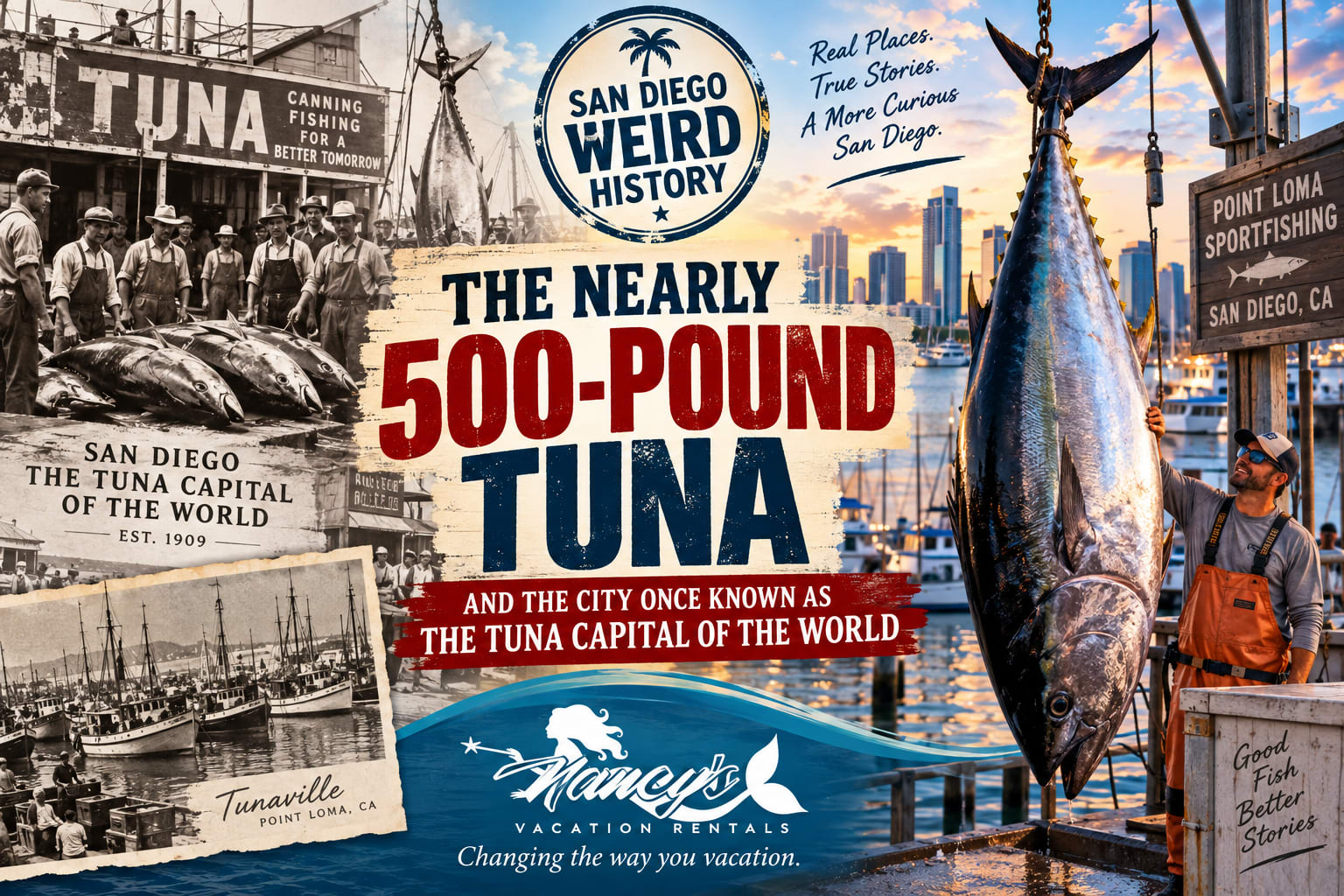
San Diego Weird History | Nancy's Vacation Rentals
San Diego has always had a complicated relationship with really big fish.
But September 2026 has been ridiculous.
Within a matter of days, Southern California anglers and fishermen landed multiple enormous Pacific bluefin tuna — including one fish estimated to have weighed somewhere around 500 pounds before being cleaned.
Another bluefin, officially weighing 420 pounds, made headlines as a potential California sportfishing record.
And then, just when you thought San Diego's offshore fishing couldn't get any crazier, a 648-pound blue marlin was brought into Fisherman's Landing.
But the giant tuna story has a fascinating San Diego connection that goes far beyond the size of the fish.
Because more than a century ago, San Diego wasn't just a good place to catch tuna.
San Diego was known as the Tuna Capital of the World.
First, Let's Talk About That Giant Bluefin
In September 2026, Capt. Markus Medak and Capt. James Roe aboard the Shearwater landed an extraordinary Pacific bluefin tuna off Southern California.
The fish reportedly weighed approximately 446 to 449 pounds after it had been gilled, gutted and bled.
That means the tuna's original whole weight was considerably higher.
Estimates put the intact fish somewhere around the 500-pound class.
That's an absolutely enormous Pacific bluefin.
And it was caught using rod-and-reel fishing gear.
But there's an important catch to the record-breaking story.
Why the Nearly 500-Pound Tuna Isn't the California Sportfishing Record
You might see headlines describing this fish as a record tuna, but there's an important distinction.
The Shearwater was reportedly operating commercially when the fish was caught.
That means the catch doesn't compete in the same recreational sportfishing record category as a fish caught during a recreational trip.
And that's where another giant San Diego bluefin enters the story.
Just days earlier, Capt. Ryan Stahl and the crew aboard the Game Changer landed a Pacific bluefin that officially weighed approximately 420 pounds.
That fish measured roughly 89 inches long with a 63-inch girth and was reported as potentially establishing a new California sportfishing benchmark.
So San Diego essentially had two extraordinary catches almost back-to-back:
- 420 pounds: A recreationally caught bluefin associated with a potential California sportfishing record.
- 446–449 pounds dressed: A commercially caught bluefin estimated to have approached roughly 500 pounds whole.
Different categories.
Both enormous fish.
Then Someone Caught a 648-Pound Marlin
Apparently San Diego wasn't finished.
On September 14, 2026, Capt. Alec Stockfelt and the crew of the Pegasus brought a massive blue marlin into Fisherman's Landing.
The fish reportedly weighed an astonishing 648 pounds.
Reports described it as the largest fish ever weighed at Fisherman's Landing.
So within a remarkably short period, the San Diego offshore fishing community was talking about:
A 420-pound bluefin.
A roughly 500-pound-class bluefin.
And a 648-pound blue marlin.
That's a pretty good week to own a very large cooler.
But Here's Where the Story Gets Really San Diego
Seeing enormous tuna coming through Point Loma feels surprisingly appropriate.
Because there was a time when tuna wasn't simply something San Diegans caught for sport.
Tuna helped build San Diego.
San Diego Becomes the Tuna Capital of the World
San Diego's commercial tuna story stretches back more than a century.
The city's early tuna canning industry emerged in the early 1900s, and by the middle of the 20th century San Diego had developed into one of the world's most important tuna fishing and processing centers.
Point Loma became closely associated with the fleet.
Generations of fishermen headed into the Pacific aboard increasingly sophisticated tuna boats, while canneries and related businesses employed thousands of people back on shore.
The industry became so intertwined with the city that San Diego earned a nickname:
“The Tuna Capital of the World.”
Welcome to Tunaville
The connection was particularly strong around Point Loma.
The waterfront community associated with San Diego's tuna fleet became known informally as Tunaville.
Italian, Portuguese, Japanese and other immigrant fishing families played major roles in building the industry.
Tuna boats became part of San Diego's identity in much the same way Navy ships, beaches and surfboards are today.
At the industry's peak, commercial tuna fishing, processing and supporting businesses represented a major part of the local economy.
By the mid-20th century, tens of thousands of San Diegans were reportedly connected directly or indirectly to the tuna business.
The Tuna Boats Got Bigger — Much Bigger
San Diego's fishermen didn't just participate in the modern tuna industry.
They helped transform it.
Early fishermen often used poles and live bait to catch tuna individually.
Over time, boats became larger, more sophisticated and capable of traveling thousands of miles.
San Diego became an important center for the development and operation of modern tuna seiners capable of harvesting huge quantities of fish.
The city's waterfront filled with fishing vessels, processing facilities, shipyards and businesses supporting the fleet.
For decades, tuna was one of San Diego's signature industries.
Then the Tuna Capital Started Disappearing
By the late 20th century, San Diego's tuna industry began changing dramatically.
Economic pressures, foreign competition, environmental regulations, labor costs and changes in global seafood processing all played roles.
Canneries closed.
Processing moved elsewhere.
Much of the commercial fleet disappeared from the waterfront.
By the 1980s and 1990s, the enormous industry that had once helped define San Diego had largely vanished from the city.
Today, millions of visitors can walk along San Diego Bay without realizing that this beautiful waterfront was once connected to one of the largest tuna industries in the world.
But the Tuna Didn't Disappear
And that's what makes today's story so fascinating.
Commercial tuna processing may have largely disappeared from San Diego, but offshore fishing certainly didn't.
San Diego remains one of the premier sportfishing ports in the United States, with boats leaving Point Loma and San Diego Bay for fishing grounds stretching far into the Pacific.
And in recent years, Southern California fishermen have encountered some astonishingly large Pacific bluefin tuna.
Pacific bluefin populations have also undergone a significant recovery after decades of concern over depleted stocks, although fisheries management remains closely monitored.
Combine improving fish populations with changing ocean conditions and the result can be spectacular fishing within reach of Southern California boats.
Imagine Seeing a 500-Pound Tuna
Numbers don't really communicate how enormous a fish like this is.
A Pacific bluefin approaching 500 pounds isn't the tuna you picture sitting next to a fishing pole in a vacation photo.
It's closer to the weight of a large male grizzly bear.
Getting a fish that size to the boat can require extraordinary equipment, skill, teamwork and endurance.
And that's part of what makes these recent catches so remarkable.
More Than 100 Years Later, the Tuna Came Home
There's something wonderfully appropriate about one of the largest bluefin tuna taken on rod-and-reel gear in Southern California ending up back in Point Loma.
Think about the timeline:
Early 1900s: San Diego's tuna canning industry begins developing.
Mid-20th century: San Diego becomes internationally known as the Tuna Capital of the World.
Late 20th century: The canneries close and much of the commercial tuna industry leaves San Diego.
September 2026: A roughly 500-pound-class Pacific bluefin is caught off Southern California and brought back through San Diego's fishing community.
More than a century after tuna helped transform San Diego's waterfront, an absolutely enormous bluefin provided a reminder that this city's connection to the Pacific is still very much alive.
A Piece of San Diego History Hiding in Plain Sight
Today we think of San Diego's waterfront as a place of restaurants, hotels, parks, Navy ships, marinas and vacation destinations.
But look a little deeper and you'll find another San Diego underneath it.
A city of fishermen.
A city of canneries.
A city of tuna boats traveling thousands of miles into the Pacific.
A city once known around the world as the Tuna Capital of the World.
And every once in a while, a 400- or 500-pound bluefin shows up to remind us.
San Diego Weird History
San Diego's best stories aren't always found in museums.
Sometimes they're underneath a parking lot, hidden along the waterfront, buried beneath a neighborhood — or hanging from a scale at a Point Loma dock.
Follow Nancy's Vacation Rentals as we uncover the strange, surprising and often forgotten stories that made San Diego what it is today.
Local places. Real stories. A more curious San Diego.
Nancy's Vacation Rentals — Changing the way you vacation.
Keep reading

How Mission Beach Became San Diego's Seaside Playground
Mission Beach wasn't simply discovered as a beach destination. In the 1920s, John D. Spreckels combined real estate, streetcars, a massive amusement center, swimming pool and oceanfront recreation to create one.

Why 100% Occupancy Could Be Costing Your Vacation Rental Money
A fully booked calendar may look like success, but 100% occupancy can sometimes mean your vacation rental is priced too low. Learn how San Diego owners should balance occupancy, ADR and revenue.

The Goof on the Roof
San Diego's Strange Tiki Landmark Hiding in Mission Valley