
San Diego's Tuna Empire: When Fishing Helped Power the City
San Diego was once the Tuna Capital of the World. Discover how fishing boats, immigrant families and waterfront canneries built an industry that employed tens of thousands before largely disappearing from the bay.

Greg Ross
CEO / Owner - Nancy's Vacation Rentals

SAN DIEGO UNCOVERED
San Diego's Tuna Empire: When Fishing Helped Power the CityWalk along San Diego's waterfront today and you'll see hotels, restaurants, cruise ships, museums and Navy vessels.
Seventy-five years ago, the view could be dramatically different.
Tuna boats crowded the harbor. Canneries lined the waterfront. Thousands of San Diegans earned their living catching, processing, repairing, packing and selling fish.
For a time, San Diego wasn't merely a city that caught tuna.
It was known as the “Tuna Capital of the World.”
Before Tuna, San Diego Already Had Fishing Communities
Commercial fishing around San Diego Bay predates the tuna boom. Chinese fishermen were important participants in the nineteenth-century fishery, followed by Japanese, Portuguese, Italian and other fishing communities.
These weren't side characters in San Diego's development. Fishing families helped shape waterfront neighborhoods including Point Loma and Little Italy and built an economy tied directly to the Pacific.
The Cannery Changed Everything
The crucial breakthrough wasn't simply catching more fish. It was finding a way to sell San Diego's catch to consumers thousands of miles away.
A small fish cannery opened at La Playa in 1909, initially processing sardines. Then, in 1911, the Pacific Tuna Canning Company began canning albacore at the foot of F Street.
Canning transformed a perishable local catch into a product that could travel across the country.
San Diego suddenly had access to a national market.
Americans Had to Learn to Eat Tuna
Tuna wasn't always the supermarket staple it is today.
Early canners had to convince consumers that albacore was desirable. Its light-colored meat proved easier to market than many people expected, and demand grew rapidly.
As canned tuna became popular, fishermen had a powerful incentive to pursue it.
San Diego's waterfront began changing around the new industry.
Japanese Fishermen Helped Revolutionize the Catch
One of the industry's most important innovations came from Japanese fishermen.
San Diego History Center research describes how Japanese crews used live bait to attract schools of albacore around their boats. Once the tuna began feeding aggressively, fishermen could catch them rapidly using poles and artificial lures.
Other fishermen recognized how effective the technique was and adopted it.
That knowledge helped turn tuna fishing into a much larger business.
The Boats Got Bigger—and Went Farther
Local tuna grounds couldn't support unlimited growth.
During the 1920s and 1930s, San Diego fishermen increasingly moved into deeper offshore waters in search of yellowfin, skipjack and other tuna.
New diesel-powered vessels could travel thousands of miles. Refrigerated cargo holds allowed crews to remain at sea for weeks.
San Diego was developing one of the world's great high-seas tuna fleets.
The Harbor Filled With Tuna Clippers
The vessels became part of San Diego's identity.
Large tuna clippers tied up along the waterfront carrying enormous catches from the Pacific and waters off Mexico, Central America and South America.
Behind them stood an entire support economy: boatyards, machinists, net makers, fuel suppliers, ice plants, truckers, wholesalers and canneries.
A tuna boat didn't create one job.
It supported a network.
San Diego Became America's Leading Fishing Port
By 1950, San Diego's fishing economy had reached extraordinary scale.
San Diego History Center accounts describe approximately 200 boats supplying six local canneries with about $30 million worth of tuna.
At that point San Diego was described as the leading fishing port in the United States.
The city's relationship with tuna had gone from experiment to industrial powerhouse in only a few decades.
At One Point, San Diego Canned Most of America's Tuna
The scale is difficult to appreciate today.
San Diego History Center reporting on the industry's peak says that during the 1940s an estimated 95 percent of tuna canned in the United States was processed in San Diego.
Even allowing for differences in how historical statistics were calculated, the larger point is unmistakable:
San Diego was at the center of America's tuna business.
Tuna Became One of San Diego's Biggest Industries
City and Port historical records describe tuna as San Diego's third-largest industry during its mature years, behind the Navy and aerospace.
The Port of San Diego says the industry involved almost 40,000 workers in the 1960s when fishing, processing, selling and related employment are considered.
For thousands of local families, tuna wasn't a colorful chapter of history.
It paid the mortgage.
The Canneries Created Their Own Workforce
The fishing boats get most of the romantic imagery, but the canneries were equally important.
Hundreds of workers cleaned, cooked, packed and processed the catch.
Women formed a significant part of the cannery workforce, while other workers built and repaired vessels, handled cargo and maintained machinery.
The industry connected households across San Diego to the waterfront whether or not anyone in the family ever went to sea.
Immigration and Tuna Became Intertwined
The tuna industry cannot be separated from San Diego's immigrant history.
Japanese, Portuguese, Italian and Hispanic families all played important roles in the industry, although they did not experience San Diego society or its laws equally.
Fishing communities clustered around Point Loma, Little Italy and other waterfront neighborhoods.
The restaurants, churches, family names and cultural institutions left behind are part of the industry's legacy.
There Was a Darker Side to the Success
The story wasn't simply hardworking fishermen becoming prosperous.
Asian fishing communities faced discriminatory laws and social exclusion. Japanese Americans were forcibly removed and incarcerated during World War II, disrupting families and businesses.
Competition over fishing grounds, imports, labor and access to Mexican waters repeatedly created conflict.
And as fishing technology became more efficient, environmental consequences became harder to ignore.
Technology Changed the Tuna Fleet Again
For decades, tuna fishermen famously caught fish with poles and live bait.
Beginning in the mid-twentieth century, purse-seine nets transformed the industry.
Large nets could surround entire schools of tuna, dramatically increasing the amount of fish a vessel could capture.
But the efficiency came with a serious problem: dolphins and other marine animals could become trapped with the tuna.
Then San Diego's Advantage Started Disappearing
The decline wasn't caused by one event.
Foreign competition increased. Imported frozen tuna could be cheaper than fish landed by San Diego crews. Tuna populations near California had declined, forcing boats to travel farther. Mexican regulations and licensing affected access to fishing grounds.
Processing plants increasingly had reasons to locate closer to the fish—or closer to cheaper labor.
The economics that had built San Diego's tuna empire were changing.
The Canneries Began Leaving
By 1960, historical accounts describe only one major cannery still operating locally, increasingly dependent on imported frozen tuna.
The industry later experienced periods of renewed activity, but the long-term direction was clear.
Corporate processing operations moved away from the West Coast.
When the last major cannery departed San Diego in 1984, San Diego History Center reporting estimates the loss at roughly 12,000 jobs.
A Waterfront Industry Almost Vanished From the Waterfront
That is one of the strangest parts of the story.
An industry large enough to employ tens of thousands of people can disappear so completely that later generations barely realize it existed.
Hotels replaced industrial waterfront uses. Tourist attractions expanded. The skyline grew. Navy and maritime operations evolved.
The tuna boats stopped dominating the view.
But Look Closely and the Tuna Empire Is Still Here
Little Italy's connection to fishing families remains part of the neighborhood's identity.
Point Loma still carries the legacy of Portuguese fishing families. Tuna Harbor preserves the name directly on the waterfront.
San Diego's restaurant culture, maritime businesses and multigenerational families still contain pieces of the old industry.
The factories disappeared faster than the culture they helped create.
San Diego's Economy Has Reinvented Itself Before
The tuna story is also a useful reminder about cities.
Industries that seem permanent rarely are.
San Diego once depended heavily on tuna fishing and canning. Today its economy is associated far more with defense, tourism, biotechnology, research, technology and services.
Future generations may look back at some of today's dominant industries with the same surprise we feel looking at photographs of hundreds of tuna boats filling the harbor.
Imagine Harbor Drive in 1950
Forget the waterfront you know.
Picture tuna clippers tied up along the bay. Cannery workers heading into sprawling processing plants. Trucks hauling fish. Nets piled on decks. Boat crews preparing for voyages that might take them thousands of miles from San Diego.
The smell would have been different.
The sound would have been different.
And the people working along the bay weren't primarily serving visitors.
They were feeding the country.
San Diego Uncovered
San Diego Uncovered explores the forgotten industries, lost places, remarkable people and surprising events behind America's Finest City.
Before San Diego's waterfront became one of the city's biggest visitor attractions, it was a working industrial landscape.
And for decades, tuna helped power it.
Explore San Diego With Nancy's
Nancy's Vacation Rentals has been helping guests experience San Diego for more than 25 years. We love sharing the stories behind the neighborhoods, coastline and landmarks that make San Diego unlike anywhere else.
Browse Nancy's San Diego Vacation Rentals
Sources & Further Reading
- San Diego History Center — TUNA! Celebrating San Diego's Famous Fishing Industry
- San Diego History Center — Fishermen of San Diego
- San Diego History Center — San Diego: Where California Began
- San Diego History Center — A Fish Tale
- Port of San Diego — Commercial Fishing
- City of San Diego Digital Archives — Harbor Drive 1969, Tuna Boats Docked
Keep reading

What Does a Vacation Rental Management Company Actually Do for Its Fee?
What are you really paying for when you hire a vacation rental management company? Learn what full-service management can include, where fees vary, and how San Diego owners should evaluate value.
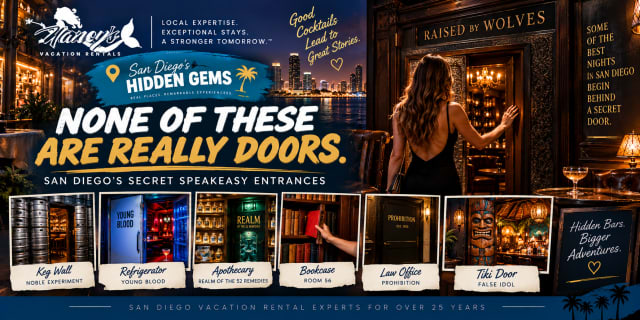
San Diego's Best Secret Doors
A Guide to Hidden Speakeasies
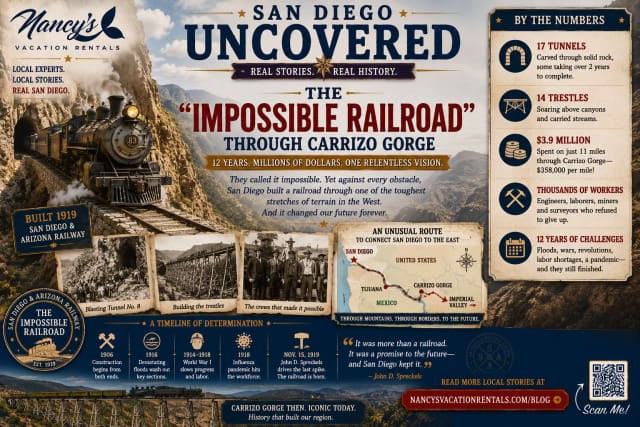
The “Impossible Railroad” Through Carrizo Gorge
San Diego spent more than a decade building a railroad engineers called impossible. Discover how John D. Spreckels pushed tracks through Carrizo Gorge to give San Diego a direct rail connection east.