
San Diego Was Hollywood's Military Backlot Long Before Top Gun
Decades before Top Gun, Hollywood used San Diego's Navy bases, Marines, aircraft, ships and beaches to create America's military movies. Discover the century-old partnership behind the screen.

Greg Ross
CEO / Owner - Nancy's Vacation Rentals
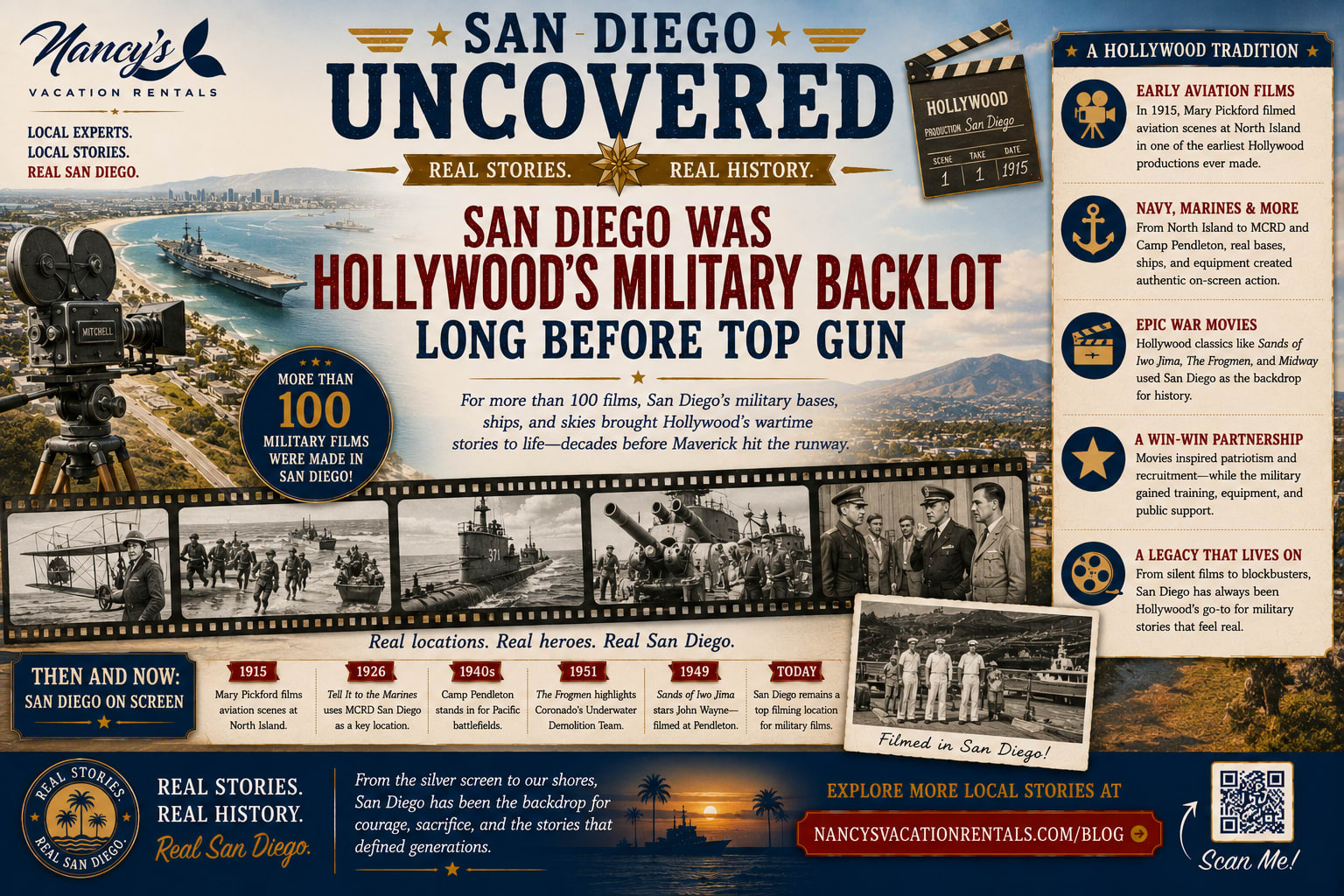
SAN DIEGO UNCOVERED
San Diego Was Hollywood's Military Backlot Long Before Top GunWhen Top Gun turned Miramar, fighter jets and San Diego sunsets into movie icons, Hollywood wasn't discovering San Diego.
It was returning to a military backlot it had been using for generations.
For more than a century, San Diego's bases, ships, aircraft, beaches and military personnel have helped filmmakers recreate everything from pilot training to Iwo Jima.
Hollywood Was Filming San Diego Before Hollywood Was Hollywood
San Diego's relationship with motion pictures reaches back to the earliest years of the medium. The San Diego History Center traces local filming to 1898, when an Edison company camera captured a downtown street scene and double-decker trolley.
By the 1910s, filmmakers were shooting westerns and short films around Lakeside, La Mesa and the backcountry.
Then they discovered something even more valuable: San Diego had a growing American military presence only a short trip from Los Angeles.
North Island Put Real Airplanes on the Screen
One of the earliest aviation movies filmed here was a short about Glenn Curtiss's aviation school, shot around 1912.
In 1915, director Allan Dwan returned with one of the biggest stars in the world: Mary Pickford.
Her film A Girl From Yesterday included aviation scenes at North Island's Rockwell Field. Army cooperation included lining up seven biplanes, with aircraft taking off for the cameras.
San Diego History Center research describes it as possibly the first feature film to receive U.S. military aviation assistance.
That Created a Formula Hollywood Would Use for Decades
The arrangement was irresistible.
Hollywood wanted authenticity. The military had authentic bases, aircraft, ships, equipment and personnel.
The military, meanwhile, understood that movies could influence how Americans viewed military service.
Hollywood got production value. The armed forces got publicity.
There Was a Catch
Military cooperation wasn't simply free access to expensive equipment.
The relationship could involve script review and negotiations over how the armed forces would be portrayed.
Filmmakers gained access that would otherwise have been prohibitively expensive to reproduce. Military leaders gained some influence over the resulting image.
That makes San Diego's military-film history more interesting than a list of celebrity sightings. It is also a story about how popular culture helped shape public perceptions of the military.
More Than 100 Military Movies Were Filmed Here
San Diego History Center research identifies more than 100 military movies filmed at least partly in San Diego.
The region could supply almost every branch and environment a filmmaker might need: North Island and Miramar for aviation, the Naval Training Center and Marine Corps Recruit Depot for recruits, Camp Pendleton for ground combat, Coronado for amphibious operations, and the bay and Pacific for ships and submarines.
San Diego wasn't one set.
It was dozens of military sets within driving distance of Hollywood.
Tell It to the Marines Helped Prove the Formula
The 1926 silent film Tell It to the Marines, starring Lon Chaney and William Haines, filmed at the Marine Corps Recruit Depot and Santa Fe Station.
The movie became a major success.
Its use of San Diego helped demonstrate that real military facilities could give a Hollywood story scale and authenticity that studios struggled to reproduce on a backlot.
North Island Became a Ready-Made Aviation Set
As naval aviation grew, so did Hollywood's appetite for flying movies.
San Diego locations and military cooperation supported films including Devil Dogs of the Air, Hell Divers, Test Pilot and Dive Bomber.
Actors such as James Cagney, Clark Gable, Spencer Tracy, Errol Flynn and Fred MacMurray became fictional aviators against a backdrop of real military aviation.
Camp Pendleton Could Become the Pacific Theater
World War II created a different challenge for Hollywood.
Studios wanted to tell stories about battles taking place thousands of miles away, but they couldn't simply send movie crews into active combat zones.
San Diego County offered an alternative.
Camp Pendleton and other local landscapes could stand in for Pacific islands and battlefields.
Guadalcanal Was Recreated in San Diego County
The 1943 film Guadalcanal Diary, based on Richard Tregaskis's wartime book, used Camp Pendleton to help recreate the Pacific campaign.
Gung Ho!, released the same year, also used the area while dramatizing Carlson's Raiders and the Makin Island raid.
Audiences watched Hollywood's version of the Pacific War without necessarily realizing that parts of the “battlefield” were Southern California.
John Wayne's Iwo Jima Was Camp Pendleton
One of the clearest examples came in 1949.
Sands of Iwo Jima helped cement John Wayne's screen image as the archetypal American fighting man.
But when Wayne's character was charging through the movie's Pacific battlefield, portions of that landscape were actually Camp Pendleton.
The director was Allan Dwan—the same filmmaker who had been shooting movies around San Diego County during the silent era nearly four decades earlier.
San Diego Bay Could Become Almost Any Navy Theater
The Navy side of San Diego offered another enormous advantage.
Aircraft carriers, submarines, destroyers, amphibious craft, naval bases and the open Pacific were already here.
During the Korean War era, one military official reportedly observed that a production didn't need to film in Korean waters when the necessary scenes could be shot outside San Diego.
Hollywood didn't have to build a fleet.
San Diego already had one.
The Frogmen Used a Real Underwater Demolition Base
The 1951 movie The Frogmen drew on the Navy's Underwater Demolition Team community in Coronado—the predecessors of today's Navy SEALs.
The production used access to real military expertise and facilities at a time when much about underwater demolition operations remained unfamiliar to the public.
Movies weren't simply borrowing San Diego scenery. They were borrowing specialized knowledge.
Even Military Comedies Came Here
Not every military movie was about combat.
Abbott and Costello's In the Navy filmed portions at San Diego's Naval Training Center.
In 1955, Francis in the Navy brought Donald O'Connor—and a young Clint Eastwood—to Coronado.
San Diego's military installations could support drama, propaganda, romance, action and comedy.
For Hollywood, San Diego Was Almost Too Convenient
Geography mattered.
San Diego was close enough to Los Angeles for major productions to reach without crossing the country, but different enough to provide coastlines, bases, ships, deserts, mountains and military installations unavailable on a studio lot.
That combination made the region unusually efficient for location filmmaking.
Real Equipment Made Movies Look Expensive
Recreating a carrier deck, submarine base or squadron of military aircraft from scratch would be enormously costly.
Military cooperation could put authentic hardware in front of the camera.
The result looked bigger because it was bigger.
Those weren't always studio props behind the actors.
Sometimes they were actual ships and aircraft operated by actual military personnel.
But Authenticity Came With Influence
This partnership had an obvious tension.
When filmmakers depend on the military for access to expensive equipment and restricted installations, the military has leverage.
San Diego History Center's research notes that military leaders recognized the recruiting and public-relations value of movies and sometimes sought script changes before providing cooperation.
That doesn't make the films illegitimate.
It does mean “realistic” military movies may reflect a negotiated version of reality.
Movies Helped Build the Military Image of San Diego
For viewers elsewhere in America, movies repeatedly associated San Diego with sailors, Marines, fighter pilots, carriers, submarines and training bases.
That screen identity reinforced something that was already true economically and culturally: the military had become one of the defining forces in modern San Diego.
Hollywood amplified the image.
Then Came Top Gun
By the time Top Gun began filming in the 1980s, the basic partnership was already old.
Real military facilities. Real aircraft. Real personnel. Hollywood stars. Navy cooperation. San Diego locations.
Top Gun perfected the formula for a new generation—but it didn't invent it.
Mary Pickford had been filming military aviation at North Island roughly 70 years earlier.
San Diego's Greatest Movie Role May Have Been Playing the American Military
Over the decades, San Diego has played foreign countries, tropical islands and fictional cities.
But one of its longest-running roles required very little disguise.
It played America's military world because so much of that world was actually here.
North Island. Miramar. Camp Pendleton. MCRD. Coronado. Point Loma. The Pacific Fleet.
Hollywood simply pointed the cameras at it.
San Diego Uncovered
San Diego Uncovered explores the overlooked people, industries, places and surprising connections behind America's Finest City.
The next time an old war movie shows a carrier deck, a Marine training ground or a fighter pilot preparing for takeoff, look closely.
There's a surprisingly good chance you're looking at San Diego.
Explore San Diego With Nancy's
Nancy's Vacation Rentals has been helping guests experience San Diego for more than 25 years. We love sharing the stories behind the beaches, neighborhoods, landmarks and history that make this city unlike anywhere else.
Browse Nancy's San Diego Vacation Rentals
Sources & Further Reading
Keep reading

Mt. Soledad at Night
The San Diego View Most Visitors Only See by Day

Why Vacation Rental Owners Change Property Managers
Learn the most common reasons vacation rental owners change property managers, from weak revenue and poor communication to maintenance, accounting, transparency and owner workload.
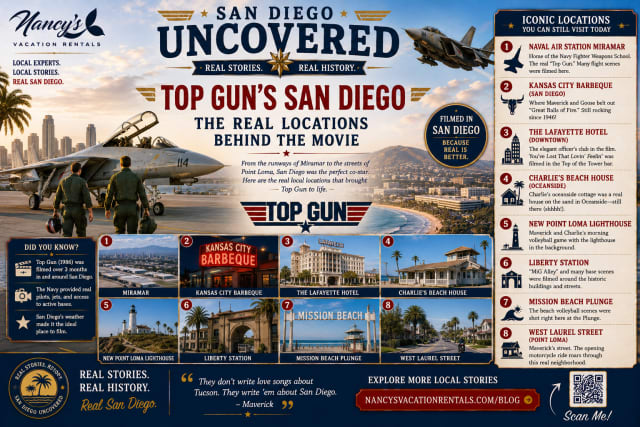
Top Gun's San Diego: The Real Locations Behind the Movie
From Miramar and Point Loma to a downtown barbecue joint and an Oceanside cottage, explore the real San Diego locations behind 1986's Top Gun.