The 1887 Railcar Hiding in National City

Greg Ross
CEO / Owner - Nancy's Vacation Rentals
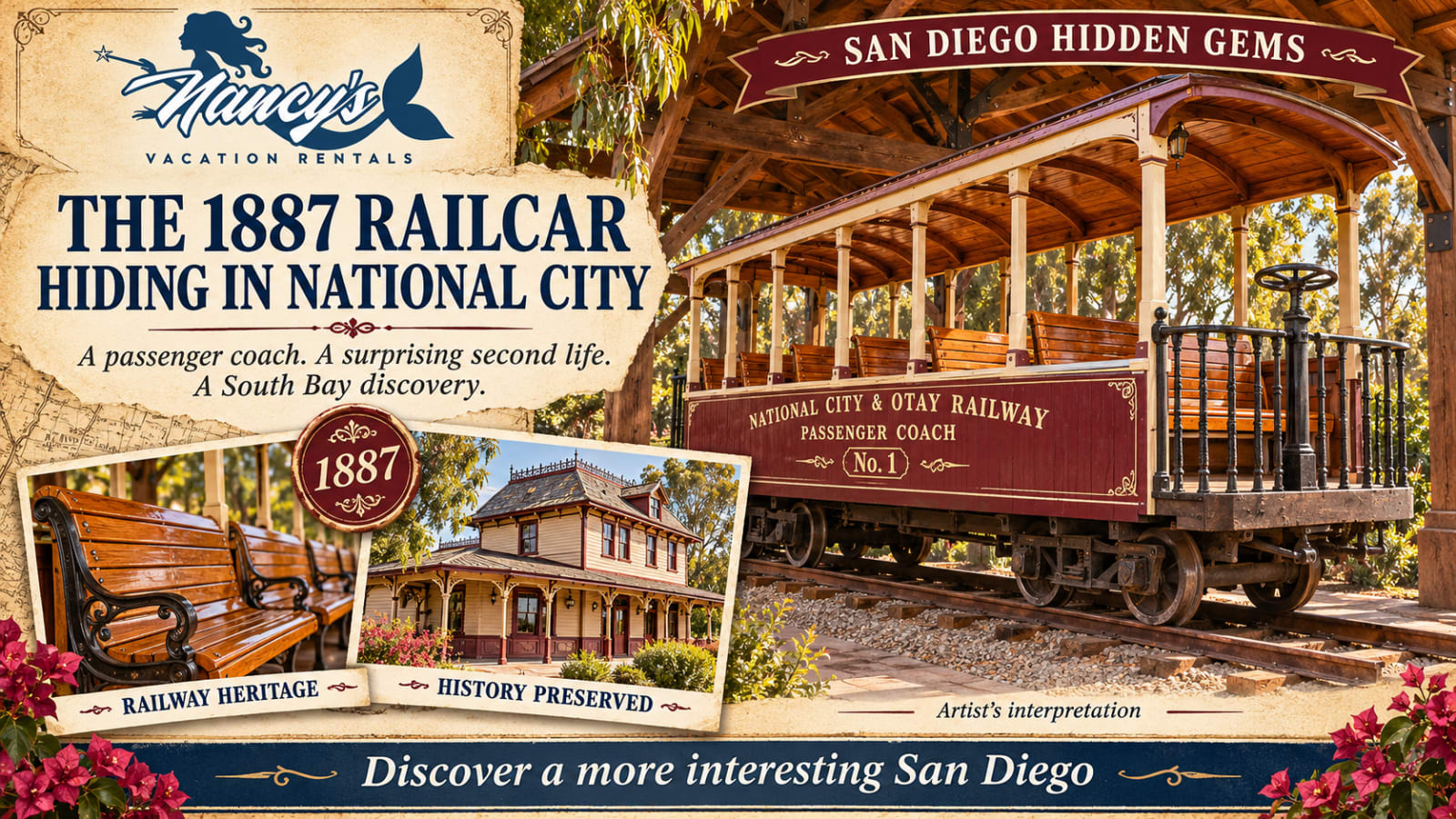
Some San Diego history comes with a towering mast or a grand museum entrance. This piece comes with wooden seats, a nineteenth-century build date and a location many vacationers never think to explore: National City’s historic rail district.
Restored Passenger Coach No. 1 of the National City & Otay Railway survives at Historic Railcar Plaza, across from the National City Depot. Built in 1887, it offers a remarkably tangible connection to the years when local rail lines helped people work, travel and imagine new communities around San Diego Bay.
It is a compact stop with a substantial story, and a fitting addition to Nancy’s San Diego Hidden Gems series.
A passenger coach from the South Bay’s early railway years
Coach No. 1 was built by Hammond Car Works in San Francisco. The plaza’s historical marker identifies it as part of the “Motor Cannon Ball” excursion train associated with National City founder Frank Kimball. That memorable name belongs to an early chapter of local transportation, long before today’s freeway exits and red Trolley cars.
The National City & Otay Railway connected places around the South Bay, including San Diego, the border area and Sweetwater Dam. Its passengers included people traveling for business and people taking excursions. The line also served practical construction needs: Save Our Heritage Organisation describes its role in moving workers and equipment for the dam, as well as quarry stone used for the Zuniga Jetty.
That combination matters. A railway could be transportation infrastructure, a working industrial connection and a way to introduce visitors to a growing region. The surviving coach makes those overlapping purposes easier to picture.
When a train ride could also sell a future
The San Diego Architectural Foundation’s account explains that Kimball used the train to bring prospective real-estate buyers to Rancho de la Nación, the land associated with National City’s development. Excursions were also popular with visitors.
Think about what that meant from a passenger’s perspective. A journey could introduce someone to a landscape they might eventually call home. Transportation made land more accessible, while the experience of the trip helped give that land a story.
There is an interesting echo for modern visitors here. We still learn a city through the routes we take across it. Looking beyond the familiar beach-to-downtown circuit reveals a different set of places, ambitions and connections.
The coach survived by becoming something else
Perhaps the most surprising part of this artifact’s history happened after its railway career. According to Save Our Heritage Organisation’s National City guide, the coach was recovered from Descanso, where it had been used as a house.
The guide credits Rurik Kallis and Richard Pennick with finding and retrieving it. Bruce Coons later purchased it from Kallis, brought it back to National City and made it available for permanent display. Port of San Diego public-art funding helped make the restoration and display building possible.
The plaza marker records that the coach left service in 1914 and was restored to its 1880s appearance in 2000. The plaza was dedicated that September. What visitors see is a restored historic vehicle, with a preservation story of its own, rather than an untouched object that simply waited in place.
Take time to look at the display around it
The coach is the main attraction, but the plaza’s interpretation adds context. Its marker describes the railway’s routes and purpose, and explains that decorative tile inlays reproduce designs made by National City’s California China Products Company between 1911 and 1917.
Pause over those smaller details. They connect the vehicle to the community that chose to preserve it. A photograph records what the railcar looks like; reading the interpretation helps explain why it is here.
The Port of San Diego’s hidden-gems guide lists the restored coach as a no-ticket attraction. Treat it as a historic display, and confirm any special access before assuming you can enter or climb aboard.
Pair the plaza with the National City Depot
Across the street, the historic depot gives the outing a second focus. The San Diego Electric Railway Association operates this restored 1882 building as the National City Depot Museum, with exhibits devoted to the area’s rail and streetcar history.
As checked in November 2026, the operator’s website lists Saturday and Sunday opening hours of 10 a.m. to 4 p.m., with major-holiday closures. Check directly before traveling, especially if the museum interior is the reason for your trip. Those are depot hours; a separate current opening schedule for the railcar enclosure has not been confirmed.
Allow roughly an hour as an initial planning choice for the plaza and a look at the depot, then leave more room if your group enjoys exhibits. This is our suggested pace, not an official tour duration. The outing will appeal most to railway enthusiasts, preservation-minded travelers and curious families who enjoy examining how things used to work.
Finding the right place
Look for Historic Railcar Plaza opposite the National City Depot near Bay Marina Drive. City listings identify the plaza as 840 West 24th Street, while architectural guides use 840 Bay Marina Drive. Use the attraction name and check the map pin before setting out.
For a transit approach, the depot operator identifies the Blue Line’s 24th Street station, with the depot about four blocks west. Check MTS for current service and plan the pedestrian connection for your group. Confirm mobility access directly if needed, and use designated crossings around the active railway area.
After more than 25 years welcoming guests to San Diego, Nancy’s Vacation Rentals appreciates discoveries that add another layer to a familiar vacation. This little coach does exactly that: it turns an overlooked corner of the South Bay into a connection with the region’s railway past. Explore at your own pace, then return to your San Diego vacation rental with a story you probably did not expect to find.