
The First Modern Triathlon Happened at Mission Bay |
In September 1974, 46 athletes gathered at Mission Bay for an experimental run-bike-swim race that became a foundational event in modern triathlon history.
Greg Ross
CEO / Owner - Nancy's Vacation Rentals
SAN DIEGO UNCOVERED
The First Modern Triathlon Happened at Mission BayBefore Ironman. Before Olympic triathlon. Before carbon-fiber bikes, aerodynamic helmets and transition zones packed with expensive gear, a small group of San Diego athletes tried something unusual at Mission Bay.
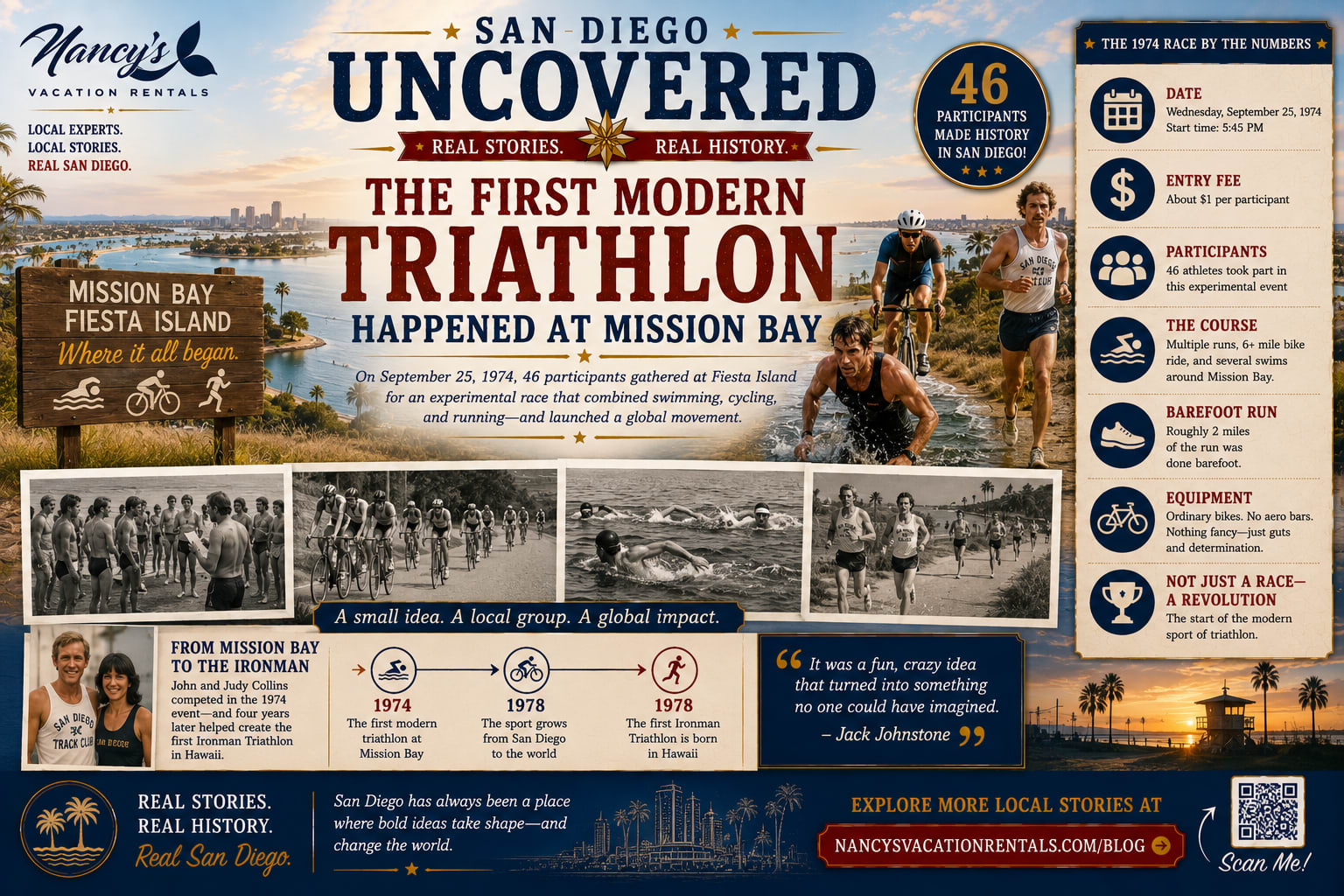
On September 25, 1974, 46 participants gathered around Fiesta Island for an experimental race combining running, cycling and swimming.
That event is widely recognized as the first modern triathlon.
It Started With Runners Looking for Something Different
The race grew out of San Diego's energetic endurance-sports culture in the early 1970s.
San Diego Track Club members Jack Johnstone and Don Shanahan each had ideas for a multi-sport event. Johnstone had a strong swimming background and had competed in a run-swim “biathlon” organized by masters-sports pioneer Dave Pain. Shanahan wanted cycling included.
When the Track Club connected the two men, their ideas merged.
Run. Bike. Swim.
They called it a triathlon.
Wednesday Night, 5:45 PM
This wasn't launched as a massive destination race.
The first annual Mission Bay Triathlon was scheduled for a Wednesday evening—September 25, 1974—with a 5:45 p.m. start near the Fiesta Island causeway.
The entry fee was reportedly just one dollar.
Forty-six men and women took part.
They could hardly have known they were participating in an event that would eventually be described as a birthplace of an international sport.
The First Course Looked Nothing Like Today's Triathlons
Modern triathlons usually follow a simple sequence: swim, bike, run.
The Mission Bay race was far messier—and arguably more fun.
Contemporary descriptions show a course with roughly six miles of running, five miles of cycling and about 500 yards of swimming, broken into multiple segments.
Participants ran, rode, ran again, swam, scrambled across sand and grass, and returned to the water more than once.
Approximately two miles of the running was expected to be barefoot.
This was less like today's polished triathlon and more like an organized endurance experiment.
Everyone Had to Bring a Bike
There were no racks filled with $10,000 racing machines.
The original Track Club announcement simply instructed each participant to bring a bicycle.
The point wasn't specialized equipment. It was figuring out whether runners, swimmers and cyclists could combine three disciplines into one competitive event.
Why Mission Bay?
Mission Bay was almost purpose-built for this kind of experiment.
Fiesta Island provided relatively open roads for cycling. The bay supplied protected water for swimming. Shoreline, grass, sand and paths provided multiple running surfaces.
All three disciplines could happen within a compact recreational area without requiring athletes to travel across the city.
San Diego's mild climate and outdoor culture made the location even more natural.
The Word “Triathlon” Wasn't Yet a Household Word
Today the term needs no explanation.
In 1974, it did.
The San Diego Track Club newsletter advertised the event as a race made up of running, bicycle riding and swimming. Accounts of the organizers' memories describe the word itself as unfamiliar enough to cause questions.
The concept existed in earlier multi-sport competitions—including events in France decades earlier—but the Mission Bay race helped establish the recognizable modern triathlon tradition in the United States.
That's Why “First” Needs a Little Context
Calling Mission Bay the first time human beings ever combined swimming, cycling and running would go too far.
European multi-sport competitions combining similar disciplines existed earlier in the twentieth century.
What San Diego can credibly claim is more specific and more important:
The September 1974 Mission Bay event is widely recognized as the first modern triathlon and a foundational starting point for the sport as we know it today.
Bill Phillips Crossed the Line First
Bill Phillips, a San Diego Track Club athlete, is recorded as the first-place finisher.
But the more historically consequential names weren't necessarily at the front of the field.
Among the participants were John and Judy Collins.
Their involvement would connect this modest Mission Bay experiment to something much bigger.
Four Years Later Came Ironman
John and Judy Collins later moved to Hawaii.
There, a debate developed over which endurance athletes were the fittest: swimmers, cyclists or runners.
The proposed solution was wonderfully unreasonable—combine three major Hawaiian endurance events into one race.
The result was the first Hawaiian Iron Man Triathlon on Oahu in 1978.
John and Judy Collins had already experienced the multi-sport concept firsthand in San Diego.
Mission Bay to Hawaii to the World
The progression is remarkable.
A small San Diego Track Club race in 1974 helped establish the modern triathlon format.
Four years later, Ironman dramatically expanded the concept's distance and mythology.
During the following decades, triathlon grew into an international competitive and recreational sport.
In 2000, triathlon made its Olympic debut at the Sydney Games.
The Original Race Was Almost Comically Small
Compare 46 participants on a Wednesday evening with today's enormous endurance-sports industry.
Major triathlons now involve thousands of competitors, professional athletes, international sponsors, television coverage, sophisticated timing systems and highly specialized equipment.
The first Mission Bay event needed friends and family as volunteers and athletes willing to bring whatever bicycle they owned.
That contrast is part of what makes the story so good.
San Diego Was the Right Laboratory
The race didn't emerge here by accident.
San Diego already had strong running, swimming, surfing, cycling and outdoor-fitness cultures.
Mission Bay gave those communities a shared playground.
The 1970s running boom encouraged ordinary adults to experiment with endurance competition, while the region's climate made year-round outdoor training practical.
Triathlon emerged from a place where moving between land and water was already part of everyday recreation.
There's a Marker on Fiesta Island
The event is commemorated on Fiesta Island with a memorial recognizing San Diego's role in triathlon history.
It's an unusually understated monument considering what followed.
Millions of people around the world now participate in triathlons and related multi-sport events.
Yet one of the sport's most important origin points remains a patch of Mission Bay better known to many San Diegans for cycling, running, dogs, beach days and weekend recreation.
A San Diego Idea Became an Olympic Sport
That may be the most surprising part of the story.
The organizers weren't creating an Olympic discipline.
They weren't launching a global governing body.
They were putting an unusual race on the San Diego Track Club calendar.
Twenty-six years later, athletes were racing for Olympic medals in the same three disciplines.
The First Triathlon Didn't Look Like a Triathlon
History often becomes cleaner after the fact.
We imagine the first version of something looking like the mature version we know today.
Mission Bay reminds us that innovation is usually messier.
The order was different. The distances were different. There were multiple swim and run segments. People ran barefoot. The equipment was ordinary.
What mattered was the idea.
Run. Bike. Swim. San Diego.
Some cities become famous for inventions created in laboratories or factories.
This one emerged around a recreational bay on a Wednesday evening.
Forty-six athletes showed up.
They paid about a dollar.
They ran, rode bicycles and jumped into Mission Bay.
And without realizing it, they helped start something that would spread around the world.
San Diego Uncovered
San Diego Uncovered explores the overlooked history, strange stories, famous moments and hidden connections behind America's Finest City.
The next time you're running or riding around Fiesta Island, remember:
you're exercising on one of the most important pieces of ground in triathlon history.
Explore San Diego With Nancy's
Nancy's Vacation Rentals has been helping guests experience San Diego for more than 25 years. We love sharing the stories behind the beaches, neighborhoods, parks and landmarks that make San Diego unlike anywhere else.
Browse Nancy's San Diego Vacation Rentals
Sources & Further Reading
Keep reading

The Secret History Beneath Old Town San Diego
Graves, Lost Buildings and the City Under Your Feet

The Complete Guide to San Diego Short-Term Rental Regulations in 2026
A practical 2026 guide to San Diego short-term rental regulations, including STRO license tiers, Mission Beach rules, TOT, local contacts, operating requirements, renewals and HOA restrictions.
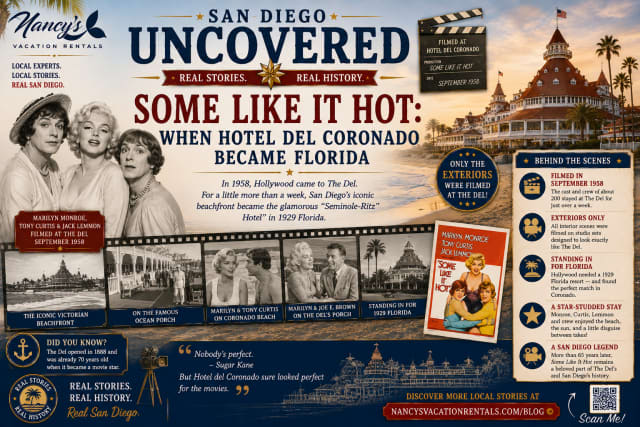
Some Like It Hot: When Hotel del Coronado Became Florida
Billy Wilder's Some Like It Hot turned Hotel del Coronado into a 1929 Florida resort. Discover what was really filmed in Coronado, what was built on a soundstage, and why The Del was perfect for Marilyn Monroe's classic comedy.