
The Immigrant Fishing Communities That Built San Diego's Tuna Industry
Chinese, Japanese, Italian, Portuguese and Hispanic fishing families helped transform San Diego into the Tuna Capital of the World—and their neighborhoods still carry that legacy today.

Greg Ross
CEO / Owner - Nancy's Vacation Rentals
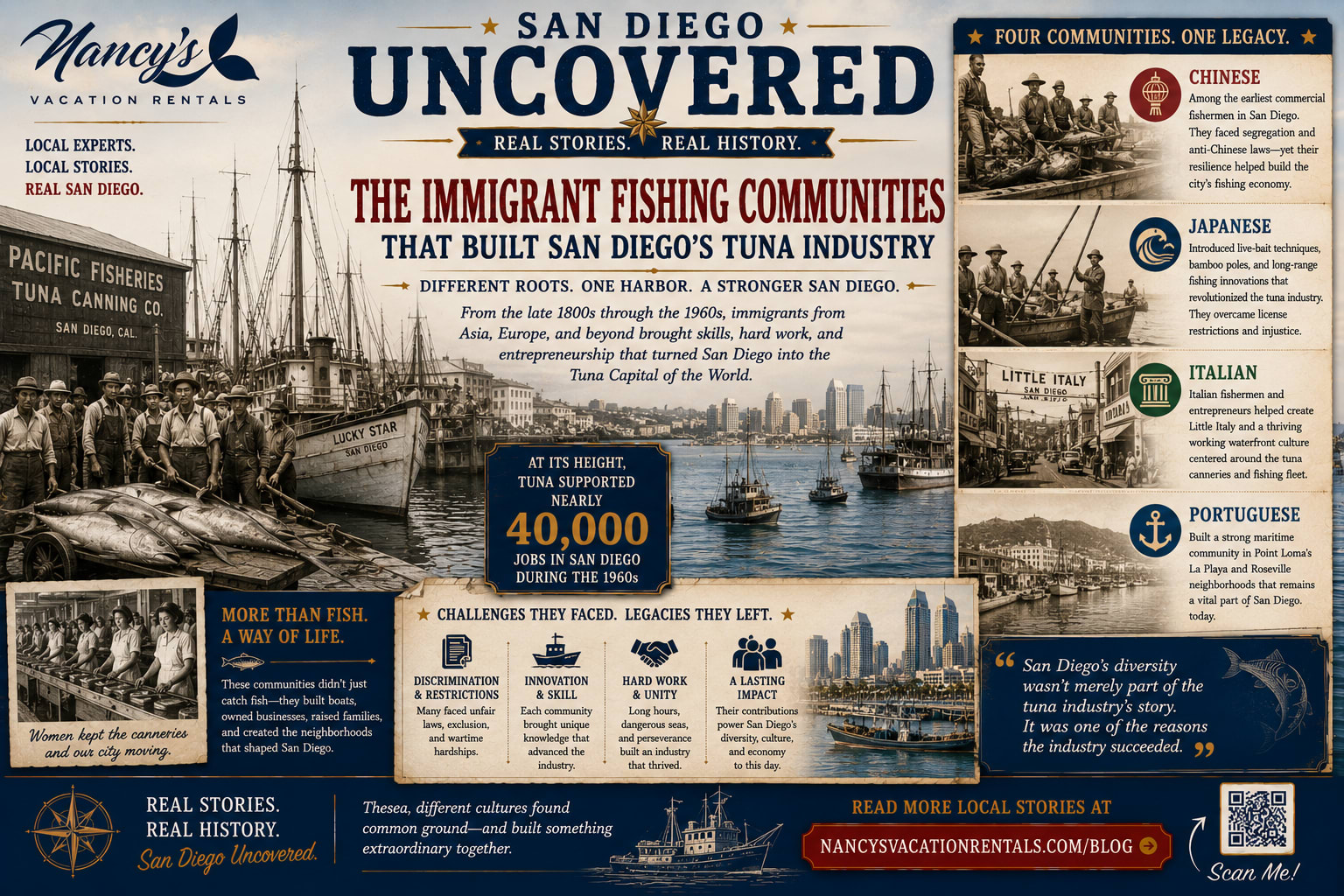
SAN DIEGO UNCOVERED
The Immigrant Fishing Communities That Built San Diego's Tuna IndustrySan Diego's tuna empire didn't begin with a corporation.
It began with people.
Chinese fishermen. Japanese fishing crews. Italian families. Portuguese seafarers. Hispanic cannery workers and fishing families.
They brought boats, nets, techniques, knowledge and generations of maritime experience to San Diego Bay.
Together, they helped turn San Diego into what became known as the “Tuna Capital of the World.”
San Diego's Fishing Story Started Before the Tuna Boom
Commercial fishing was part of San Diego's economy decades before canned tuna became a national product.
Chinese fishermen were among the earliest important commercial fishing communities in the region during the nineteenth century. Historical research documents Chinese fishing operations along the coast and their role supplying fresh and dried seafood.
But their opportunities were constrained by discriminatory laws, prejudice and segregation. San Diego History Center research notes that Chinese residents were pushed toward low-lying areas south of Market Street, including the district later associated with the Stingaree.
Different Communities Settled Around Different Parts of the Bay
Geography and discrimination helped create a patchwork of waterfront communities.
Chinese residents clustered south of downtown. Japanese fishermen also lived and worked near the southern waterfront. Italian immigrants established themselves north of downtown in the neighborhood that became Little Italy.
Across the bay-side of Point Loma, Portuguese families built a maritime community around La Playa and Roseville.
They were separated by language, culture and sometimes law—but connected by the same ocean.
Italian Fishermen Helped Build Little Italy
Italian fishermen were arriving in San Diego by the 1870s, with larger numbers following around the turn of the twentieth century.
Many came from Liguria and other coastal regions where fishing was already a family occupation.
They settled around India, Columbia, State and nearby streets because those neighborhoods put them close to the harbor and their boats.
The neighborhood we now call Little Italy was not originally built around restaurants and nightlife.
It was a working waterfront community.
Fishing Knowledge Traveled With the Immigrants
These families didn't arrive empty-handed.
They brought maritime technology and techniques developed elsewhere.
Italian fishermen used specialized nets and helped expand the local sardine and market fisheries. Portuguese fishermen brought experience from Atlantic fishing and whaling traditions. Japanese fishermen introduced methods that would dramatically improve San Diego's tuna catch.
Immigration wasn't simply supplying labor.
It was importing expertise.
Japanese Fishermen Changed Tuna Fishing
One of the most important innovations came from Japanese fishermen.
San Diego History Center research describes how Japanese crews kept live bait aboard their boats. When they located albacore, they scattered live bait around the vessel, triggering intense feeding behavior.
Fishermen then used bamboo poles and artificial lures to pull tuna aboard rapidly.
Other San Diego fishermen watched, learned and adopted the technique.
The method helped revolutionize the American tuna industry.
Japanese Innovation Went Beyond Live Bait
Historical research credits Japanese fishermen with contributions including bamboo poles, fishing lures and refrigerated long-range vessels.
These innovations allowed boats to travel farther and remain at sea longer.
That mattered because San Diego's tuna fleet was evolving from a local coastal fishery into an international operation stretching toward Mexico, Central America and beyond.
Portuguese Families Built a Community on Point Loma
Portuguese fishermen—many with roots in the Azores—became deeply associated with Point Loma.
Their maritime experience included fishing, whaling and long ocean voyages.
Families settled around La Playa and Roseville, close to the boats and fishing grounds.
As San Diego's tuna fleet expanded, Portuguese fishermen became increasingly prominent in the offshore fleet.
The Portuguese cultural imprint remains visible in Point Loma generations later.
Then the Cannery Changed the Entire Business
For years, San Diego fishermen were limited by a basic problem: fresh fish spoils.
That meant the size of the fishing industry was limited by how quickly the catch could reach consumers.
Fish canning changed the equation.
A sardine cannery opened at La Playa in 1909. In 1911, the Pacific Tuna Canning Company began canning albacore at the foot of F Street.
Suddenly San Diego fish could be shipped across the country.
The Fishing Communities Became an Industrial Workforce
The new tuna economy needed far more than fishermen.
Canneries required workers to clean, cook and pack fish. Boat builders constructed increasingly sophisticated vessels. Machinists maintained diesel engines. Net makers, truckers, wholesalers, dock workers and suppliers all became part of the industry.
Women played an important role in cannery work, including Japanese and other immigrant women.
The tuna industry became a community ecosystem.
Families Often Worked Together
Fishing was frequently a family enterprise.
Historical accounts of Italian crews show boats staffed by brothers, cousins and relatives from the same community.
Children sometimes began accompanying fathers to fishing grounds at remarkably young ages.
Knowledge moved through generations: how to read weather, find fish, repair nets, operate boats and survive long voyages.
That family structure helped create tight-knit waterfront neighborhoods.
But the Communities Did Not Face Equal Opportunities
It's tempting to tell the story simply as immigrants arriving, working hard and succeeding.
The reality was more difficult.
Chinese residents faced decades of anti-Chinese discrimination. Japanese fishermen encountered laws designed to restrict land ownership, citizenship rights and fishing licenses. A 1935 court case became important when Japanese fishermen won the right to obtain California fishing licenses that had previously been denied to people classified as “aliens ineligible for citizenship.”
Economic success did not erase racial barriers.
World War II Hit Fishing Families Hard
The war transformed San Diego—and disrupted some of the same communities that had helped build its fishing industry.
Japanese Americans were forcibly removed from the West Coast and incarcerated under federal policy.
Italian non-citizen fishermen also faced wartime restrictions. Historical research documents hundreds of Italian fishermen in California being barred from offshore employment under alien restrictions.
Meanwhile, many large tuna boats were requisitioned for military service.
The industry that immigrant families had built became entangled with wartime policy and national security.
After the War, Tuna Became Enormous
Despite the disruption, San Diego's tuna industry surged again.
By the middle of the twentieth century, the city was internationally identified with tuna fishing and processing.
San Diego History Center estimates say that at the industry's 1940s peak, approximately 95 percent of tuna canned in the United States was processed in San Diego.
By its mature years, tuna was described as San Diego's third-largest industry behind the Navy and aerospace and supported tens of thousands of jobs.
The Neighborhoods Were Part of the Industry
Little Italy wasn't merely near the tuna business. Its families participated in it.
Point Loma wasn't merely a picturesque peninsula. It was home to generations of Portuguese fishing families.
Waterfront districts south of downtown carried Chinese, Japanese and Hispanic maritime histories that are much easier to overlook today.
The tuna industry didn't just build boats and canneries.
It helped build neighborhoods.
Then the Industry Started Leaving
Beginning in the postwar decades, the economics changed.
Foreign tuna became cheaper. Fishing grounds shifted farther away. Access to Latin American waters became more complicated. Purse-seine technology replaced many traditional bait-boat methods. Processing increasingly moved to places with lower labor costs.
The giant San Diego tuna industry gradually contracted.
By the 1980s, the major local canning era was essentially over.
But the People Didn't Disappear
This is where the story becomes especially interesting.
The factories can disappear much faster than culture.
Family names remained. Churches remained. Restaurants remained. Maritime businesses remained. Community organizations remained.
Little Italy evolved into one of San Diego's most recognizable neighborhoods. Point Loma retained a strong Portuguese heritage.
The tuna empire faded, but the communities that built it continued shaping San Diego.
San Diego's Diversity Was an Economic Advantage
There is a broader lesson hidden inside the tuna story.
San Diego didn't become a great fishing port because one group possessed all the necessary knowledge.
Different communities contributed different experience, technology, labor and entrepreneurial instincts.
Japanese live-bait methods influenced Italian and Portuguese fishermen. European net-making traditions adapted to Pacific fisheries. Cannery workers and boat builders turned catches into an industrial supply chain.
The industry's strength came partly from knowledge crossing cultural boundaries.
Look at Little Italy Differently
The next time you walk through Little Italy, look beyond the restaurants and modern towers.
Imagine fishing nets drying near homes. Boats tied up only a few blocks away. Families waiting for crews to return from weeks at sea. Cannery whistles marking the working day.
Then cross toward Point Loma and imagine another community built around the same ocean but shaped by Portuguese maritime traditions.
Modern San Diego sits directly on top of those stories.
The Tuna Capital Was Built by Immigrants
Corporations eventually put famous brand names on cans.
But long before tuna became a global business, people had to figure out how to catch it, preserve it, process it and build boats capable of following it across thousands of miles of ocean.
Much of that knowledge came to San Diego with immigrant families.
They didn't simply work in San Diego's tuna industry.
They helped create it.
San Diego Uncovered
San Diego Uncovered explores the overlooked communities, forgotten industries, remarkable people and surprising events behind America's Finest City.
The story of San Diego's tuna empire isn't only about fish.
It's about what happens when people from different parts of the world bring their knowledge to the same harbor.
Explore San Diego With Nancy's
Nancy's Vacation Rentals has been helping guests experience San Diego for more than 25 years. We love sharing the stories behind the neighborhoods, coastline and communities that make San Diego unlike anywhere else.
Browse Nancy's San Diego Vacation Rentals
Sources & Further Reading
- San Diego History Center — SD250: Ethnic Immigrant Communities and the Tuna Industry
- San Diego History Center — TUNA! Celebrating San Diego's Famous Fishing Industry
- San Diego History Center — Fishermen of San Diego
- San Diego History Center — Chinese Fishermen at San Diego, 1870–1893
- San Diego History Center — Kondo Masaharu and Japanese Fishermen
- San Diego History Center — Asian and Pacific Islander History in San Diego
Keep reading

Co-Hosting vs. Full-Service Vacation Rental Management
Compare Airbnb co-hosting with full-service vacation rental management, including pricing, guest support, cleaning, maintenance, accounting and owner workload for San Diego vacation rentals.
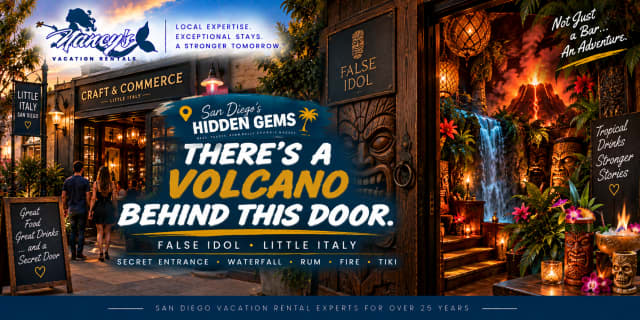
False Idol
The Secret Tiki Bar Hiding in San Diego's Little Italy
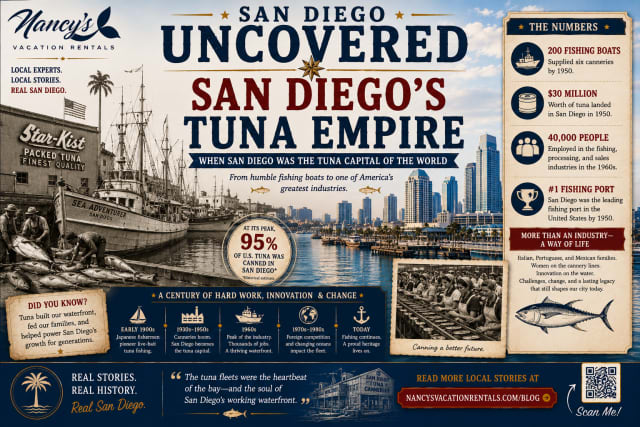
San Diego's Tuna Empire: When Fishing Helped Power the City
San Diego was once the Tuna Capital of the World. Discover how fishing boats, immigrant families and waterfront canneries built an industry that employed tens of thousands before largely disappearing from the bay.