
The “Impossible Railroad” Through Carrizo Gorge
San Diego spent more than a decade building a railroad engineers called impossible. Discover how John D. Spreckels pushed tracks through Carrizo Gorge to give San Diego a direct rail connection east.

Greg Ross
CEO / Owner - Nancy's Vacation Rentals
SAN DIEGO UNCOVERED
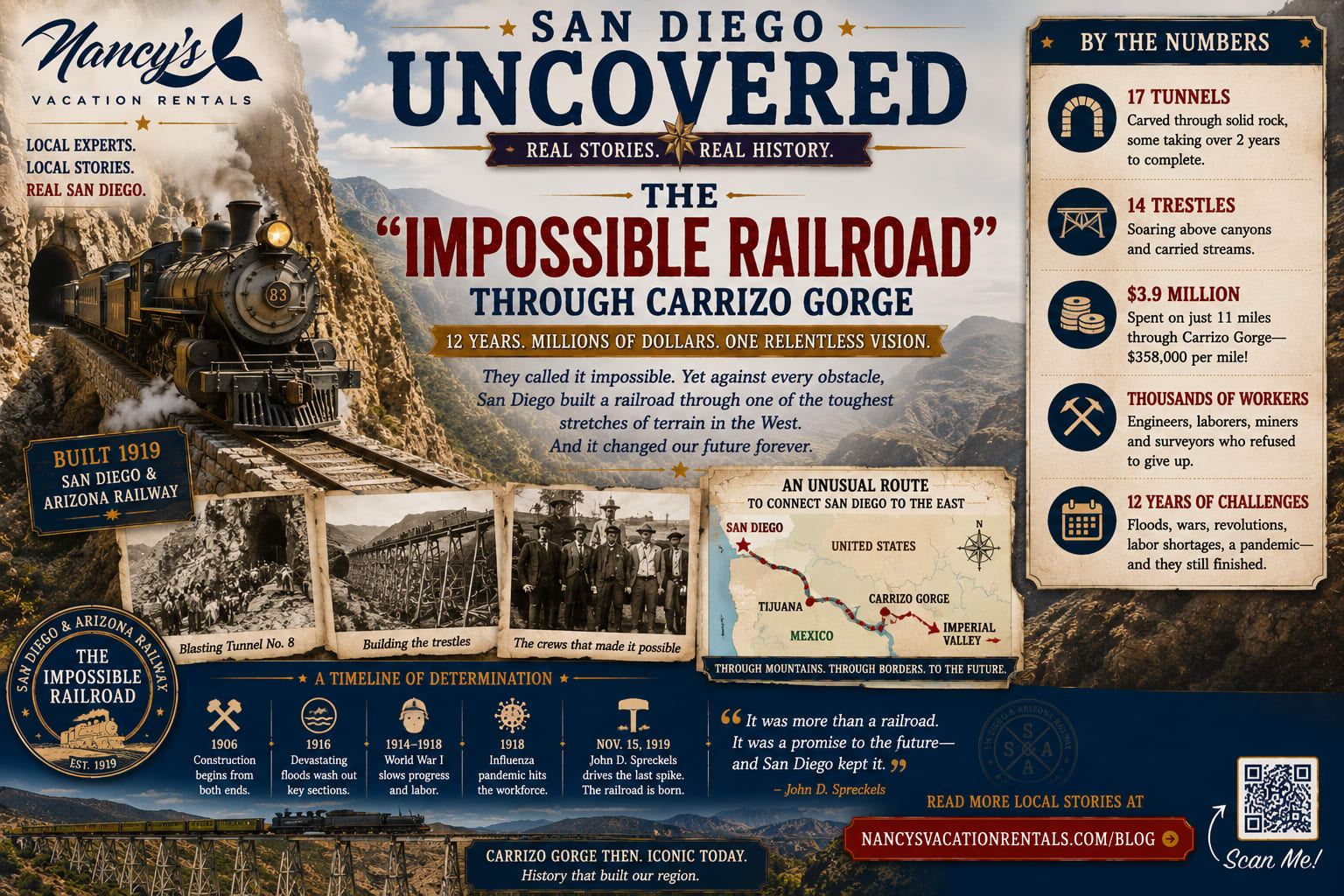
The “Impossible Railroad” Through Carrizo GorgeSan Diego wanted something Los Angeles already had: a direct railroad connection to the East.
There was one problem.
Mountains.
Between San Diego and the Imperial Valley stood terrain so steep, hot and unforgiving that the project became known as the “Impossible Railroad.”
John D. Spreckels decided to build it anyway.
San Diego Had a Railroad Problem
By the late nineteenth century, railroads were determining which western cities would become major commercial centers.
San Diego had a magnificent natural harbor, but its rail connections put it at a disadvantage. Much eastbound traffic had to move north through the Los Angeles region before connecting with national rail networks.
San Diego business leaders dreamed of a direct route east that could connect the harbor with the Imperial Valley and the Southern Pacific system.
For decades, that dream repeatedly collided with geography and money.
John D. Spreckels Decided to Try
John D. Spreckels had already become one of the most influential businessmen in San Diego.
In 1906, Spreckels and other investors incorporated the San Diego & Arizona Railway. Groundbreaking followed in September 1907.
The goal was ambitious: build a railroad from San Diego eastward to connect with the national rail system near El Centro.
They hoped the job would take only a few years.
It would take more than twelve.
The Route Went Through Mexico
The most practical route was not a straight line east from downtown San Diego.
The railroad headed south to Tijuana, traveled east through northern Baja California, reentered the United States near Campo, crossed the mountains and descended toward the Imperial Valley.
That made the railroad international before it ever reached its eastern connection.
Passengers traveling the completed route would cross the international border twice.
Then Came Carrizo Gorge
The final great obstacle was Carrizo Gorge in eastern San Diego County.
The gorge is an extraordinarily rugged desert landscape. Some hillsides exceed a 40-percent slope, and the railroad had to descend from the mountains toward the desert while keeping the track's grade manageable for steel-wheel trains.
Chief Engineer Edmund J. Kallright wrote in 1907 that Carrizo Gorge was among the most formidable places where anyone had attempted to build a railroad.
The nickname practically wrote itself:
The Impossible Railroad.
Eleven Miles Became an Engineering Nightmare
The Carrizo Gorge section was only about 11 miles long.
But those 11 miles required an extraordinary amount of engineering.
Historical research by the San Diego History Center documents 17 tunnels and 14 trestles through the gorge, with tunnels totaling more than 13,000 feet.
Rock had to be blasted away. Tunnels had to be bored into mountainsides. Trestles had to carry tracks across ravines where there was effectively no usable ground beneath them.
The Railroad Essentially Had to Make Its Own Mountain Pass
There wasn't a convenient railroad corridor waiting to be used.
The builders had to carve one.
Tracks clung to canyon walls. Tunnels punched through rock. Wooden structures extended the railroad over terrain that dropped sharply away beneath the rails.
San Diego historian Richard Pourade later summarized the challenge neatly: the railway virtually had to make its own mountain pass.
The Grade Was the Key
A train can climb a mountain, but only gradually.
The route through Carrizo Gorge allowed engineers to keep the railroad's gradient to roughly 2.2 percent or less on the descent toward the desert floor.
That constraint helps explain the seemingly bizarre curves, tunnels and trestles.
The railroad couldn't simply point downhill.
It had to stretch the descent across miles of mountainside.
Construction Didn't Even Reach the Gorge for Years
The company began preliminary work in the area in 1907, but substantial construction in Carrizo Gorge did not begin until about a decade later.
Before crews could tackle the gorge, they had to complete enough railroad from both directions to bring workers, equipment and supplies close to the construction zone.
Then they needed roads, camps, water systems and supply dumps simply to support the workers who would build the railroad.
Water Was a Construction Project of Its Own
Carrizo Gorge was brutally hot and isolated.
Before major construction could proceed, contractors had to secure water for the labor camps.
Historical records describe crews tapping several springs and piping the water to camps in the gorge.
Building the railroad first required building an infrastructure system for the people building the railroad.
Then World Events Got in the Way
The mountains were only part of the problem.
Construction was repeatedly disrupted by events far beyond Carrizo Gorge.
The Mexican Revolution complicated work along the international portion of the route.
The great San Diego flood of 1916 damaged railroad infrastructure.
World War I created shortages of workers and materials.
Then the 1918–1919 influenza pandemic struck the construction camps.
The Biggest Problem May Have Been Finding Workers
It is tempting to assume that geology was the primary reason Carrizo Gorge took so long.
Detailed research into the railway's archives suggests something more complicated.
Labor shortages were a major cause of delay.
Workers could find safer or better-paying jobs elsewhere, particularly during World War I. Tunnel work was dangerous, remote and uncomfortable.
The influenza epidemic made recruiting and keeping workers even harder.
Sometimes the “impossible” part wasn't the mountain.
It was finding enough people willing to dig through it.
Tunnel No. 8 Became the Final Bottleneck
One tunnel in particular delayed completion.
Tunnel No. 8 was originally projected at about 2,515 feet and ultimately measured roughly 2,527 feet.
Work stretched from September 1917 until October 1919.
Some rock was so difficult that progress could be measured in inches per day.
Until Tunnel No. 8 was finished, San Diego's direct railroad east remained incomplete.
The Cost Became Enormous
The entire San Diego & Arizona Railway ultimately cost roughly $18 million—an extraordinary amount for the era.
The Carrizo Gorge section alone cost about $3.9 million.
According to San Diego History Center research, the 11 miles through the gorge averaged approximately $358,000 per mile, compared with roughly $109,000 per mile for the rest of the railroad.
One short section of mountain railroad consumed close to the amount originally imagined for a much larger portion of the project.
Spreckels Kept Spending
Financial partners came and went.
After Southern Pacific leader E.H. Harriman died in 1909, support for the project became uncertain and Spreckels increasingly relied on his own fortune to keep construction moving.
From a purely financial perspective, the railroad was becoming difficult to justify.
But Spreckels saw the line as something larger than a normal investment.
He believed San Diego needed an independent rail connection east if it was going to compete commercially with Los Angeles.
November 15, 1919: The Impossible Became Real
On November 15, 1919, John D. Spreckels drove the ceremonial final spike near Carrizo Gorge.
After more than twelve years of construction, San Diego finally had its direct rail connection east.
About a thousand people attended the ceremony.
The first eastbound train left San Diego for El Centro on November 30, and the following day San Diego celebrated the arrival of the first train coming back from the east.
It Was an Engineering Triumph—and a Business Problem
Completing the railroad did not make its economic problems disappear.
The same geography that made the line extraordinarily expensive to build also made it expensive to operate and maintain.
Floods, landslides, tunnel problems and fires repeatedly damaged the route.
John Spreckels died in 1926. His heirs eventually sold their interest to Southern Pacific in 1933.
The railroad survived, but never became the commercial revolution its boosters had imagined.
One Famous Trestle Came Later
Today, the image most commonly associated with Carrizo Gorge is the enormous wooden Goat Canyon Trestle.
But there is an important historical distinction.
The famous Goat Canyon Trestle was not part of the original 1919 railroad.
It was constructed later after problems with Tunnel No. 15 culminated in its abandonment following a 1932 collapse.
The trestle became a spectacular bypass around the failed tunnel and eventually one of the most recognizable structures on the route.
That Distinction Matters
Historic photographs of Goat Canyon Trestle are frequently used to illustrate stories about the construction of the “Impossible Railroad.”
Visually, it makes sense.
Historically, it can be misleading.
When Spreckels drove the final spike in 1919, the giant Goat Canyon structure people recognize today did not yet exist.
The original Carrizo Gorge achievement was already extraordinary without borrowing a later landmark.
San Diego Finally Got Its Railroad
For generations, San Diego civic leaders believed a direct eastern railroad could transform the city into a major commercial gateway.
The Panama Canal had opened in 1914. San Diego possessed the first major American Pacific harbor north of the canal.
Now it finally had the rail connection boosters believed could link that harbor directly to the interior.
The dream had taken decades.
The final railroad took more than twelve years to build.
And Carrizo Gorge nearly broke it.
Why the “Impossible Railroad” Still Matters
The San Diego & Arizona Railway is a reminder that cities aren't shaped only by geography.
They're shaped by people who decide geography isn't good enough.
Spreckels and thousands of workers spent years carving, blasting and bridging a railroad through terrain that made little economic sense to cross.
The result never fulfilled every commercial promise made for it.
But more than a century later, the route remains one of the most audacious engineering stories in San Diego history.
San Diego Uncovered
San Diego Uncovered explores the forgotten projects, strange events, lost places and remarkable people behind America's Finest City.
San Diego wanted a railroad to the East.
The mountains said no.
San Diego built one anyway.
Explore San Diego With Nancy's
Nancy's Vacation Rentals has been helping guests experience San Diego for more than 25 years. We love sharing the stories behind the landscapes, neighborhoods and landmarks that make San Diego unlike anywhere else.
Browse Nancy's San Diego Vacation Rentals
Sources & Further Reading
- San Diego History Center — Formidable Places: Construction of the San Diego & Arizona Railway in Carrizo Gorge
- San Diego History Center — The Impossible Railroad
- San Diego History Center — Gold in the Sun, Chapter 13
- San Diego History Center — The Impossible Railroad
- San Diego & Arizona Railway: The Impossible Railroad
Keep reading
San Diego's Tuna Empire: When Fishing Helped Power the City
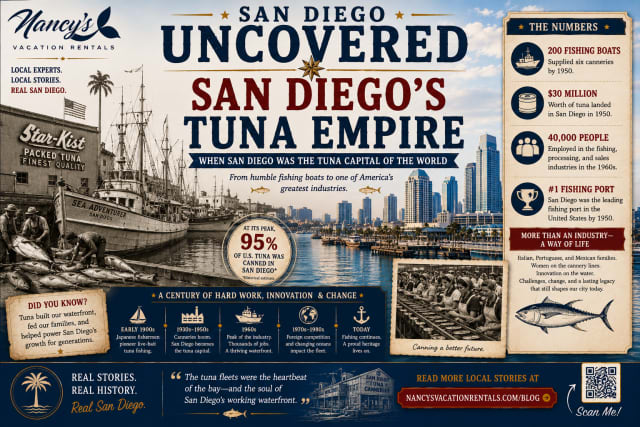
San Diego was once the Tuna Capital of the World. Discover how fishing boats, immigrant families and waterfront canneries built an industry that employed tens of thousands before largely disappearing from the bay.

What Does a Vacation Rental Management Company Actually Do for Its Fee?
What are you really paying for when you hire a vacation rental management company? Learn what full-service management can include, where fees vary, and how San Diego owners should evaluate value.

San Diego's Best Secret Doors
A Guide to Hidden Speakeasies