
The Star of India Nearly Became a Forgotten Relic
How San Diego’s famous sailing ship spent decades waiting for a second life.

Greg Ross
CEO / Owner - Nancy's Vacation Rentals
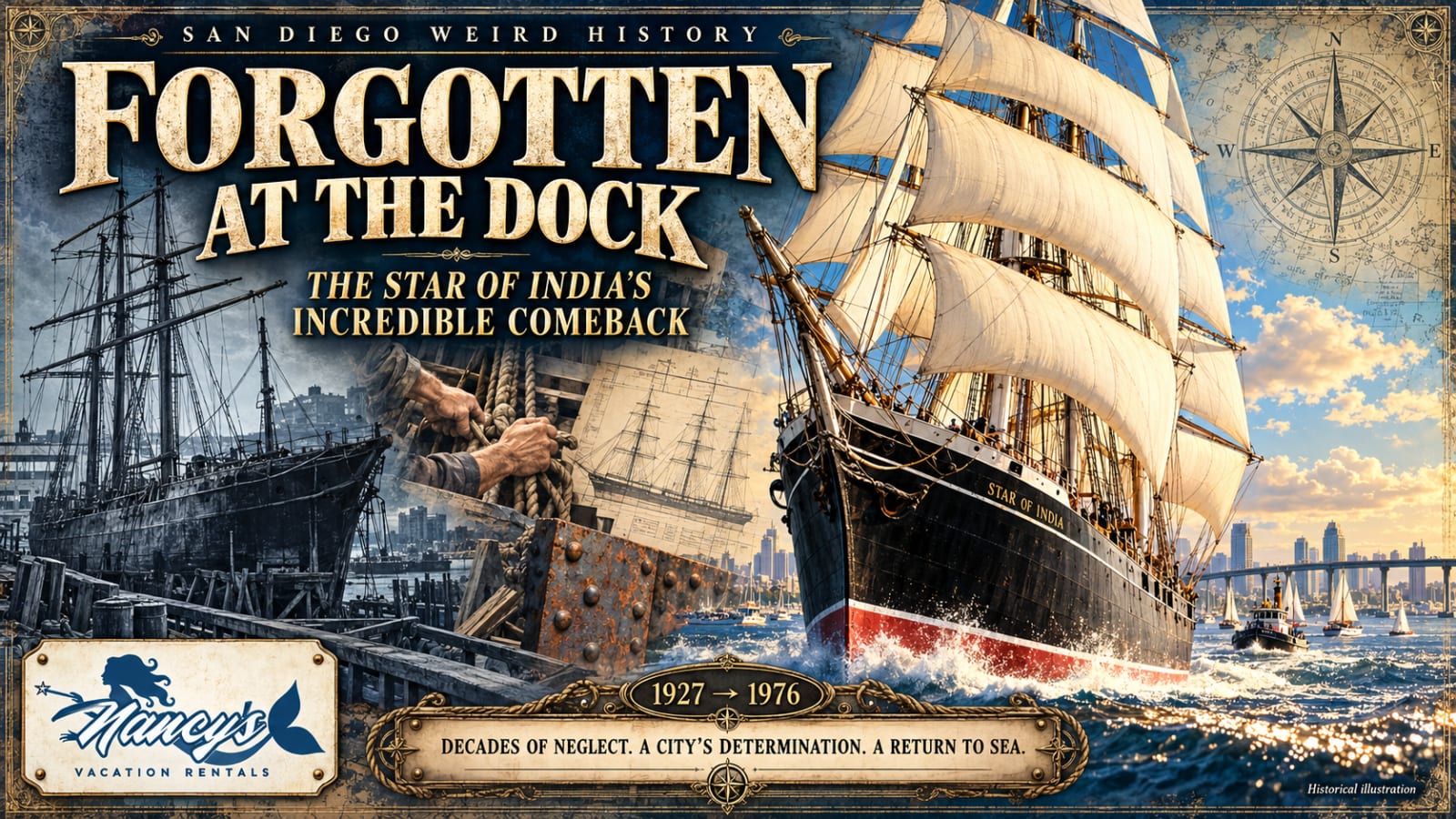
How San Diego’s famous sailing ship spent decades waiting for a second life.
Walk along San Diego’s Embarcadero and the Star of India looks as though she has always belonged there. The masts rise above the waterfront, the rigging draws your eyes upward, and suddenly a casual bayfront stroll becomes a reason to stop.
It is easy to assume a ship this recognizable was carefully protected from the moment she arrived.
Her San Diego story was much less straightforward.
The Star of India reached the city in 1927, but her celebrated return to sailing did not happen until 1976. Between those dates lay stalled plans, financial hardship, and a long effort to restore a working vessel rather than simply keep an old hull afloat.
For our San Diego Weird History series, this is a waterfront story with an unexpected twist: surviving the ocean was only part of the challenge. Surviving retirement took a community.
Before San Diego, there was Euterpe
The ship was built on the Isle of Man in 1863 under the name Euterpe, after the Greek muse of music and poetry. Her iron hull belonged to an era when wooden ships were still common.
Her early career was hardly reassuring. The Maritime Museum recounts a collision and mutiny on her first voyage, followed by a cyclone on her second. Later, she carried emigrants to New Zealand and completed 21 voyages around the world in that service.
Those journeys give the vessel a human scale that statistics alone cannot provide. For an emigrating family, the ship was the uncomfortable space between a familiar life and an uncertain new one. Looking at the decks today, try imagining the voyage without the certainty of a return ticket.
The museum also notes that she has never been fitted with auxiliary propulsion. That helps explain why her eventual return to sailing meant so much. The achievement required recovering the ability to work a sailing ship, not merely presenting its outline.
Her story includes the people who worked below the romance
In her Alaska Packers Association years, the vessel transported supplies, fishermen, and cannery workers between California and Alaska.
The National Park Service’s account emphasizes the Asian contract laborers who traveled aboard ships in that trade. Their work supported a major food industry, while contracting arrangements and racial discrimination could leave them vulnerable to exploitation.
That history deserves a place alongside the dramatic sails. A ship can be beautiful and still carry difficult stories about the economy it served.
When visiting, ask whose experience an exhibit describes: the captain’s, a passenger’s, or a worker’s. The answers can make the same vessel feel like several different worlds.
The zoo connection most visitors would never guess
The next chapter sounds like a San Diego trivia question: what did this sailing ship have to do with the Zoological Society?
In 1926, the Society purchased the Star of India for a proposed museum and aquarium. The following year, she arrived in San Diego.
That plan did not become the immediate transformation its supporters envisioned. The City’s historical account identifies the Great Depression and World War II as obstacles that derailed the proposal.
It is a striking reminder that acquiring a landmark and securing its future are different accomplishments. A waterfront attraction needs more than a berth and a good idea. Restoration demands money, expertise, and the patience to keep working when attention moves elsewhere.
The ship’s arrival was a beginning. It was not a finished rescue.
The long work of bringing her back
The museum’s archival history records the formation of the Star of India Auxiliary in 1959, followed by fundraising and restoration work. Other historical summaries place the first restoration efforts in the late 1950s. The consistent point is the scale of the undertaking: the return took years.
There is an important difference between making an old ship attractive and making her capable of sailing. The second goal involves the vessel as a functioning system, along with people who know how to operate it.
The surviving documentary collection reflects that practical world. It includes survey certificates, inventories, navigation records, employment documents, and correspondence. These are useful reminders that maritime history is built from maintenance and administration as well as storms and adventure.
The waterfront silhouette is the part visitors notice first. The quieter work behind it is what made that silhouette possible.
July Fourth, 1976: a ship becomes a celebration
On July 4, 1976, the Star of India sailed again as part of the United States Bicentennial celebration. The City’s photographic archive preserves the ship accompanied by a flotilla of followers.
For a vessel launched in 1863, the occasion linked two very different eras. For San Diego, it turned a lengthy preservation effort into something people could watch moving across the water.
The Maritime Museum’s timeline describes an audience of several hundred thousand watching from boats and shore. Whatever a spectator knew about her earlier voyages, the essential sight needed little explanation: the old sailing ship was sailing again.
This year, 2026, marks 50 years since that return. It is an anniversary worth remembering the next time the ship appears in the background of a waterfront photograph.
How to make the story part of your visit
The Star of India is part of the Maritime Museum of San Diego at 1492 North Harbor Drive. The museum offers access to historic vessels and exhibits through general admission, with separate on-the-water experiences also available.
Check the museum’s official visitor page for current admission details, vessel access, events, and any separately ticketed activities. A museum visit should not be assumed to include a sailing trip aboard the Star of India.
Give yourself time to look beyond the exterior. Consider how much space passengers had, how work was organized, and how the ship’s different careers changed what people expected of her. With children, one simple question can turn a visit into a conversation: what would you miss most during a long voyage?
At Nancy’s Vacation Rentals, our more than 25 years of local experience have given us an appreciation for the stories behind San Diego’s familiar views. Build a waterfront afternoon into your beach stay, and leave time for a landmark whose second life was anything but guaranteed.
The Star of India is easy to photograph. Knowing how close she came to remaining a relic gives you a reason to look longer.


