The Titanic Was Sunk Just South of San Diego
Inside the Massive Movie Studio Built for James Cameron

Greg Ross
CEO / Owner - Nancy's Vacation Rentals
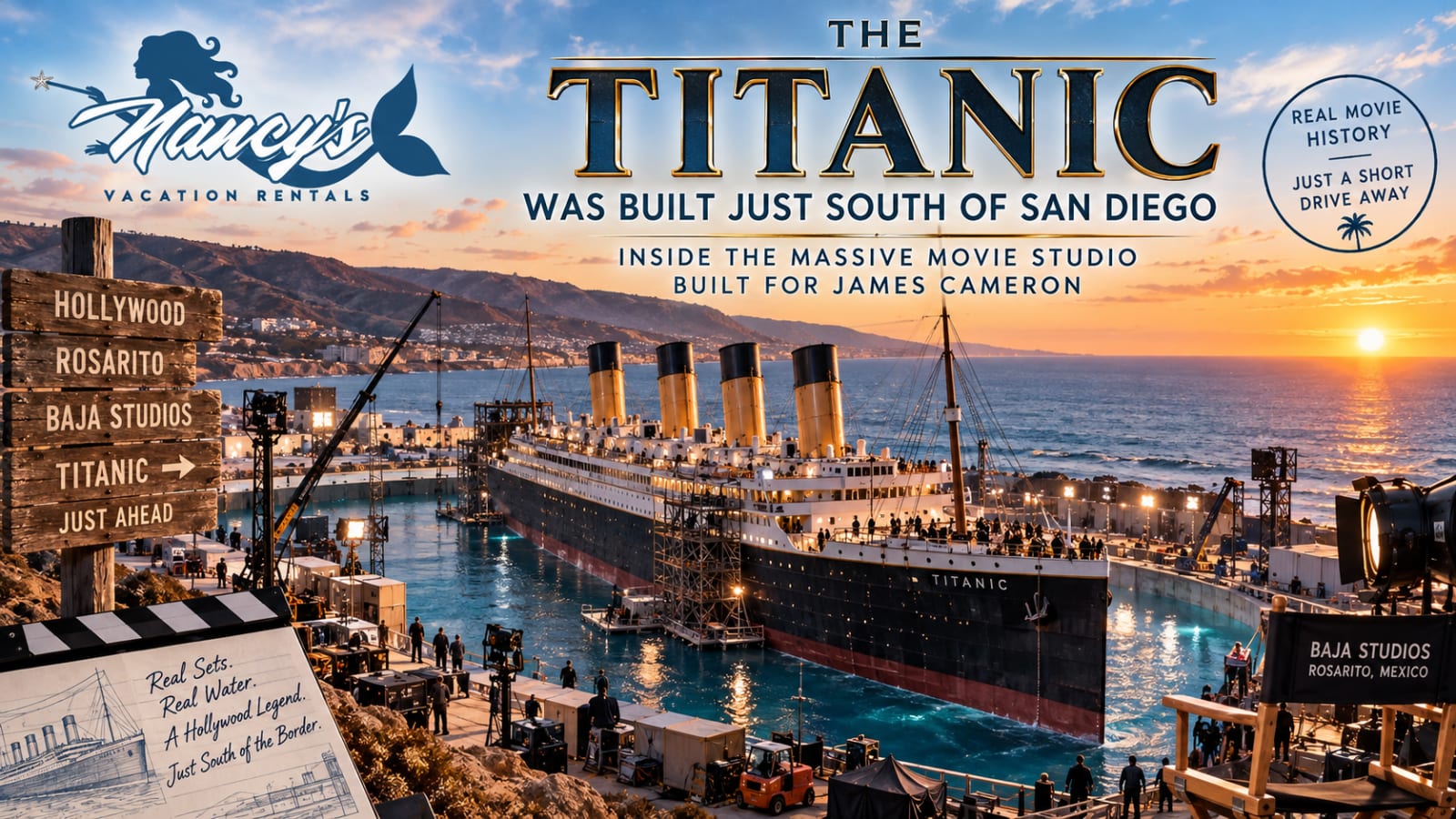
Just south of Rosarito sits one of the strangest pieces of Hollywood history on the Baja California coast: an enormous oceanfront movie studio originally built so James Cameron could recreate — and sink — the Titanic.
If you've ever driven south from San Diego through Tijuana toward Rosarito and Ensenada, you've probably admired the dramatic Baja coastline.
What you may not realize is that one of the most famous ships in movie history once sat along that very shoreline.
Not the real RMS Titanic, of course.
But something remarkably close.
In 1996, 20th Century Fox constructed an enormous movie studio near the fishing village of Popotla, just south of Rosarito, for James Cameron's ambitious new movie.
That movie was Titanic.
Rather than trying to recreate the North Atlantic inside a traditional Hollywood soundstage, Cameron essentially brought Hollywood to the Pacific Ocean.
The result was Fox Baja Studios, now known as Baja Studios — a massive filmmaking complex containing some of the world's largest movie-production water tanks.
James Cameron Had a Problem
By the mid-1990s, James Cameron had decided to make an extraordinarily ambitious movie about the 1912 sinking of RMS Titanic.
But Cameron wasn't interested in creating an ordinary historical drama.
He wanted audiences to feel as though they were actually aboard the ship.
That presented a rather significant problem.
Where do you put the Titanic?
Existing Hollywood facilities didn't have the enormous stages and water tanks Cameron needed.
So 20th Century Fox did something remarkable.
They built an entire studio for him.
Hollywood Comes to Rosarito
The location selected was a stretch of Pacific coastline near Popotla, Baja California, only a few miles south of Rosarito.
It was an unusually good location for a project this ambitious.
The area was close enough to Southern California to support a massive Hollywood production, while also providing plenty of undeveloped land and a spectacular unobstructed Pacific horizon.
Construction began in 1996.
And the schedule was astonishingly aggressive.
The huge facility was reportedly constructed in roughly 100 days.
Fox Built a 17-Million-Gallon Ocean
The centerpiece of the new studio was something Hollywood had rarely seen before.
An enormous outdoor filming tank positioned immediately beside the Pacific Ocean.
The tank held approximately 17 million gallons of water.
But its location was the really clever part.
From carefully selected camera angles, the edge of the tank visually disappeared into the real Pacific Ocean beyond it.
That meant Cameron could place his enormous Titanic set inside the controlled environment of a movie studio while making it appear as though the ship were sailing across an endless ocean.
No artificial horizon could compete with what was sitting right behind the set.
The Pacific Ocean became the North Atlantic.
Then They Built the Titanic
Inside the enormous tank, the production constructed a nearly full-scale exterior recreation of RMS Titanic.
The movie set is generally described as approximately 775 feet long.
The real Titanic measured approximately 882 feet.
Even though the movie version was slightly smaller, it was still an extraordinary structure by filmmaking standards.
This wasn't simply a small facade designed to fool the camera.
The production recreated enormous sections of the decks, railings, lifeboats, funnels, stairways and exterior architecture.
Hollywood Used a Clever Trick to Save Space
There was one major limitation.
They didn't need — or want — to build both complete sides of the ship.
Much of the primary exterior set represented Titanic's starboard side.
When filmmakers needed the opposite orientation, footage could sometimes be flipped during post-production.
That created some very unusual production challenges.
Writing on certain signs and props occasionally had to be created backward so that it would appear correctly after the movie image was reversed.
It's the kind of movie magic most viewers would never notice.
Even the Direction of the Ship Mattered
The orientation of the enormous Titanic set wasn't accidental.
Cameron's team studied the prevailing winds along the Baja coastline.
They wanted smoke from Titanic's funnels to naturally blow toward the stern, making the ship appear to be steaming forward.
The replica was positioned accordingly.
It was another example of the extraordinary attention to detail that went into the production.
They Didn't Just Build Titanic — They Sank It
Building the ship was only half the problem.
James Cameron also needed to destroy it.
Parts of the ship were engineered specifically for the dramatic sinking sequences.
One enormous set representing Titanic's stern could be tilted to increasingly steep angles as the ship disappeared beneath the water.
Other sets could be flooded.
Hallways filled with rushing water.
Staircases disappeared beneath the surface.
Rooms tilted.
Actors and stunt performers worked inside enormous controlled tanks while Cameron recreated the final hours of the world's most famous ship.
Although digital effects played an important role in Titanic, an enormous amount of what audiences saw was created using real water, massive physical sets, mechanical structures and hundreds of performers.
That's part of the reason the movie still looks remarkably convincing decades later.
Leonardo DiCaprio and Kate Winslet Were Really in Rosarito
For months, one of the world's largest movie productions was operating just down the road from San Diego.
Leonardo DiCaprio.
Kate Winslet.
James Cameron.
Billy Zane.
Kathy Bates.
Hundreds of crew members and extras.
All working along the Baja California coastline.
Principal photography moved to the newly constructed Fox Baja Studios in September 1996.
For nearby Rosarito, Popotla, Tijuana and Ensenada, it was an extraordinary moment.
Hundreds of local workers were reportedly involved in constructing the massive tanks, roads, pumping systems, buildings and sets required for the production.
Titanic Was Supposed to Be a Disaster
There is an amusing bit of irony surrounding the production.
The movie about one of history's greatest maritime disasters nearly became known as one of Hollywood's greatest financial disasters.
The budget kept climbing.
The schedule grew longer.
Stories circulated throughout Hollywood suggesting that James Cameron's massive gamble could become one of the biggest flops in movie history.
Instead, Titanic became a global phenomenon.
Released in December 1997, the film became the highest-grossing movie in history at the time.
It also won 11 Academy Awards, including Best Picture and Best Director.
And suddenly this enormous movie studio south of Rosarito had become part of cinematic history.
What Happened to the Titanic Set?
Unfortunately, you can't drive down the Baja coast today and see Jack and Rose's Titanic sitting beside the highway.
The enormous ship set was eventually dismantled.
But the studio survived.
Hollywood quickly discovered that the gigantic water tanks were incredibly valuable for filming anything involving ships, oceans or large-scale water sequences.
Productions associated with the facility over the years have included:
- Tomorrow Never Dies
- Deep Blue Sea
- Pearl Harbor
- Master and Commander: The Far Side of the World
- The Chronicles of Narnia: The Voyage of the Dawn Treader
- Fear the Walking Dead
The facility helped establish the Rosarito area as an unexpectedly important international filmmaking location.
For a While, You Could Actually Visit Titanic
This is the part some longtime San Diegans may remember.
20th Century Fox eventually realized that people were fascinated by what had been built along the Baja coast.
A Titanic exhibit became popular enough that the idea expanded into a tourist attraction called Foxploration.
The attraction opened in 2001.
Visitors could explore movie props, sets and filmmaking exhibits connected to Titanic and other productions filmed at the studio.
There were Titanic-related props, lifeboats, recreated interiors and exhibits showing visitors how Hollywood created some of the movie's most famous scenes.
For San Diegans, it became a wonderfully strange Baja day trip.
Cross the border.
Drive to Rosarito.
And visit the place where Titanic sank.
Fox Eventually Sold the Studio
In 2007, 20th Century Fox sold the oceanfront facility to private investors.
The property became known simply as Baja Studios.
The Foxploration tourist attraction eventually closed as well.
And there's an important distinction for visitors today:
Baja Studios is not currently a Titanic theme park or normal public tourist attraction.
The original Titanic set is gone, and visitors should not drive to the property expecting to freely tour the working studio.
The Fishing Village Next Door Is Still There
Perhaps one of the most interesting parts of the story is the contrast between Hollywood and the community immediately beside it.
Next to this enormous piece of movie history sits Popotla, a traditional Baja fishing community.
Hollywood arrived.
Built the Titanic.
Spent millions of dollars.
Brought movie stars, giant film crews and international attention.
Created one of the most successful movies ever made.
And then largely disappeared behind the gates of the studio.
Popotla kept fishing.
Today, you can drive through the area without realizing that one of the most technologically ambitious films ever made was created just beyond the road.
The North Atlantic Was Actually Baja California
There's something wonderfully appropriate about the illusion.
When audiences watched Titanic, they were supposed to believe they were somewhere in the freezing North Atlantic in April 1912.
In reality, many of the movie's most memorable scenes were filmed beneath the Baja California sun.
The endless North Atlantic horizon?
The Pacific Ocean.
The enormous luxury liner?
A giant movie set.
The ocean surrounding it?
A 17-million-gallon movie tank.
And the location?
Not Belfast.
Not Southampton.
Not the North Atlantic.
Just south of Rosarito, surprisingly close to San Diego.
Frequently Asked Questions
Was Titanic really filmed in Rosarito, Mexico?
Yes. A substantial portion of James Cameron's 1997 film Titanic was filmed at Fox Baja Studios near Rosarito, Baja California. Additional filming took place at other locations.
Did 20th Century Fox build the studio specifically for Titanic?
Yes. Fox Baja Studios was constructed in 1996 primarily to accommodate the extraordinary production requirements of James Cameron's Titanic, particularly the enormous ship sets and water tanks.
Was the Titanic movie set full size?
Not quite. The large exterior replica was approximately 775 feet long, compared with the real Titanic's approximately 882-foot length. It was still one of the largest and most elaborate ship sets ever constructed for a movie.
How large was the Titanic water tank?
The main exterior filming tank held approximately 17 million gallons of water. The larger studio complex contained several additional water tanks used for film production.
Can you visit the Titanic set today?
No. The original Titanic ship set has been dismantled, and the former Foxploration tourist attraction is no longer operating. Baja Studios remains an active production facility and should not be considered a normal public tourist attraction.
Where is Baja Studios?
Baja Studios is located along the Pacific coast near Popotla, south of Rosarito in Baja California, Mexico. The site is relatively close to San Diego, which makes its Hollywood history especially surprising to many Southern California residents.
A Little Hollywood History Just Across the Border
One of the best things about living in or visiting San Diego is how much lies within a relatively short drive.
Beaches, mountains, deserts and Mexico are all part of the larger Southern California experience.
And sometimes the most interesting places are the ones thousands of people drive past without ever knowing their story.
At Nancy's Vacation Rentals, we've spent more than 25 years helping visitors experience San Diego and the surrounding region.
Through our local-history and hidden-gems series, we're exploring the forgotten attractions, unusual landmarks and incredible stories hiding throughout San Diego and beyond.
Because sometimes you don't have to travel very far to find something extraordinary.
Sometimes you just have to know where to look.
Planning a San Diego Stay?
Make San Diego your home base while exploring everything Southern California and Baja have to offer.
Explore Nancy's Vacation Rentals
SEO Details
SEO Title:
The Titanic Was Filmed Near San Diego | Fox Baja Studios in Rosarito
Meta Description:
Just south of San Diego, 20th Century Fox built a massive oceanfront movie studio so James Cameron could film Titanic. Discover the incredible story of the 17-million-gallon tank, enormous ship replica and Baja studio where Hollywood sank the world's most famous ship.
Suggested URL Slug:
/blog/titanic-filming-location-rosarito-baja-studios
Suggested Keywords:
Titanic filming location Rosarito, Titanic Mexico set, Fox Baja Studios, Baja Studios Titanic, Titanic filmed in Mexico, Titanic movie set Rosarito, Rosarito history, Baja California attractions, San Diego day trips, Hollywood filming locations near San Diego