Top Gun Was Born in San Diego
The Incredible History Behind Miramar's Fighter Jets

Greg Ross
CEO / Owner - Nancy's Vacation Rentals

San Diego Weird History | Nancy's Vacation Rentals
This weekend, hundreds of thousands of eyes will turn toward the skies over San Diego as fighter jets roar above MCAS Miramar.
But here's something many people watching the Miramar Air Show may not realize:
TOPGUN wasn't invented by Hollywood.
It was real.
And it was born right here in San Diego.
Long before Tom Cruise climbed into a cockpit, Miramar was training some of America's most skilled fighter crews.
In fact, the story of Miramar involves World War II, Cold War dogfights, F-14 Tomcats, Hollywood movie sets, Navy fighter pilots, Marine aviation — and one of the biggest air shows in America.
So before you look up at the jets this weekend, let's look back at how San Diego became one of America's most famous aviation cities.
Before the Jets, Miramar Was Mostly Ranch Land
It's difficult to imagine today, but the enormous military installation beside Interstate 15 didn't begin as a famous fighter-jet base.
The Miramar area was once largely open ranchland north of San Diego.
Military use of the area dates back more than a century, with the property becoming increasingly important as the United States expanded its military presence in Southern California.
During World War II, both the Navy and Marine Corps used portions of Miramar.
East Miramar included Camp Elliott, where Marines trained for artillery and armored operations, while aviation training took place on the western side.
San Diego was becoming a military aviation powerhouse.
Then Came the Jet Age
After World War II, aviation technology changed incredibly quickly.
Propeller-driven fighters gave way to jets.
Aircraft became faster.
Runways became longer.
Training became more sophisticated.
And Miramar was about to become one of the most important naval aviation installations in America.
In 1952, the installation was officially designated Naval Air Station Miramar.
Miramar developed into the Navy's principal West Coast jet base.
By the middle of the 1950s, nearly 400 jets were reportedly based there.
San Diegans had entered the jet age.
Then Vietnam Exposed a Problem
By the 1960s, American fighter aircraft had become extraordinarily sophisticated.
They were fast.
They carried advanced missiles.
And military planners believed technology was changing aerial combat.
But combat experience during the Vietnam War revealed an uncomfortable problem.
American fighter crews weren't achieving the air-to-air combat results military planners expected.
The Navy decided fighter crews needed more specialized training in air combat maneuvering — essentially, modern dogfighting.
And the solution would become legendary.
TOPGUN Is Born at Miramar
In 1969, the Navy established the United States Navy Fighter Weapons School at NAS Miramar.
Its purpose was straightforward:
Take experienced fighter crews and teach them how to become even better at air-to-air combat.
The school became better known by a much shorter name:
TOPGUN.
Students studied enemy aircraft, weapons, tactics and advanced air-combat maneuvering.
They then returned to their fleet squadrons and shared what they had learned.
Miramar's skies became a classroom.
And some of the world's most highly trained fighter crews came to San Diego to learn how to fight.
Then Came the F-14 Tomcat
If one airplane became synonymous with Miramar, it was the F-14 Tomcat.
In 1972, the first two Pacific Fleet F-14 squadrons were established at Miramar.
The aircraft looked like something from the future.
Its distinctive wings could sweep backward at high speed and extend forward for slower flight.
The Tomcat could exceed twice the speed of sound.
For decades, seeing F-14s in the skies above San Diego became part of everyday life around Miramar.
Then Hollywood showed up.
Hollywood Discovers Miramar
In the mid-1980s, filmmakers began working on a movie about elite Navy fighter pilots.
There was really only one obvious place to set it.
Miramar.
The 1986 movie Top Gun, starring Tom Cruise as Pete “Maverick” Mitchell, transformed the already-famous fighter school into a worldwide pop-culture phenomenon.
Miramar itself became part of the movie.
Aircraft, flight-line areas and military facilities around San Diego helped create the world audiences saw on screen.
Even the old Miramar air traffic control tower appeared in the film.
Suddenly millions of moviegoers around the world associated San Diego with fighter jets, aviator sunglasses, motorcycles and the phrase:
“I feel the need...”
Well, you know the rest.
San Diego Became Top Gun Country
The movie didn't just feature Miramar.
Locations throughout San Diego County became part of the film.
Scenes were filmed around San Diego, including recognizable locations that fans can still visit today.
More than four decades later, people still travel to San Diego specifically to see places associated with Top Gun.
Hollywood helped turn Miramar's very real aviation history into part of San Diego's identity.
But Then TOPGUN Left Miramar
Here's the part of the story many people don't know.
TOPGUN isn't actually at Miramar anymore.
Military restructuring during the 1990s dramatically changed Southern California's military installations.
The Navy Fighter Weapons School eventually moved away from Miramar.
Meanwhile, Marine Corps Air Stations El Toro and Tustin were selected for closure.
The Marine Corps needed somewhere to relocate major aviation operations.
And Miramar was waiting.
NAS Miramar Becomes MCAS Miramar
On October 1, 1997, Naval Air Station Miramar officially became Marine Corps Air Station Miramar.
The installation had come full circle.
Marines had operated there decades earlier.
Now they were back.
Miramar became home to the 3rd Marine Aircraft Wing and one of the most important Marine aviation installations on the West Coast.
The Navy's famous fighter school was gone.
But Miramar's aviation story was far from over.
And Then There's the Miramar Air Show
Once a year, the gates open and civilians get an extraordinary opportunity to experience Miramar up close.
The MCAS Miramar Air Show has become one of San Diego's signature annual events.
And in 2026, it returns September 25–27.
The three-day event features military flight demonstrations, civilian aerobatic performers, historic aircraft, static displays and opportunities to see modern aviation technology up close.
Even better:
General admission and parking are free.
The 2026 Miramar Air Show
This year's theme is “Soaring Into America's 250th.”
The show celebrates the 250th anniversary of the United States while highlighting both the history and future of American aviation.
Visitors can expect everything from historic warbirds to some of today's most advanced military aircraft.
The flight-line gates open at 8:00 a.m. each day.
Flight demonstrations continue throughout the day, with the schedule subject to weather and operational requirements.
Before You Go: A Few Things Worth Knowing
The Miramar Air Show is enormous, so planning ahead makes a big difference.
Dates: September 25–27, 2026
Location: MCAS Miramar, San Diego
Gates Open: 8:00 a.m.
General Admission: Free
Parking: Free
Parking areas can be a considerable distance from the flight line, but shuttles operate from the parking areas.
Rideshare is available through a designated pickup and drop-off area rather than directly at the flight line.
And here's one tip parents shouldn't ignore:
Bring hearing protection for children.
Modern military jets are extraordinarily loud, and event organizers specifically recommend hearing protection, particularly for children and anyone sensitive to loud noise.
Look Up — But Remember What You're Looking At
When a modern fighter screams across the sky above Miramar this weekend, it's easy to focus entirely on the airplane.
But you're also watching another chapter in more than a century of San Diego aviation history.
The same landscape has seen:
World War II training.
The birth of TOPGUN.
Hundreds of Navy jets.
F-14 Tomcats.
Hollywood movie crews.
Marine Corps aviation.
And generations of San Diegans standing outside looking toward the sky.
From TOPGUN to Today
Think about the timeline:
1940s: Navy and Marine aviation operations expand at Miramar.
1952: The installation becomes Naval Air Station Miramar.
1969: The Navy Fighter Weapons School — TOPGUN — is established at Miramar.
1972: The first Pacific Fleet F-14 Tomcat squadrons arrive.
1986: Top Gun turns Miramar into a worldwide pop-culture icon.
1997: NAS Miramar becomes Marine Corps Air Station Miramar.
2026: America's Air Show once again brings San Diego's aviation history to life.
The airplanes changed.
The uniforms changed.
The mission changed.
But Miramar never stopped flying.
San Diego Weird History
San Diego's history isn't always hidden underground or inside old buildings.
Sometimes it's moving at hundreds of miles per hour directly above our heads.
Follow Nancy's Vacation Rentals as we uncover the strange, surprising and often forgotten stories that made San Diego what it is today.
Real places. True stories. A more curious San Diego.
Nancy's Vacation Rentals — Changing the way you vacation.
Keep reading

10 of San Diego’s Newest Restaurants You Need to Try in 2026
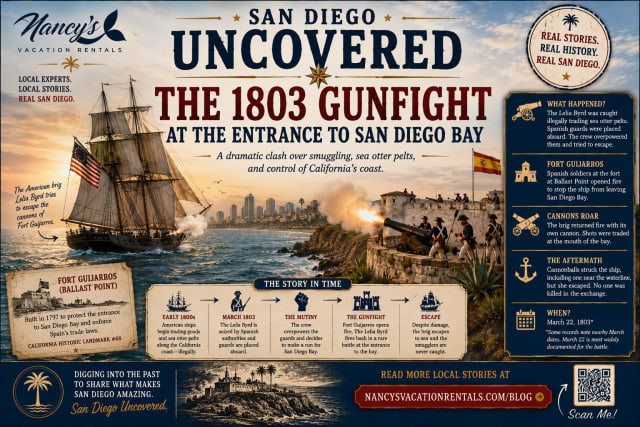
The 1803 Gunfight at the Entrance to San Diego Bay
In 1803, an American trading brig trying to escape San Diego exchanged cannon fire with a Spanish fort at Ballast Point. Discover the strange true story of the Battle of San Diego Bay.