
When San Diego Had a Whaling Industry
Long before San Diego Bay became synonymous with Navy ships, tourism and waterfront dining, crews hunted migrating gray whales off Point Loma and processed them at shore-whaling stations around the bay.

Greg Ross
CEO / Owner - Nancy's Vacation Rentals
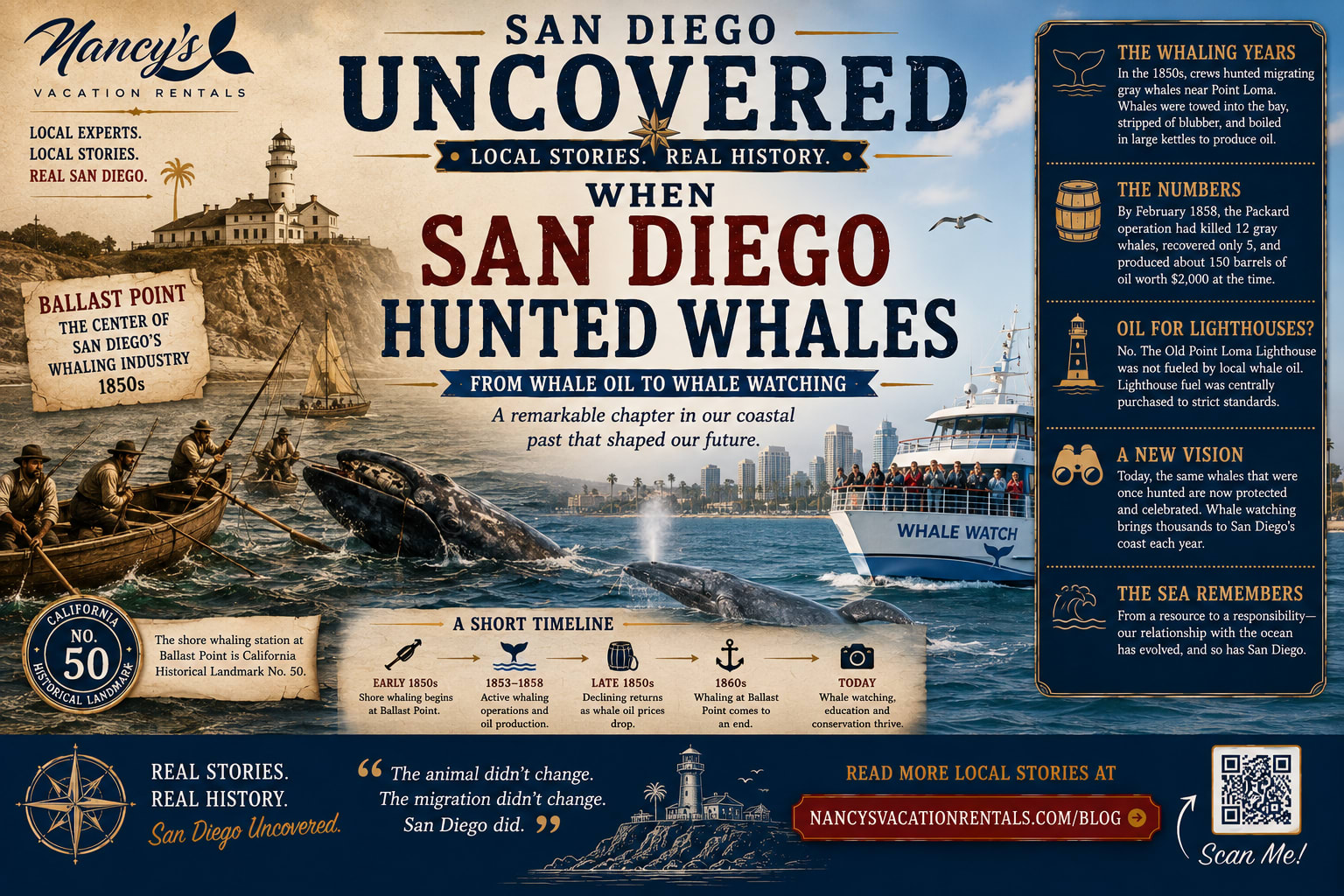
SAN DIEGO UNCOVERED
When San Diego Had a Whaling IndustryToday, spotting a gray whale off Point Loma is a reason to grab binoculars, book a whale-watching trip or point excitedly toward the horizon.
In the 1850s and 1860s, San Diegans sometimes reacted very differently.
They launched boats to kill it.
Long before San Diego Bay became known for Navy ships, marinas and waterfront restaurants, shore-whaling crews operated around Point Loma and the bay. Whales were hunted offshore, towed back toward land and processed for oil in huge iron kettles.
For a brief period, whaling was one of San Diego's notable waterfront industries.
Whales Once Entered San Diego Bay in Remarkable Numbers
Historical accounts describe a San Diego Bay very different from the one we know today.
Gray whales migrating between Arctic feeding grounds and breeding lagoons in Baja California regularly passed the entrance to the harbor. Some entered the bay itself.
Early San Diego historian William Smythe wrote that in the 1840s the bay was a favored place for female whales during calving season. Later resident Andrew Cassidy recalled seeing as many as eleven whales inside Ballast Point at once, and a January 1872 account reported fifteen.
To nineteenth-century entrepreneurs, those whales weren't primarily wildlife.
They were an economic opportunity.
San Diego Tried to Become a Whaling Port
Before shore whaling developed locally, San Diego hoped to profit by supplying the larger Pacific whaling fleet.
Whaling ships could remain at sea for years and needed ports where crews could obtain food, water, repairs and supplies.
Then the business model changed.
Instead of merely servicing offshore whalers, entrepreneurs began establishing shore-based operations along the California coast.
San Diego joined them.
The Packard Brothers Saw an Opportunity
Alpheus and William Packard became central figures in San Diego's shore-whaling industry.
Historical research published by the San Diego History Center traces their early activity to the mid-1850s. By February 1858, their company had killed twelve gray whales and recovered five of them, producing about 150 barrels of oil worth roughly $2,000 at the time.
California's official historic-landmark record says the Johnson brothers and twin Packard brothers surveyed Ballast Point for a whale-oil operation late in 1857 and began operations the following year.
Ballast Point Became a Whale-Processing Site
Ballast Point sits at the entrance to San Diego Bay on the Point Loma peninsula.
Its location was ideal for shore whaling. Migrating gray whales passed close to the coast, while the protected waters inside the bay provided a place to tow and process a carcass.
The whaling station occupied ground with an even older history: the area had previously been associated with the Spanish Fort Guijarros.
Today the site is within the military complex at Naval Base Point Loma.
This Wasn't Moby-Dick-Style Whaling
San Diego's operation was primarily shore whaling.
Crews watched for whales migrating near the coast, launched relatively small whaleboats and pursued them from land-based stations.
Gray whales were especially attractive targets because their predictable migration brought them close enough to shore for crews to intercept them.
The hunters used harpoons and, increasingly, explosive bomb lances.
Then came the difficult part: getting the whale back to shore.
A Dead Whale Had to Be Towed Back to the Bay
Killing a whale did not automatically mean making money.
Some wounded whales escaped. Others sank or were lost before crews could recover them.
Historical accounts of the Packard operation show this clearly: twelve whales might be killed while only five were successfully recovered.
A whale that couldn't be brought back to the processing station represented enormous lost effort.
Then Came the Smell
Once a whale reached the station, crews stripped away its blubber and cut it into manageable pieces.
The blubber was heated in large iron kettles in a process called trying out.
The heat separated the valuable oil from the tissue.
It was dirty, smoky work—and almost certainly produced an unforgettable waterfront smell.
The postcard version of nineteenth-century San Diego this was not.
Why Was Whale Oil So Valuable?
Before petroleum products and electricity transformed American life, oils and fats were important commodities.
Whale products were used for lighting, lubrication, soap and other industrial purposes.
That demand made a successfully recovered whale financially valuable.
But one San Diego legend deserves a correction: the nearby Old Point Loma Lighthouse was not simply fueled with oil produced by the local gray-whale station. National Park Service research says lighthouse oil was centrally purchased to strict specifications, and the sperm oil used by the Lighthouse Service did not come from San Diego's shore-whaling catch.
San Diego Had More Than One Whaling Operation
Ballast Point wasn't the only place associated with the industry.
Historical sources describe whaling activity around La Playa and North Island as well.
The San Diego History Center notes that shore-whaling stations were established in San Diego Bay, while Coronado historical accounts describe processing operations at both Point Loma and North Island.
For a time, the entrance to San Diego Bay was a working whaling landscape.
The Crews Were More Diverse Than You Might Expect
The National Park Service describes the nineteenth-century Ballast Point whaling community as interracial.
Research into California shore whaling identifies workers with Portuguese, Mexican, Spanish, Irish, African and New England backgrounds.
Portuguese-American families in particular played an important role in California's shore-whaling industry.
That makes Ballast Point part of another often-overlooked San Diego story: the city's waterfront economy was internationally connected and culturally diverse long before the modern tourism era.
Whaling Helped Change the Whales' Behavior
Older accounts describe whales entering San Diego Bay in numbers that would seem extraordinary today.
As hunting intensified and maritime traffic increased, those patterns changed.
Historical writers observed that whales stopped entering the harbor as frequently, although migrating animals continued to pass close to Point Loma.
The very accessibility that made San Diego attractive to whales also made those animals vulnerable to hunters.
Then the Economics Changed
San Diego's shore-whaling boom did not last.
Petroleum products increasingly competed with animal oils. Whale populations had been heavily depleted. And Ballast Point was becoming strategically important to the federal government.
California's historic-landmark record says the United States acquired the Ballast Point property in 1869 and that whaling operations there ended in 1873.
Other whaling activity in the San Diego region continued for a time afterward, but the industry's best years were over.
The Whaling Station Became a Military Landscape
The transformation of Ballast Point is almost a miniature history of San Diego itself.
It had been associated with Spanish coastal defenses.
Then came American commerce and whaling.
Then federal military defenses, lighthouses and eventually a major naval presence.
Today, instead of whaleboats and kettles of boiling blubber, the area is associated with Naval Base Point Loma and submarines.
The Whales Came Back
There is a striking ending to this story.
Gray whales were hunted so aggressively that their populations were severely depleted.
After commercial protection and conservation efforts, the eastern North Pacific gray-whale population recovered dramatically compared with its nineteenth-century lows, although its numbers continue to fluctuate and scientists monitor recent declines closely.
Today San Diego makes money from gray whales again.
But now the business is mostly about seeing them alive.
From Whale Oil to Whale Watching
That reversal may be one of the most dramatic changes in San Diego's relationship with the ocean.
In the nineteenth century, a whale passing Point Loma represented barrels of oil.
Today the same migration supports whale-watching boats, tourism, marine science and conservation education.
The animal didn't change.
San Diego did.
A Hidden Chapter at the Entrance to the Bay
Stand at Cabrillo National Monument today and look down toward Ballast Point.
It's difficult to picture crews launching wooden boats after gray whales, towing carcasses into the bay and tending smoky try-works along the shoreline.
But for a brief period in the nineteenth century, that was part of everyday San Diego commerce.
One of the city's most beautiful maritime viewpoints once overlooked one of its messiest industries.
San Diego Uncovered
San Diego Uncovered explores the forgotten industries, strange events, lost places and surprising people behind America's Finest City.
Before whale watching came whale hunting.
And the entrance to San Diego Bay once looked—and probably smelled—very different.
Explore San Diego With Nancy's
Nancy's Vacation Rentals has been helping guests experience San Diego for more than 25 years. We love sharing the stories behind the coastline, neighborhoods and landmarks that make San Diego unlike anywhere else.
Browse Nancy's San Diego Vacation Rentals
Sources & Further Reading
- California Office of Historic Preservation — Ballast Point Whaling Station Site, Landmark No. 50
- San Diego History Center — Dog-Holes, Bomb-Lances and Devil-Fish
- San Diego History Center — History of San Diego, Whaling
- San Diego History Center — The Silver Dons, 1833–1865
- National Park Service — Ballast Point
- National Park Service — Old Point Loma Lighthouse History
Keep reading

After Dark
The Ghosts, Legends & Strange History of Balboa Park

Local vs. National Vacation Rental Management Companies
Compare local and national vacation rental management companies, including pricing, service, technology, maintenance, guest support and local expertise for San Diego owners.

Kensington
The Tiny San Diego Neighborhood That Feels Like a Village