
Why Is There an Oktoberfest in El Cajon?
The 200-Year Journey From Bavaria to San Diego

Greg Ross
CEO / Owner - Nancy's Vacation Rentals

San Diego Weird History | Nancy's Vacation Rentals
Every fall, something slightly unexpected happens in El Cajon.
The lederhosen come out.
Beer steins fill up.
Bratwurst hits the grill.
Oom-pah music starts playing.
People dance.
A queen is crowned.
And for two weekends, part of San Diego County starts looking—and sounding—a little like Bavaria.
It's Oktoberfest in El Cajon.
But here's the strange part:
Oktoberfest didn't originally have much to do with beer.
It began with a royal wedding.
And a horse race.
More than 200 years ago.
So how did a wedding celebration for a Bavarian prince in 1810 eventually turn into bratwurst, beer and polka music in El Cajon?
Grab a pretzel.
This story travels more than 6,000 miles.
It All Started With a Wedding
Let's go back to Munich.
The year was 1810.
Bavaria had only recently become a kingdom when Crown Prince Ludwig—who would later become King Ludwig I—married Princess Therese of Saxe-Hildburghausen.
This wasn't going to be a quiet family wedding.
The celebration lasted for days.
There was music.
Food.
Public festivities.
Parades.
And on October 17, something particularly important happened:
A horse race was held outside Munich's city gates.
The public was invited.
The celebration was such a success that people decided to do it again.
And again.
And again.
Eventually, that celebration became known around the world as...
Oktoberfest.
And That's Why It's Called the Wiesn
The field where the celebration took place was named in honor of the bride.
Theresienwiese.
Roughly translated: Therese's Meadow.
More than two centuries later, Munich's Oktoberfest is still held there.
Locals often simply call Oktoberfest “the Wiesn.”
Which means one of the world's most famous parties is still nicknamed after the meadow where a princess celebrated her wedding more than 200 years ago.
So Where Was the Beer?
Beer eventually became one of Oktoberfest's defining traditions, but the festival evolved considerably from that first celebration.
Over time, food stalls, carnival attractions, music, beer stands and eventually the enormous beer tents associated with modern Oktoberfest became part of the event.
What began as a royal celebration evolved into one of the world's most famous folk festivals.
Then Germans began taking those traditions with them around the world.
German Immigrants Come to America
Millions of German-speaking immigrants came to the United States during the 19th and early 20th centuries.
They brought much more than food and beer.
They brought music.
Clubs.
Dance.
Language.
Holiday traditions.
Social organizations.
And a strong tradition of gathering together to celebrate German culture.
Those traditions eventually made their way to Southern California.
San Diego Gets Its Own German Community
For more than six decades, the German American Societies of San Diego have worked to preserve and celebrate German culture in the region.
The organization isn't simply an Oktoberfest committee.
Throughout the year, its members participate in German cultural traditions including music, dancing, theater, language, card games, holiday celebrations and other community events.
There are children's dance groups.
A German theater group.
A brass band.
German language activities.
Traditional celebrations such as Maifest and Karneval.
And, of course...
Oktoberfest.
Why El Cajon?
The German American Societies established their clubhouse at 1017 S. Mollison Avenue in El Cajon.
That clubhouse became a center for German cultural activities in San Diego County.
And each fall, the property transforms.
Tables fill with visitors.
Traditional music fills the patio.
German flags appear.
Food starts coming out of the kitchen.
Beer starts flowing.
And suddenly you're not just at another Southern California street festival.
You're participating in a tradition whose roots stretch all the way back to Munich in 1810.
This Isn't Just “German-Themed”
One thing makes El Cajon's Oktoberfest particularly interesting.
The people organizing it aren't simply borrowing a German theme for the weekend.
They're a German cultural organization that operates year-round.
That means many of the traditions visitors encounter at Oktoberfest are extensions of activities the club practices throughout the year.
The organization even describes the event as one of Southern California's closest experiences to Munich's Oktoberfest.
They Even Bring a Band From Germany
For the 2026 celebration, the Guggenbach-Buam are coming from Baden-Württemberg, Germany.
The musicians perform traditional German music similar to what you might hear in Bavarian beer gardens.
Expect polkas.
Waltzes.
Beer-drinking songs.
And yes...
Probably the Chicken Dance.
The club's own Germania Blaskapelle also performs.
Then There's the Food
If you're going to preserve German culture, you might as well make it delicious.
The menu traditionally includes:
Bratwurst.
Ox-on-the-spit.
Potato pancakes.
Sauerkraut.
Red cabbage.
German potato salad.
Salted pretzels.
European pastries.
And, naturally, German beer.
Even the Pretzel Has a Story
The pretzel is so closely associated with German-speaking Europe that versions of the twisted bread have been used as symbols of bakers and baker guilds for centuries.
In Germany you'll often see it written as Brezel rather than pretzel.
Which means that giant salted pretzel you're eating at Oktoberfest has a history considerably older than the festival itself.
And Yes, El Cajon Crowns an Oktoberfest Queen
Opening night includes some wonderfully traditional pageantry.
For 2026, the opening ceremony is scheduled for Friday, September 25 at 6:30 p.m.
It includes an opening parade, the ceremonial tapping of the keg and the crowning of the 2026 Oktoberfest Königin—or Queen.
Two centuries after Bavarian royalty helped start Oktoberfest...
El Cajon still has a crown involved.
History has a sense of humor.
There's Also a Very German Grand Prize
Throughout Oktoberfest, visitors can purchase raffle tickets.
And the grand prize?
Round-trip airfare for two to Germany.
The winner is scheduled to be drawn on the final Sunday evening.
You don't even have to be present to win the grand prize.
Although being handed a ticket to Germany while holding a bratwurst in El Cajon would admittedly make a better story.
2026 Oktoberfest in El Cajon
This year's celebration takes place over two weekends:
September 25–27, 2026
and
October 2–4, 2026
Festival hours are:
Fridays: 4:00 p.m.–10:00 p.m.
Saturdays: Noon–10:00 p.m.
Sundays: Noon–9:00 p.m.
The event takes place at the German American Societies of San Diego clubhouse at:
1017 S. Mollison Avenue
El Cajon, CA 92020
Sunday Is Family Day
Oktoberfest isn't only a beer festival.
There are folk dances, musical performances, games, contests, shopping booths and a dedicated Kid Zone.
Sundays are designated Family Day and feature reduced adult admission.
Guests under 21 and active-duty military receive free admission throughout the festival, according to the organizers.
One Important Tip: Don't Count on Parking
Parking at the German American Societies property is free—but organizers warn that it is extremely limited.
They recommend rideshare, carpooling or public transportation.
A designated rideshare pickup and drop-off area is available near the entrance.
That's probably especially good advice if your Oktoberfest plans involve sampling German beer.
From a Royal Wedding to El Cajon
Think about this journey.
1810: A Bavarian crown prince marries a princess.
October 17: Munich celebrates with a horse race on a meadow outside the city.
The celebration becomes an annual tradition.
German immigrants carry their traditions around the world.
German Americans build cultural organizations across the United States.
And more than 200 years later...
Thousands of people gather in El Cajon wearing lederhosen, eating bratwurst, listening to German musicians and raising beer steins.
All because a prince got married in 1810.
That's a pretty impressive wedding reception.
San Diego Weird History
Some of San Diego's best stories didn't actually begin in San Diego.
They traveled here with the people who made this region their home—and became part of the cultural patchwork that makes San Diego what it is today.
Follow Nancy's Vacation Rentals as we uncover the strange, surprising and often forgotten stories behind San Diego.
Real places. True stories. A more curious San Diego.
Nancy's Vacation Rentals — Changing the way you vacation.
Keep reading

How a Polynesian Voyaging Canoe Helped Create America's Largest Pacific Islander Festival
Right Here in San Diego
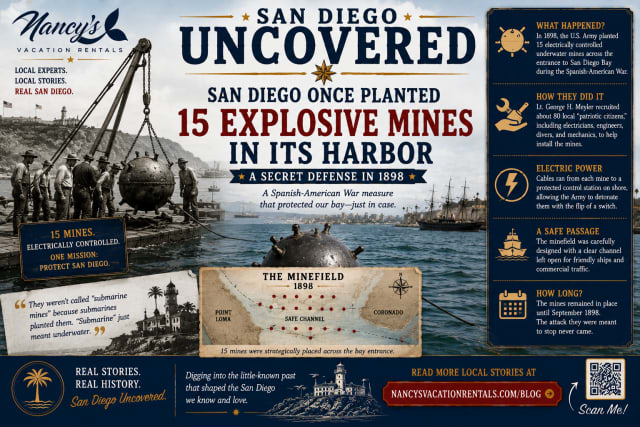
San Diego Once Planted 15 Explosive Mines in Its Harbor
During the Spanish-American War in 1898, the U.S. Army planted 15 electrically controlled explosive mines across the entrance to San Diego Bay. Here's the forgotten story of the harbor's underwater defenses.

What Happens to Your Airbnb Listing When You Change Property Managers?
Changing vacation rental managers? Learn what can happen to your Airbnb listing, reviews, reservations, photos, pricing, co-host access and guest communication during the transition.