
Why San Diego Became an Aviation Capital
From Glenn Curtiss and North Island to Ryan, Convair and wartime aircraft production, discover why San Diego became one of America's great aviation cities.

Greg Ross
CEO / Owner - Nancy's Vacation Rentals
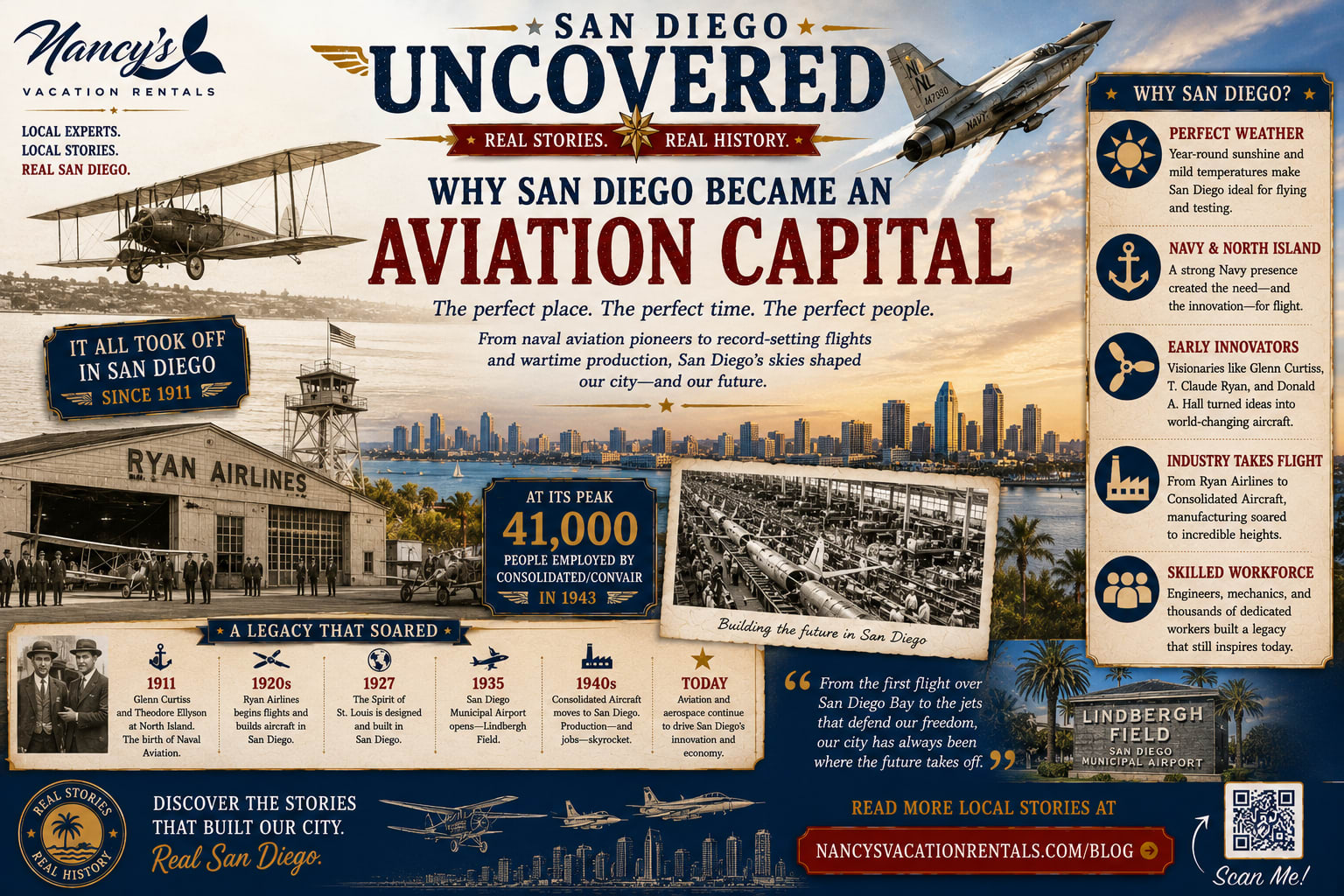
SAN DIEGO UNCOVERED
Why San Diego Became an Aviation CapitalSan Diego didn't become an aviation city because of one famous airplane.
It happened because several advantages collided in the same place: remarkably flyable weather, a protected bay, military investment, ambitious entrepreneurs and an aircraft-manufacturing industry that eventually employed tens of thousands of people.
Long before San Diego became known for biotech and telecommunications, it was helping invent the future of flight.
It Started With the Weather
Early aviation was extremely sensitive to weather. Aircraft were fragile, instruments primitive and training dangerous.
San Diego offered something enormously valuable: mild temperatures and conditions that allowed pilots and engineers to fly and test aircraft through much of the year.
That advantage attracted Glenn Curtiss, one of America's most important aviation pioneers, to North Island.
North Island Was Almost a Perfect Aviation Laboratory
In 1911, Curtiss established an aviation school on North Island. The location offered open ground, relatively isolated flying space and protected water where he could experiment with aircraft capable of operating from the sea.
North Island wasn't yet the intensely developed military installation people recognize today.
For aviation pioneers, that emptiness was an advantage.
The Navy Sent Its First Student
In January 1911, Navy officer Theodore Gordon Ellyson began training with Curtiss at North Island.
Ellyson would become Naval Aviator No. 1.
The relationship between Curtiss and the Navy helped transform aviation from a novelty into a potential military tool. On May 8, 1911, the Navy purchased its first aircraft, the Curtiss A-1 Triad.
San Diego Helped Prove Airplanes Belonged at Sea
The most consequential experiments weren't simply about teaching pilots to fly.
Curtiss was demonstrating that aircraft could operate with naval fleets.
In January 1911, Eugene Ely made the first successful airplane landing aboard a ship, the USS Pennsylvania. Days later at North Island, Curtiss demonstrated his hydroaeroplane. In February, he landed alongside the Pennsylvania in San Diego Bay and had the aircraft hoisted aboard by crane.
The aircraft carrier age was beginning to look possible.
That's Why San Diego Calls Itself the Birthplace of Naval Aviation
The phrase isn't simply civic marketing.
North Island became one of the critical places where naval aviation was tested, taught and developed.
A permanent naval air station was established there during World War I. During the interwar years, San Diego became deeply connected to America's emerging aircraft-carrier fleet.
The San Diego Air & Space Museum notes that at one point in the 1930s, every U.S. Navy aircraft carrier was home-ported at North Island.
Then Commercial Aviation Arrived
Military aviation provided infrastructure and expertise, but San Diego's aviation story soon moved into private business.
T. Claude Ryan came to San Diego in the early 1920s and started with a surplus military biplane.
In 1925, Ryan Airlines began scheduled passenger service between San Diego and Los Angeles—an extraordinarily early example of regular commercial air travel.
Ryan Started Building Airplanes on the Waterfront
Ryan's company moved beyond carrying passengers and began manufacturing aircraft.
Production expanded into an unused cannery on San Diego's waterfront.
That detail says a lot about early aviation: an industry that would eventually reshape the world was still small enough to grow inside converted industrial buildings.
Then San Diego Built the Spirit of St. Louis
In 1927, Charles Lindbergh needed an airplane capable of flying nonstop from New York to Paris.
A San Diego team led by engineer Donald Hall designed and built the Ryan NYP—the Spirit of St. Louis.
Lindbergh's successful Atlantic flight instantly connected San Diego with one of the most famous achievements in aviation history.
The city increasingly promoted itself as the “Air Capital of the West.”
San Diego Built an Airport for Its Aviation Future
In November 1927, voters approved a $650,000 bond issue for development of a municipal airport on waterfront tidelands.
The airport that emerged would eventually carry Lindbergh's name.
Its location near downtown remains one of San Diego's most unusual geographic features—and a visible reminder of how closely aviation became woven into the city itself.
Then Reuben Fleet Made a Decision That Changed San Diego
One of the most important moments came in the 1930s.
Reuben H. Fleet had founded Consolidated Aircraft in Buffalo, New York. San Diego's weather was far better suited to developing and testing aircraft, particularly seaplanes.
Fleet relocated Consolidated to San Diego in 1935.
He brought hundreds of engineering and management employees with him.
Convair Became an Industrial Giant
Consolidated—later Consolidated Vultee and ultimately Convair—became one of the defining companies in San Diego's twentieth-century economy.
It produced aircraft including the PBY Catalina and the B-24 Liberator.
During World War II, the company's San Diego employment reached approximately 41,000 people.
Aircraft manufacturing wasn't merely another local industry.
For many families, it was San Diego's economy.
World War II Transformed the City
San Diego's military and aviation industries expanded at breathtaking speed as the United States prepared for and entered World War II.
Historical research indicates that by 1939 roughly half of San Diegans employed in manufacturing worked in aircraft; by 1941, the share had risen to about two-thirds.
Workers poured into the region to build aircraft and support military operations.
The aviation boom helped reshape neighborhoods, housing, transportation and the city's population.
San Diego's Aviation Industry Created More Than Airplanes
A major aerospace company needs engineers, machinists, toolmakers, electronics specialists, suppliers and managers.
Those skills don't disappear when one aircraft program ends.
Convair alumni and the wider aerospace workforce helped seed later San Diego technology companies and engineering businesses.
In that sense, aviation helped create part of the technical talent base that later supported San Diego's broader high-tech economy.
Then Aircraft Led to Missiles and Spacecraft
The progression was almost natural.
A company that knew how to design sophisticated aircraft possessed many of the skills needed for rockets and missiles.
Convair developed the Atlas missile in San Diego during the Cold War.
Atlas technology later became part of America's space program, including the launch vehicle that carried John Glenn into orbit in 1962.
San Diego's aviation story had expanded beyond the atmosphere.
Why San Diego?
There was no single reason.
Climate made year-round flying and testing practical.
San Diego Bay created ideal conditions for early seaplane experimentation.
The Navy brought investment, pilots, aircraft and long-term demand.
Entrepreneurs such as Curtiss, Ryan and Fleet brought ideas and companies.
Manufacturing created a skilled workforce that attracted still more aerospace work.
Each advantage reinforced the others.
Success Created More Success
This may be the most important part of the story.
Once San Diego had experienced pilots, aircraft engineers, military facilities, suppliers and factories, it became easier for the next aviation company or program to succeed here.
What began as a geographic advantage became an industrial ecosystem.
San Diego wasn't simply lucky enough to attract aviation.
It developed the infrastructure and talent that made aviation keep coming back.
You Can Still See the Aviation City Today
North Island remains a major naval aviation installation. Aircraft still cross San Diego Bay constantly. San Diego International Airport sits unusually close to downtown. Aerospace history fills the San Diego Air & Space Museum in Balboa Park.
Even residents who rarely think about aviation live inside a city whose physical and economic development was profoundly shaped by it.
The Air Capital Never Completely Disappeared
San Diego's economy diversified. Many of the giant aircraft factories disappeared or changed ownership. Aerospace employment no longer dominates the city the way it did during World War II.
But the legacy remains.
The Navy, defense contractors, aerospace engineering, unmanned aircraft, satellite technology and advanced manufacturing all trace pieces of their local ecosystem back to the aviation industry that grew here more than a century ago.
San Diego Uncovered
San Diego Uncovered explores the inventions, industries, people and overlooked events behind America's Finest City.
San Diego's aviation story didn't begin with the Spirit of St. Louis, and it didn't end with Convair.
It began when a remarkable combination of geography, military strategy and ambitious people turned an isolated stretch of North Island into one of America's great laboratories of flight.
Explore San Diego With Nancy's
Nancy's Vacation Rentals has been helping guests experience San Diego for more than 25 years. We love sharing the stories behind the places and neighborhoods that make San Diego unlike anywhere else.
Browse Nancy's San Diego Vacation Rentals
Sources & Further Reading
- San Diego Air & Space Museum — Birthplace of Naval Aviation
- San Diego History Center — SD250
- San Diego History Center — Reuben H. Fleet
- San Diego History Center — The Rising Tide: Early Commercial Aviation
- San Diego History Center — The Rising Tide: Air Capital of the West
- San Diego History Center — When the Lone Eagle Returned to San Diego
Keep reading

What’s Happening in San Diego This Weekend: October 2–4, 2026
If you're spending the first weekend of October in San Diego, you picked a good one.

Are Hidden Vacation Rental Management Fees Eating Into Your Profits?
Vacation rental management fees go beyond the headline percentage. Learn which hidden or overlooked charges can reduce owner profit and how San Diego owners can compare true management costs.

Las Cuatro Milpas
The Barrio Logan Institution Worth Waiting in Line For