
Why San Diego's “Old Spanish Lighthouse” Wasn't Spanish
Point Loma's famous Old Spanish Lighthouse wasn't built by Spain. It was built by the United States in the 1850s. Discover how Spanish fort materials, local families and romantic storytelling helped create one of San Diego's most persistent historical nicknames.

Greg Ross
CEO / Owner - Nancy's Vacation Rentals
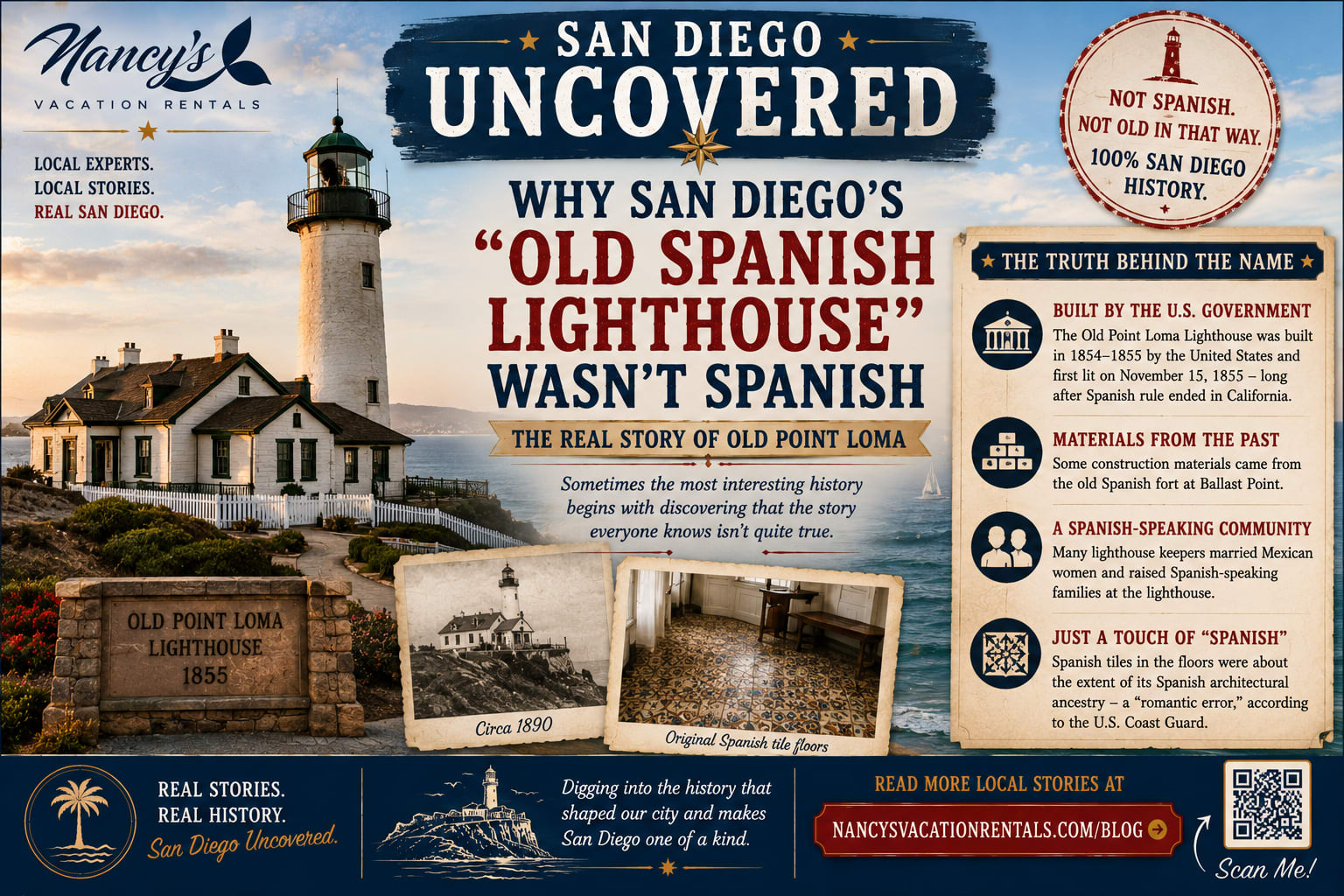
SAN DIEGO UNCOVERED
Why San Diego's “Old Spanish Lighthouse” Wasn't SpanishFor generations, people referred to the lighthouse high above Point Loma as the Old Spanish Lighthouse.
It's a wonderfully romantic name.
There's just one problem.
The lighthouse wasn't Spanish.
It wasn't built while Spain controlled California. It wasn't even built while Mexico controlled California.
The United States government built it after California became an American state.
So how did one of San Diego's most recognizable landmarks end up with a historical identity that wasn't actually true?
The Timeline Makes the Myth Impossible
California became part of the United States following the Mexican-American War and entered the Union in 1850.
Congress authorized a network of Pacific Coast lighthouses soon afterward, and the federal government selected Point Loma as the site for San Diego's light.
The Old Point Loma Lighthouse was completed in the 1850s and first illuminated on November 15, 1855.
By then, Spanish rule in California had ended more than three decades earlier.
It Was an American Federal Project
The United States Coast Survey helped select the site. Federal lighthouse authorities oversaw the project. Its third-order Fresnel lens came from France, and American lighthouse keepers operated the station.
The City of San Diego describes the landmark plainly: it was built in 1855 by the United States government after California's admission as a state.
Historically, there is very little ambiguity.
But There Really Is Some Spanish History Inside It
This is where the myth gets more interesting.
The lighthouse's Spanish association wasn't created entirely from thin air.
Historic National Park Service and Coast Guard accounts say construction reused material associated with the ruins of Fort Guijarros, the Spanish fortification that had stood at Ballast Point.
An older National Park Service brochure specifically notes that some tiles used in the lighthouse came from the old Spanish fort.
So while the lighthouse itself was American, pieces of San Diego's Spanish-era landscape appear to have been incorporated into it.
A Few Spanish Tiles Can Create a Great Story
Imagine visiting Point Loma decades later.
You see an old white lighthouse overlooking the harbor.
You hear that some of its building material came from a Spanish fort.
You know Spanish explorers sailed into San Diego Bay centuries earlier.
It doesn't take much for those separate facts to merge into a more romantic version of the story:
the old Spanish lighthouse.
The Lighthouse Families Added Another Layer
A 1957 National Park Service publication offered another explanation for the nickname.
It noted that several Point Loma lighthouse keepers married Mexican women and raised Spanish-speaking families there.
That cultural history was real.
But over time, the Spanish-speaking life associated with the lighthouse may have blurred into the mistaken idea that the structure itself dated from Spain's colonial period.
Even Official Sources Once Used the Nickname
The name became persistent enough to appear in historical writing and public descriptions.
Old photographs, books and local accounts sometimes refer to the structure as the “Spanish” lighthouse even while acknowledging its actual 1855 construction date.
That is how historical myths become durable: repetition makes a story feel familiar, and familiarity starts to feel like evidence.
There Was Even a Story About an Earlier Spanish Beacon
Coast Guard historical material records another piece of folklore: a story that Spain had operated a beacon on Point Loma as early as 1701.
The Coast Guard's own account says that claim was never verified.
It's a useful reminder that a story can circulate for decades without acquiring historical evidence simply because it sounds plausible.
San Diego Really Did Have a Spanish Fort Nearby
The confusion is understandable because Spain did maintain a military presence at the entrance to San Diego Bay.
Fort Guijarros was established at Ballast Point during the Spanish period to protect the harbor.
Its remains became part of Point Loma's historical landscape long before the American lighthouse appeared above it.
So the nickname mixed together two genuine chapters of history—the Spanish fort and the later American lighthouse—and turned them into one story.
Then Cabrillo Made the Spanish Connection Even Stronger
After the lighthouse was abandoned in 1891, Point Loma became increasingly associated with the commemoration of Juan Rodríguez Cabrillo's 1542 voyage.
Cabrillo sailed in the service of Spain and entered what is now San Diego Bay.
In 1913, President Woodrow Wilson established Cabrillo National Monument around the old lighthouse site.
Now visitors encountered an American lighthouse inside a monument dedicated to a sixteenth-century explorer sailing for Spain.
The ingredients for historical confusion were almost perfect.
The Romantic Version Was Better Marketing
“Old Point Loma Lighthouse” is accurate.
“Old Spanish Lighthouse” sounds like the beginning of an adventure novel.
San Diego has always marketed its climate, architecture and Spanish-colonial imagery to visitors. During the early twentieth century, romanticized versions of California's Spanish past became especially powerful tourism imagery.
A picturesque old lighthouse overlooking the Pacific fit naturally into that story—even if its construction date did not.
This Doesn't Make the Lighthouse Less Interesting
Correcting the nickname doesn't strip away the romance.
It actually reveals a richer story.
The lighthouse represents several layers of San Diego history at once:
Spanish military history at Ballast Point.
Mexican and Spanish-speaking families.
American westward expansion.
Nineteenth-century maritime technology.
And twentieth-century efforts to package California's past for tourists.
The Myth Tells Us Something About San Diego
Historical myths aren't always random mistakes.
Sometimes they reveal what later generations wanted a place to represent.
Calling the structure the Old Spanish Lighthouse connected San Diego to a deeper, more romantic past than “federal navigation project built in 1855.”
The nickname wasn't accurate.
But its popularity tells us something about how San Diego learned to tell its own story.
So What Should We Call It?
The historically accurate name is the Old Point Loma Lighthouse.
It guided ships from November 15, 1855 until March 23, 1891, when its light was moved closer to sea level because fog and low clouds too often obscured the hilltop beacon.
Today it remains one of the signature attractions at Cabrillo National Monument.
And if someone calls it the Old Spanish Lighthouse?
Now you know the much better story behind the mistake.
San Diego Uncovered
San Diego Uncovered explores the myths, lost places, strange decisions and forgotten stories behind America's Finest City.
Sometimes the most interesting history begins with discovering that the story everyone knows isn't quite true.
Explore San Diego With Nancy's
Nancy's Vacation Rentals has been helping guests experience San Diego for more than 25 years. We love sharing the stories behind the landmarks and neighborhoods that make the city unlike anywhere else.
Browse Nancy's San Diego Vacation Rentals
Sources & Further Reading
Keep reading

5 Red Flags Your Vacation Rental Management Company May Not Be Performing
Is your vacation rental manager really performing? Learn 15 warning signs San Diego vacation rental owners should watch for, from weak pricing and poor reviews to maintenance and communication problems

Convoy Street After Dark
The San Diego Food Neighborhood Tourists Miss

Missing for Nearly 3 Years
The Incredible San Diego Story of Colby Coming Home