A 200-Year-Old Ship Is Being Rebuilt in San Diego
With Bitcoin!

Greg Ross
CEO / Owner - Nancy's Vacation Rentals

San Diego Weird History | Nancy's Vacation Rentals
Only in San Diego could a story begin in 1825, involve sailors hauling cowhides on the beaches of Point Loma, inspire one of America's classic maritime books — and end 200 years later with an anonymous Bitcoin donor spending roughly $10 million to build a massive wooden sailing ship in Mission Bay.
Yes. You read that correctly.
A 149-foot replica of the historic brig Pilgrim is being built in San Diego — and the project is reportedly being funded with Bitcoin.
But to understand why anyone would spend millions recreating this particular ship, we need to go back to a San Diego that looked almost nothing like the city we know today.
Meet the Pilgrim
The original Pilgrim was a two-masted merchant brig built in 1825.
In 1834, it left Boston and began a voyage around Cape Horn to the coast of California.
California wasn't a U.S. state.
It was part of Mexico.
There was no Gold Rush.
No downtown San Diego skyline.
No Coronado Bridge.
No airport.
No Gaslamp Quarter as we know it today.
And aboard the Pilgrim was a 19-year-old Harvard student named Richard Henry Dana Jr.
Why Would a Harvard Student Become a Sailor?
Dana wasn't planning on becoming a professional sailor.
After suffering serious problems with his eyesight following an illness, he left Harvard temporarily and decided that life at sea might improve his health.
Instead of traveling as a wealthy passenger, Dana did something much more unusual for someone from his background.
He signed aboard the Pilgrim as an ordinary seaman.
That meant climbing rigging, handling sails, standing watches, loading cargo and enduring the extremely difficult life of a merchant sailor in the 1830s.
The experience would change his life.
Then the Pilgrim Arrived in San Diego
In 1835, the Pilgrim entered San Diego Bay.
The San Diego Dana encountered would be almost unrecognizable today.
Old Town was a tiny settlement.
Point Loma was largely undeveloped.
The waterfront wasn't lined with hotels, restaurants, marinas and high-rise buildings.
Instead, San Diego Bay was part of an international trading network built around something that sounds strange today:
Cowhides.
Before Tourism, San Diego Had the Hide Trade
California ranchos produced enormous numbers of cattle.
The hides became valuable export commodities that could be shipped around Cape Horn and transformed into leather goods in the eastern United States.
Ships traveled along the California coast collecting hides from ranchos and trading imported manufactured goods in return.
San Diego became an important location in that business because of its protected harbor and beaches.
Dana himself wrote that San Diego was exceptionally well suited for landing and loading hides because vessels could anchor close to a smooth beach protected from heavy surf.
Near what is now Point Loma's La Playa area, sailors processed, dried and stored thousands of hides before loading them aboard ships bound for the East Coast.
Imagine Point Loma in 1835
This is where the story becomes especially fun for anyone who knows modern San Diego.
Imagine standing near Point Loma today.
Remove the marinas.
Remove Shelter Island.
Remove the sportfishing boats.
Remove the waterfront restaurants.
Remove the skyline.
Now replace all of it with wooden sailing vessels anchored in the bay, sailors working along the beach and warehouses filled with cattle hides waiting to be shipped around Cape Horn.
That was part of the San Diego Richard Henry Dana experienced.
Dana Started Writing Everything Down
Dana kept detailed notes about his voyage.
He wrote about storms, ships, sailors, California settlements, the hide trade and the brutal conditions endured by ordinary seamen.
After returning to Massachusetts, those experiences became a book:
Two Years Before the Mast.
First published in the early 1840s, it became one of America's most famous accounts of life at sea.
For San Diego historians, the book is particularly valuable because Dana described Southern California years before the Gold Rush transformed the region.
His descriptions give us a rare glimpse of San Diego when it was still a tiny Mexican settlement connected to the outside world largely through ships like the Pilgrim.
San Diego Made Quite an Impression
Dana didn't simply document the work.
He noticed something about San Diego that generations of people would later discover for themselves.
The climate and the bay were extraordinary.
Long before developers began advertising San Diego as a paradise, Dana was already writing enthusiastically about its natural advantages.
In other words, people were talking about San Diego's weather long before weather apps existed.
So What Happened to the Original Pilgrim?
The original Pilgrim did not survive into modern times.
But the ship became permanently associated with Dana's book and California's maritime history.
Eventually, another Pilgrim would take its place.
Pilgrim II Brings the Story Back to Southern California
Decades later, a historic sailing vessel was transformed to represent Dana's famous Pilgrim.
Known as Pilgrim II, it became a familiar sight at Dana Point Harbor and served for decades as a floating educational exhibit.
Thousands of Southern California schoolchildren climbed aboard and experienced a small taste of what maritime life might have been like in Dana's era.
Then, in 2020, the story took a heartbreaking turn.
Pilgrim II sank at its dock.
The vessel had deteriorated significantly and ultimately had to be demolished.
For a while, it appeared that the physical connection to Dana's Pilgrim might be gone.
But apparently someone had another idea.
Enter Pilgrim III
Now an extraordinary new project is underway in Mission Bay.
A new vessel known as Pilgrim III is being constructed as a modern recreation inspired by the original 1825 brig.
And this isn't a small museum display.
The vessel is expected to measure approximately 149 feet long.
It is being constructed from substantial timbers and specialty woods, reportedly including African purpleheart.
When completed, the vessel is intended to serve as a floating classroom, continuing the educational mission associated with its predecessor.
And Someone Is Paying for It With Bitcoin
Here's the part Richard Henry Dana definitely didn't see coming.
The approximately $10 million project is reportedly being financed by an anonymous donor using Bitcoin.
Reports estimate the contribution at roughly 120 to 150 Bitcoin, although the dollar value naturally changes with cryptocurrency prices.
The donor's identity has not been publicly disclosed.
Ship designer Doug Sharp reportedly knows who the donor is — but isn't revealing the name.
Which gives us one of the strangest sentences we've ever written in San Diego Weird History:
An anonymous cryptocurrency benefactor is spending millions of dollars to recreate an 1825 sailing ship connected to a Harvard student who processed cowhides on the beaches of Point Loma nearly two centuries ago.
San Diego history can get weird.
From Cowhides to Cryptocurrency
Think about the economic history contained in this one ship.
In 1835, the Pilgrim came to San Diego because cattle hides were valuable international commodities.
Those hides were loaded aboard wooden ships and transported thousands of miles around Cape Horn.
Nearly two centuries later, a recreation of that ship is being financed using a digital asset that exists entirely electronically.
1835: Cowhides.
2026: Bitcoin.
Same ship.
Same city.
Very different economy.
Why Build Something Like This?
There's a larger reason the project matters.
San Diego is a maritime city.
Long before aerospace, biotech, tourism and modern military installations became major parts of the regional economy, San Diego's bay connected this small settlement to the rest of the world.
Ships carried people, news, manufactured goods and trade across enormous distances.
Recreating vessels such as the Pilgrim gives visitors something a photograph or museum display can't completely provide.
You can walk onto the deck.
Look up at the rigging.
See how little space sailors had.
And imagine crossing thousands of miles of open ocean without GPS, radar, satellite weather forecasts or an engine.
San Diego Already Has an Incredible Collection of Historic Ships
The new Pilgrim III also fits naturally into San Diego's larger maritime story.
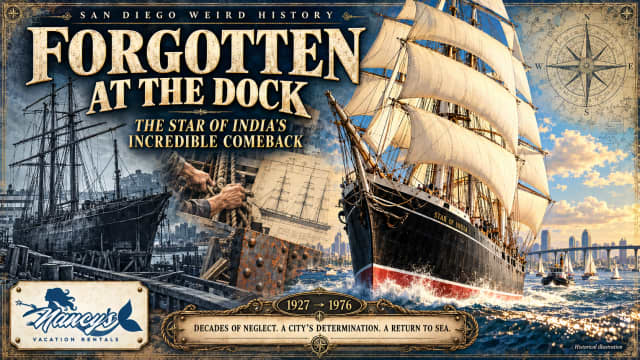
The region is already home to extraordinary historic and replica vessels, including ships such as the Star of India and the replica San Salvador.
Each represents a different chapter of the people and ships that shaped Southern California.
The Pilgrim III would add another chapter — the era of California's hide trade and the sailors who connected Mexican California with ports thousands of miles away.
The Best Part? It's Being Built Here
This isn't simply a historical ship being transported to San Diego after completion.
The project itself is taking shape in Mission Bay.
That means San Diego is not only preserving maritime history.
It's actively rebuilding it.
Timber by timber.
Two hundred years after the original Pilgrim was launched.
A 200-Year Journey Back to San Diego
The timeline is almost unbelievable:
1825: The original Pilgrim is built.
1834: Nineteen-year-old Richard Henry Dana Jr. leaves Boston aboard the ship.
1835: Dana and the Pilgrim reach San Diego during California's hide-trade era.
1840s: Dana's Two Years Before the Mast introduces generations of readers to life aboard merchant ships and early California.
Decades later: A second Pilgrim becomes a Southern California maritime landmark and educational vessel.
2020: Pilgrim II sinks at Dana Point Harbor and is demolished.
2026: Construction of Pilgrim III is underway in Mission Bay, backed by an anonymous Bitcoin benefactor.
From wooden sailing ships...
To cowhides...
To one of America's classic books...
To a sunken replica...
To cryptocurrency.
And somehow the story keeps coming back to San Diego.
San Diego Weird History
San Diego's history isn't confined to museums.
Sometimes it's underneath our neighborhoods.
Sometimes it's hidden along our beaches.
And sometimes it's being rebuilt from massive pieces of timber right here in Mission Bay.
Follow Nancy's Vacation Rentals as we uncover the strange, surprising and often forgotten stories that made San Diego what it is today.
Real places. True stories. A more curious San Diego.
Nancy's Vacation Rentals — Changing the way you vacation.