
Is Your Vacation Rental Manager Actually Maximizing Revenue?
earn how to tell whether your San Diego vacation rental manager is truly maximizing revenue—or simply keeping the calendar busy. Discover the metrics, questions and warning signs owners should watch.
Greg Ross
CEO / Owner - Nancy's Vacation Rentals
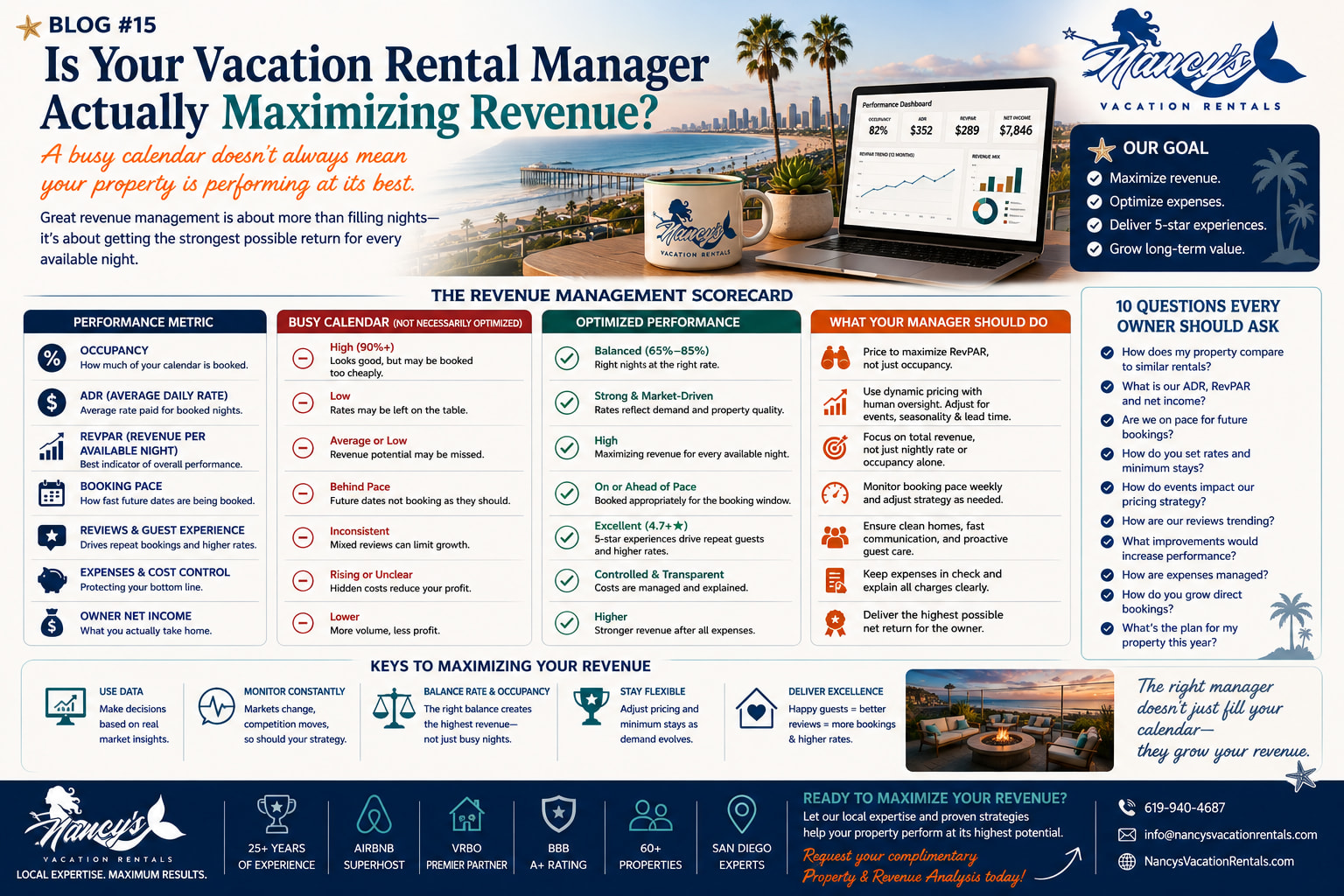
Your vacation rental calendar looks busy.
Reservations are coming in.
Guests are staying.
Owner statements arrive every month.
Everything appears to be working.
But there is a much more important question:
Is your vacation rental manager actually maximizing the financial performance of your property?
Those are not the same thing.
A manager can keep a property occupied without maximizing revenue.
They can generate impressive gross revenue while allowing unnecessary expenses to erode owner returns.
They can use sophisticated pricing software without actively managing pricing.
And they can report good-looking numbers without showing whether the property is outperforming—or underperforming—its real competitive set.
After more than 25 years managing vacation rentals in San Diego, we've learned that strong revenue management requires much more than filling nights.
The goal should be to produce the strongest reasonable owner return while protecting the property and delivering a guest experience that supports future performance.
So how can an owner tell whether that's actually happening?
Start With the Right Question
Many owners ask their manager:
"What is my occupancy?"
That's useful.
But a better question is:
"Are we generating the strongest reasonable revenue and net return from the available demand?"
Occupancy is only one part of the answer.
A Full Calendar Is Not Proof of Great Revenue Management
This is one of the most important concepts for owners to understand.
Imagine two similar vacation rentals.
Property A
- 95% occupancy
- $275 average nightly rate
Assuming 30 available nights:
28.5 booked nights × $275 = approximately $7,838
Property B
- 80% occupancy
- $350 average nightly rate
Assuming 30 available nights:
24 booked nights × $350 = $8,400
Property B has significantly lower occupancy.
Yet it produces more rental revenue.
This is why a manager who constantly advertises high occupancy may not necessarily be maximizing owner income.
The Opposite Is Also True
A high nightly rate doesn't automatically indicate success either.
Suppose a property boasts a $600 ADR but only books ten nights per month.
Another comparable property averages $425 but books twenty-two nights.
The lower-rate property may produce substantially more revenue.
Strong revenue management balances rate and occupancy.
Metric #1: Gross Rental Revenue
Gross rental revenue is an obvious starting point.
How much rental income did the property produce?
Compare:
- This year versus last year
- This month versus the same month last year
- Actual results versus budget or forecast
- Your property versus true comparable rentals
But be careful.
Gross revenue by itself still doesn't tell the whole story.
Market Conditions Matter
Suppose revenue declines 5%.
That sounds disappointing.
But what if comparable properties declined 15%?
Your property may actually be gaining market share.
Conversely, imagine your revenue increases 5% while the comparable market improves 20%.
Your numbers are technically higher—but your property may be underperforming the opportunity.
This is why managers should provide context, not simply totals.
Metric #2: Occupancy
Occupancy measures how much of the available calendar is sold.
It helps answer:
- Is the property attracting demand?
- Are rates too high?
- Are restrictions blocking reservations?
- Are competitors booking more quickly?
But occupancy should never be viewed alone.
Metric #3: ADR
ADR stands for Average Daily Rate.
It measures the average rate actually earned on booked nights.
A good manager should understand whether your ADR is:
- Increasing
- Declining
- Above relevant competitors
- Below relevant competitors
- Appropriate for the property's quality and positioning
The objective isn't simply to charge more.
It's to capture the highest appropriate rate without destroying booking conversion.
Metric #4: RevPAR
RevPAR means Revenue Per Available Rental Night.
It combines both occupancy and ADR.
The formula is:
Room Revenue ÷ Available Nights = RevPAR
or:
ADR × Occupancy = RevPAR
This is often one of the most useful metrics for evaluating whether a property is efficiently monetizing its available calendar.
Metric #5: Booking Pace
This is where stronger revenue management begins to separate itself from basic property management.
Booking pace asks:
How quickly is future inventory being sold?
Imagine your July calendar is 50% booked.
Is that good?
You can't answer without knowing:
- How far away July is
- Where you were at the same point last year
- How comparable properties are pacing
- How quickly new reservations are arriving
A Manager Should Know Whether You Are Ahead or Behind Pace
Suppose your property normally reaches 60% occupancy 45 days before arrival.
This year you're only 35% occupied at the same checkpoint.
That deserves investigation.
But if the entire market is booking later than last year, it may not require immediate panic discounting.
The manager should be able to explain what the data means.
Metric #6: Booking Lead Time
Booking lead time measures how far in advance guests make reservations.
This matters because an empty calendar can look alarming when it is actually normal.
If your typical guest books 18 days before arrival, empty dates 50 days away may not be concerning.
A manager who discounts those nights simply because they remain open could be giving away revenue unnecessarily.
Metric #7: Average Length of Stay
Length of stay affects much more than occupancy.
It can influence:
- Cleaning frequency
- Operational cost
- Calendar fragmentation
- Guest communication workload
- Maintenance exposure
Two properties can generate the same gross revenue with very different operational efficiency.
That matters to owner profitability.
Metric #8: Owner Net Income
This should ultimately matter most.
Owners don't deposit occupancy percentages.
They don't deposit ADR.
They don't deposit RevPAR.
They deposit the money that remains after expenses.
A simplified calculation is:
Gross Rental Revenue
– Management Fees
– Operating Expenses
– Maintenance
– Supplies
– Other Property Costs
= Owner Net Income
A strong manager should care about this result—not just top-line revenue.
Revenue Growth Can Be Meaningless If Expenses Grow Faster
Suppose your manager increases gross revenue by $10,000.
Great.
But what if additional expenses, markups and maintenance costs increase by $15,000?
Your property produced more revenue but less owner income.
That isn't necessarily better performance.
Look Beyond the Management Percentage
Owners often compare managers based on fees.
Consider this hypothetical example.
Manager A
- 15% management fee
- $80,000 annual rental revenue
Management fee:
$12,000
Revenue after management fee:
$68,000
Manager B
- 25% management fee
- $105,000 annual rental revenue
Management fee:
$26,250
Revenue after management fee:
$78,750
In this simplified hypothetical example, the manager charging the higher percentage still leaves the owner with:
$10,750 more.
Of course, a higher fee does not guarantee better performance.
The point is that management percentage alone isn't the right scorecard.
Ask How Pricing Decisions Are Actually Made
Almost every modern vacation rental manager will tell you they use dynamic pricing.
That's no longer enough.
Ask:
- Which software do you use?
- Who reviews the recommendations?
- How often?
- When do you override the software?
- How are comparable properties selected?
- How are local events considered?
If the answer is simply:
"The software handles it."
That should lead to more questions.
Software Is a Tool, Not a Revenue Strategy
Pricing technology can process enormous amounts of data.
It can help monitor:
- Market rates
- Demand
- Booking pace
- Lead time
- Seasonality
- Competitor inventory
But software doesn't always fully understand the difference between:
- Oceanfront and partial view
- Remodeled and dated
- Premium floor and ground floor
- Excellent parking and difficult parking
- Exceptional reviews and average reviews
Human oversight still matters.
Ask How Your Comparable Properties Are Selected
This is critical.
A manager can make almost any performance number look good by choosing weak comparisons.
For San Diego vacation rentals, good comps should consider factors such as:
- Neighborhood
- Distance to the beach
- Oceanfront or bayfront location
- View
- Bedroom count
- Sleeping capacity
- Parking
- Air conditioning
- Remodel quality
- Amenities
- Review strength
Two properties in the same ZIP code may not truly compete with one another.
Your Manager Should Understand Your Property's Competitive Advantages
Ask your manager:
"Why should a guest choose my property instead of the five most similar alternatives?"
They should have an answer.
Maybe it's:
- Better view
- Better parking
- Better interior
- Better location
- More amenities
- Stronger reviews
- Superior guest experience
If they can't articulate the property's advantage, it becomes harder to price that advantage.
Minimum Stays Are Part of Revenue Management
A manager focused only on nightly rates can miss substantial opportunity.
Imagine:
Reservation → 3-night gap → Reservation
Your standard minimum stay is four nights.
Those three nights may be impossible to book.
A revenue-focused manager should identify and adjust these calendar gaps when appropriate.
Ask Whether Minimum Stays Change Dynamically
Minimum stays may need to change based on:
- Season
- Booking window
- Existing reservations
- Calendar gaps
- Events
- Demand
A fixed three-night or seven-night rule for the entire year is simple.
But simple doesn't necessarily mean optimal.
Events Should Be Actively Managed
San Diego has major events throughout the year.
A good revenue manager should know which events meaningfully affect your property.
They should monitor:
- Booking pace
- Hotel compression
- Competitive availability
- Demand spikes
- Minimum stays
If your property books a major event weekend months ahead at a normal rate, your manager should be able to explain why.
Watch Whether Your Manager Discounts Too Quickly
This is a very common hidden revenue problem.
A future date looks empty.
The manager reduces pricing.
The night books.
Everyone celebrates.
But if that guest would have paid more two weeks later, the discount destroyed revenue rather than creating it.
Ask What Triggers a Discount
A thoughtful answer might include:
- Booking pace
- Lead time
- Competitor inventory
- Market demand
- Calendar gaps
- Seasonality
A weak answer is:
"We discount everything 20% seven days out."
There may be times when a last-minute rate should actually rise because remaining inventory has become scarce.
Ask How Often the Listing Is Reviewed
Revenue performance isn't only about price.
Your Airbnb and Vrbo listings need to convert guests.
A strong manager should periodically evaluate:
- Photography
- Listing title
- Description
- Amenities
- Sleeping arrangements
- Parking information
- Photo order
- Guest feedback
Photography Can Be a Revenue Issue
Suppose your property is priced correctly but guests repeatedly choose the competitor next door.
Maybe the competitor's images are brighter.
Maybe their ocean view is the first photo.
Maybe your strongest feature is buried.
A revenue-focused manager should recognize that pricing isn't always the answer.
Reviews Are a Revenue Metric Too
Reviews influence guest confidence.
Strong reviews can potentially support:
- Better conversion
- Higher rates
- More bookings
- Repeat business
A declining review score can therefore become a revenue-management problem.
Ask Whether Your Manager Tracks Review Trends
Don't only look at the overall score.
Watch recent feedback about:
- Cleanliness
- Maintenance
- Communication
- Accuracy
- Check-in
- Value
Recurring complaints should trigger operational action.
Maintenance Can Protect—or Destroy—Revenue
A broken air conditioner isn't simply a repair.
It can become:
Repair → guest complaint → refund → negative review → weaker conversion → lost future revenue.
Strong property management and strong revenue management are connected.
Ask How Quickly Maintenance Issues Are Resolved
Owners should understand:
- Who responds after hours?
- Are local technicians available?
- Are small issues caught during inspections?
- How are repairs documented?
- What are the labor rates and markups?
Preventive maintenance can often be cheaper than revenue recovery after a poor guest experience.
Cleaning Quality Has a Direct Financial Impact
Cleanliness is consistently one of the most important parts of the vacation rental guest experience.
A beautiful property with poor cleaning will struggle.
If cleaning complaints are appearing repeatedly, your manager should not simply apologize to guests.
The process needs to be fixed.
Ask How Guest Complaints Are Used
Complaints shouldn't only be handled individually.
They should become data.
For example:
If multiple guests mention:
- Uncomfortable beds
- Slow Wi-Fi
- Missing kitchen items
- Difficult smart locks
those patterns can reveal opportunities to improve both guest satisfaction and future revenue.
Distribution Matters
A strong manager should think about where bookings come from.
Depending on the property, distribution may include:
- Airbnb
- Vrbo
- Direct bookings
- Repeat guests
- Other appropriate channels
Relying too heavily on one channel creates risk.
Ask About Direct Bookings
Direct bookings can potentially offer benefits such as:
- Lower channel costs
- Greater guest relationship ownership
- More repeat business
But direct-booking strategy requires marketing and infrastructure.
It isn't enough to simply have a website.
Your Manager Should Be Able to Explain Why Revenue Changed
This is perhaps the easiest test.
Ask:
"Why did my revenue change this year?"
A good answer might discuss:
- Market demand
- New supply
- ADR
- Occupancy
- Booking lead time
- Events
- Review trends
- Property upgrades
- Competitive changes
A weak answer is:
"The market was just slower."
Maybe it was.
But owners deserve to understand the details.
Transparency Is a Performance Metric
Strong managers should be willing to show owners what is happening.
You should understand:
- Revenue
- Fees
- Expenses
- Adjustments
- Maintenance
- Booking performance
If reports are confusing or numbers constantly require explanation, that creates unnecessary uncertainty.
Warning Sign #1: Your Manager Only Talks About Occupancy
If every performance conversation begins and ends with:
"You're 90% occupied."
ask about:
- ADR
- RevPAR
- Net income
- Competitive performance
Warning Sign #2: Pricing Is Completely Automated
Dynamic pricing is valuable.
Completely unsupervised pricing can be risky.
Someone should understand why the system is making major changes.
Warning Sign #3: They Can't Show Relevant Comparables
If your manager can't explain what properties your rental competes with, it becomes difficult to determine whether you're actually outperforming.
Warning Sign #4: Every Empty Night Gets Discounted
Discounting should be strategic.
It should not be an automatic reaction to vacancy.
Warning Sign #5: Every Property Uses the Same Strategy
A one-bedroom oceanfront condo should not necessarily be managed like a five-bedroom beach house.
Different properties attract different guests and booking behaviors.
Warning Sign #6: Nobody Can Explain Your Booking Pace
Your manager should know whether future dates are booking:
- Faster than expected
- Slower than expected
- Approximately on pace
Warning Sign #7: Listing Updates Are Rare
Listings should evolve as:
- Properties improve
- Amenities change
- Competition changes
- Guest feedback provides insight
Warning Sign #8: Expenses Are Increasing Faster Than Revenue
Top-line growth is not enough.
Owners should understand what is happening with net return.
Warning Sign #9: Problems Repeat
If guests repeatedly complain about the same issue, the system isn't learning.
That eventually affects reviews and revenue.
Warning Sign #10: Your Manager Can't Explain Their Strategy
This might be the most important one.
A professional manager should be able to explain:
What they're doing, why they're doing it and what result they're trying to achieve.
Ten Questions Every Owner Should Ask
Try asking your vacation rental manager:
- How does my revenue compare with similar properties?
- How does my ADR compare?
- What is my RevPAR?
- Am I booking faster or slower than last year?
- What is my normal booking lead time?
- How do you manage minimum stays and calendar gaps?
- How frequently is my pricing reviewed by a person?
- What major events are affecting my future rates?
- What improvements would increase my property's performance?
- How is my owner net income trending?
The answers will tell you a lot.
What Great Revenue Management Should Look Like
We believe strong vacation rental revenue management should combine:
- Dynamic pricing technology
- Human oversight
- Property-specific knowledge
- Competitive analysis
- Booking-pace monitoring
- Flexible minimum stays
- Event awareness
- Listing optimization
- Review monitoring
- Operational excellence
No single tool or metric can replace the entire system.
The Manager Should Be Optimizing the Property, Not Just Managing Reservations
This is the difference between basic management and performance management.
A reservation manager asks:
"Did we get a booking?"
A revenue-focused manager asks:
"Was this the right reservation, at the right rate, for the right dates, given the market opportunity?"
That's a much more valuable question.
The Bottom Line
The fact that your vacation rental is receiving reservations does not automatically mean it is maximizing revenue.
True performance requires balancing:
- Occupancy
- ADR
- RevPAR
- Booking pace
- Lead time
- Length of stay
- Operating expenses
- Guest experience
- Owner net income
Your property manager should be able to explain how all of those pieces work together.
And when performance changes, you should understand why.
The goal isn't simply to keep the calendar full.
The goal is to make every available night work as hard as reasonably possible for the property owner.
Frequently Asked Questions
How do I know if my vacation rental manager is doing a good job?
Evaluate more than occupancy. Look at gross revenue, ADR, RevPAR, booking pace, competitive performance, review trends, expenses and owner net income. Your manager should also be able to clearly explain the strategy behind the results.
What metrics should a vacation rental manager track?
Important metrics can include occupancy, ADR, RevPAR, booking lead time, booking pace, average length of stay, gross rental revenue, future occupancy and owner net income.
Should my vacation rental manager use dynamic pricing?
Dynamic pricing can be extremely useful, but software should be properly configured and monitored. Experienced human oversight can help interpret property-specific factors and local demand that algorithms may not fully capture.
Is high occupancy proof that my Airbnb is performing well?
No. Very high occupancy can sometimes indicate rates are too low. Owners should evaluate occupancy together with ADR, RevPAR and overall revenue.
How often should vacation rental prices be reviewed?
Pricing should respond to changing demand, booking pace, events, competitor availability and booking lead time. In an active market, reviewing performance frequently is generally more effective than setting rates once and leaving them unchanged.
Should I switch vacation rental managers if revenue declines?
Not automatically. First determine whether the decline is property-specific or market-wide and ask your manager to explain the factors behind the change. If the manager cannot provide a credible strategy or performance analysis, a second opinion may be worthwhile.
Wondering Whether Your Vacation Rental Is Really Reaching Its Potential?
A busy calendar doesn't necessarily mean your property is maximizing revenue.
Nancy's Vacation Rentals can provide a second opinion on your property's pricing, occupancy, ADR, RevPAR, booking pace, minimum stays, listing presentation and competitive position.
With more than 25 years of San Diego vacation rental experience, we combine technology, market data, local expertise and hands-on revenue management to help owners understand what their properties should realistically be capable of producing.
Contact Nancy's Vacation Rentals to request a complimentary property and revenue performance analysis.
Nancy's Vacation Rentals
619-940-4687
info@NancysVacationRentals.com
www.NancysVacationRentals.com
Keep reading

San Diego Just Landed a Nearly 500-Pound Tuna
In the City Once Known as the Tuna Capital of the World

How Mission Beach Became San Diego's Seaside Playground
Mission Beach wasn't simply discovered as a beach destination. In the 1920s, John D. Spreckels combined real estate, streetcars, a massive amusement center, swimming pool and oceanfront recreation to create one.

Why 100% Occupancy Could Be Costing Your Vacation Rental Money
A fully booked calendar may look like success, but 100% occupancy can sometimes mean your vacation rental is priced too low. Learn how San Diego owners should balance occupancy, ADR and revenue.