The Decade Behind La Jolla’s Children’s Pool

Greg Ross
CEO / OWNER - Nancy's Vacation Rentals
San Diego Weird History
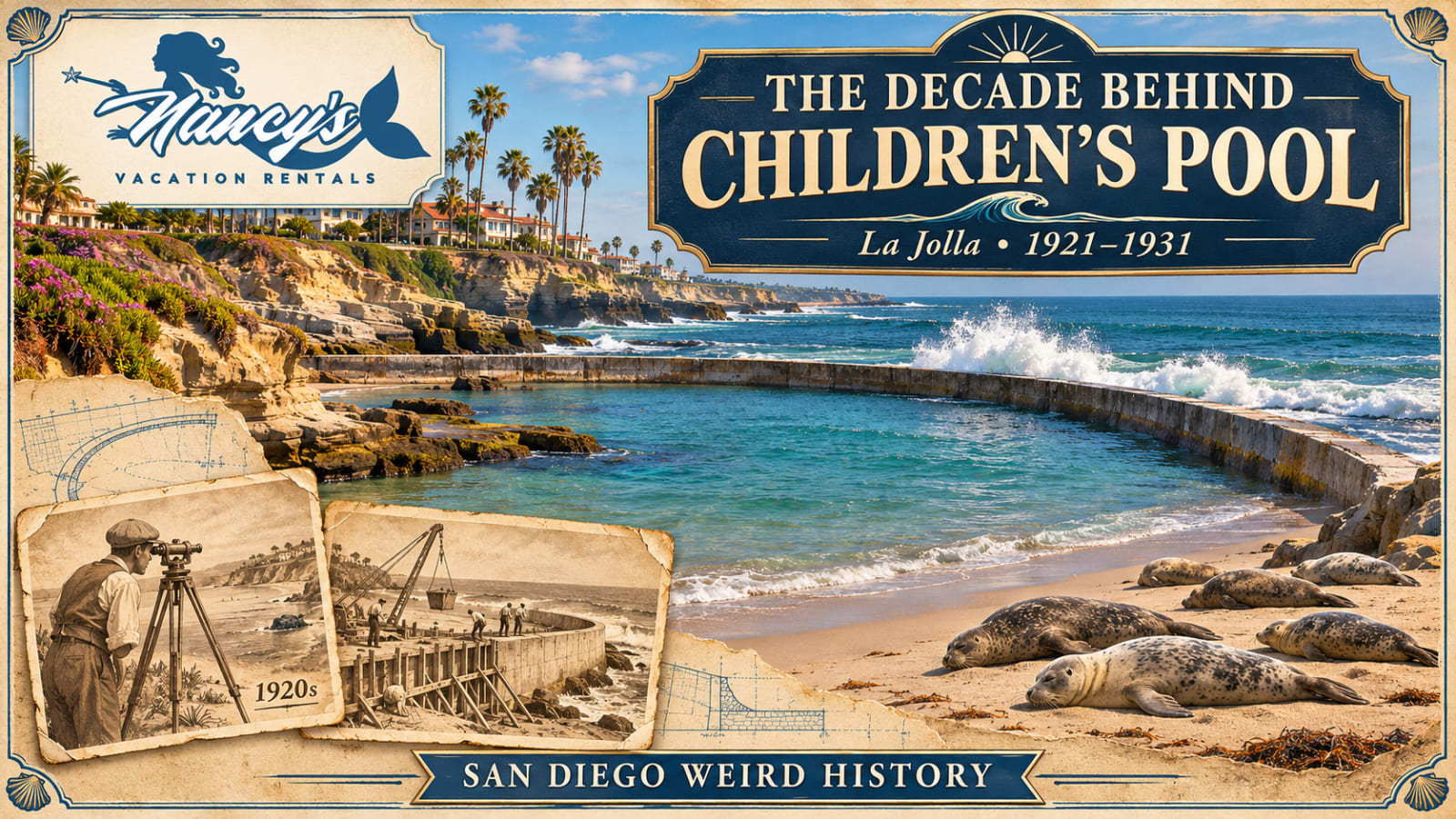
The Decade Behind La Jolla’s Children’s PoolStand above Children’s Pool in La Jolla and the curved seawall seems almost inevitable. It follows the shoreline, holds back part of the Pacific’s force and frames one of San Diego’s most recognizable coastal scenes.
But it was a deliberate intervention in a difficult place. Before the concrete, there was a problem: how could children enjoy the ocean along a coast where currents could make swimming dangerous?
The answer involved a philanthropist, an engineer, an architect and years of planning. The project that became Children’s Pool took roughly a decade from its earliest surveys to completion. That does not mean workers spent ten uninterrupted years pouring concrete. The distinction makes the story more revealing.
Ellen Browning Scripps Wanted a Safer Place to Swim
In 1921, Ellen Browning Scripps engaged hydraulic engineer Hiram Newton Savage to investigate a protected bathing place. La Jolla Historical Society’s account connects the project to a beach already known as “the pool,” near her home.
The setting offered a useful starting point: a curved natural reef. Rather than inventing an entirely new shoreline shape, the proposed barrier could work with a feature that was already there.
That is an important detail when looking at the site today. Its sheltered appearance can make the place seem wholly natural. The familiar view combines the existing coast with a substantial piece of designed infrastructure.
A Gift Still Needed Engineering and Permission
Scripps could fund an ambitious idea, but funding did not eliminate the work of deciding how it should function or obtaining approval.
The Historical Society describes a lengthy permitting process involving local, city and state authorities. Its construction-photo record dates state permission for the breakwater and associated work to September 1930.
Architect William Templeton Johnson also contributed to the project. The Cultural Landscape Foundation describes the resulting design as an arcing concrete breakwater approximately 300 feet long, with steps along the inside to offer swimmers places to rest.
Those features reveal how closely the design was tied to its intended users. It was not simply a wall placed offshore. Its shape and access features were part of a planned bathing landscape.
The Ocean Was Also Part of the Construction Schedule
Jeremy Hollins’s study in the Journal of San Diego History reconstructs the project using historical records. Its construction account describes crews working around tides, difficult drilling and rough seas.
Some work required low-water conditions. Swells damaged freshly placed material and forms, forcing repairs and changes to the schedule. Working at the edge of the Pacific meant the contractor could not control the site in the way a builder on dry land might hope to.
It is easy to appreciate the finished curve without considering that process. Every section had to become a lasting structure in a place where water was already moving through the work area.
The historical achievement becomes clearer when you look beyond the view and consider the construction setting.
What the Ten-Year Timeline Actually Means
The project began with surveys in 1921 and reached completion in 1931. Hollins describes the full sequence as taking ten years, encompassing the early investigations, design and eventual construction.
Calling it a ten-year project is reasonable. Calling it ten years of continuous building would create the wrong picture.
The difference also changes what is interesting about the story. This was a long effort to turn a public-minded idea into a workable coastal structure. The finished seawall represents decisions and approvals as well as labor and materials.
A Familiar Landmark With a Changing Setting
The Cultural Landscape Foundation identifies the site’s transfer to the City in 1931. Its description also traces later additions, including a replacement lifeguard station and an adjoining observation plaza.
That broader setting helps explain why a visit today is not an exact recreation of the original bathing experience. Public places accumulate new structures, uses and expectations over time.
The City’s current visitor information adds another physical change: sand has filled much of the area inside the wall. The original intention was a fully protected swimming area, while the beach visitors encounter now reflects decades of coastal change.
The name survived even as the setting evolved.
Why People Now Come to Watch Seals
Today, Children’s Pool is also a well-known viewing area for harbor seals. The City says seals rest on the beach year-round and closes the beach to public access during pupping season, December 15 through May 15 annually.
The original engineering story and the modern wildlife experience belong to the same place, but they answer different questions. One explains why the barrier was built. The other helps visitors understand how to behave there now.
Observe from permitted public areas, respect barriers and avoid disturbing the animals. NOAA advises keeping distance, never feeding marine mammals and avoiding attempts to touch, swim with or provoke them.
Look at the Wall Before Moving On
For a visit, start with the City’s current Children’s Pool information. Check local signs and conditions, and do not assume the historic purpose makes this a suitable place for a child to swim today.
You can appreciate the project without going onto the sand. Look at the curve, the relationship between the wall and reef, and the access arrangements above the beach. The landscape tells a more complicated story than its name suggests.
If you are planning a broader beach outing, our La Jolla Shores and La Jolla Cove guide explains the differences between those nearby destinations.
Nancy’s Vacation Rentals has helped guests explore San Diego for more than 25 years. We love the stories that make a familiar coastal stop worth another look. Explore Nancy’s San Diego vacation rentals and leave time to discover the ideas behind the landmarks.
Sources and Further Reading
- Jeremy Hollins, Journal of San Diego History: The Design and Construction of La Jolla’s Children’s Pool
- La Jolla Historical Society: Seawall construction photograph and historical account
- The Cultural Landscape Foundation: Children’s Pool
- City of San Diego: Children’s Pool
- NOAA Fisheries: Marine life viewing guidelines