When Edison, Ford, and Theodore Roosevelt Came to Balboa Park
San Diego’s 1915 exposition had a guest list that could still turn heads today.

Greg Ross
CEO / Owner - Nancy's Vacation Rentals
San Diego’s 1915 exposition had a guest list that could still turn heads today.
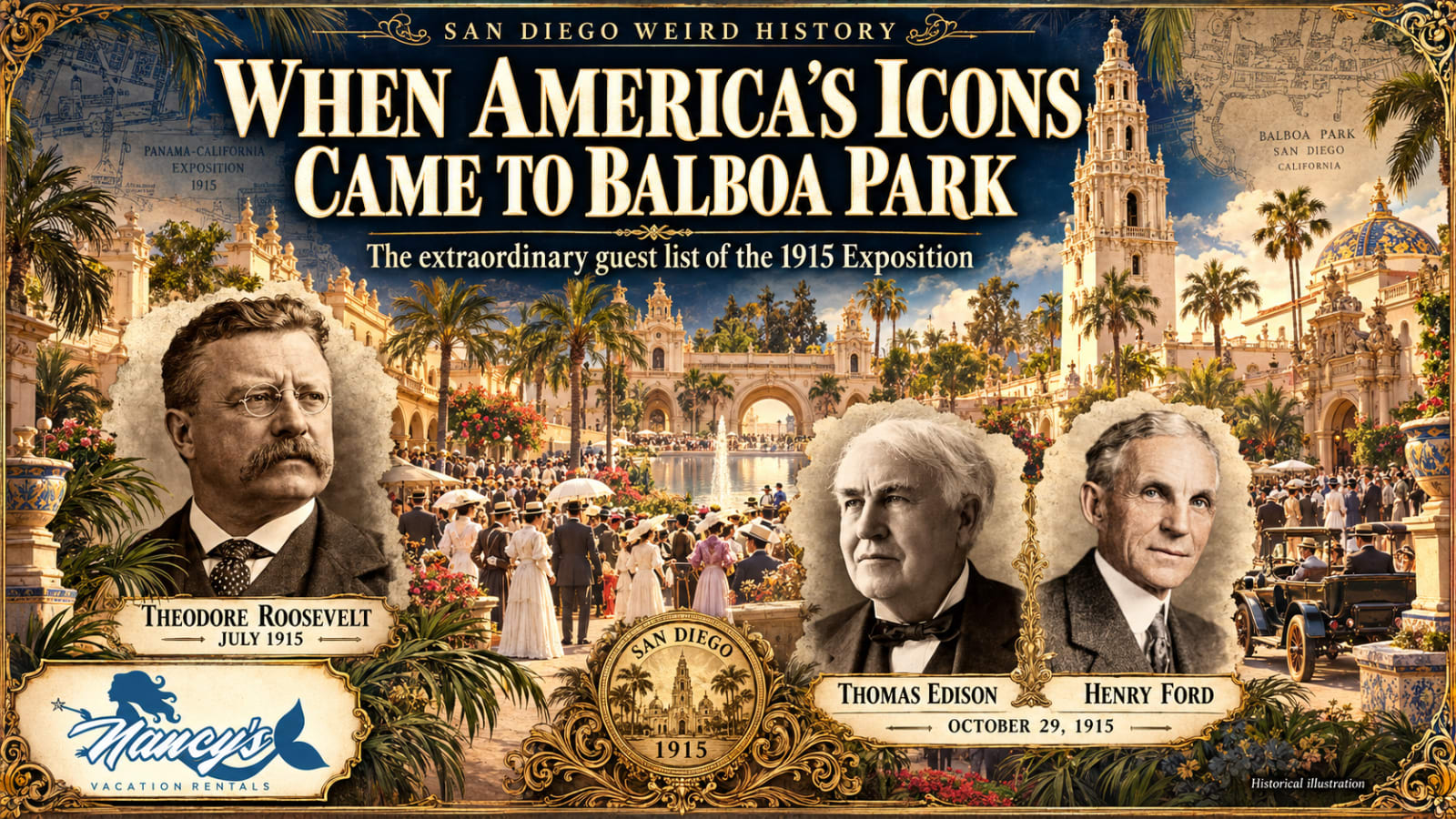
Imagine taking your child to Balboa Park and finding thousands of schoolchildren waiting to greet Thomas Edison. Henry Ford is arriving with him. A few months earlier, Theodore Roosevelt had been touring the same exposition grounds.
It sounds like someone assembled a history textbook’s most recognizable names and sent them on a San Diego vacation.
But these visits happened. In 1915, San Diego’s Panama-California Exposition attracted the former president, the inventor, and the automobile manufacturer during a year when the city was trying to capture the country’s attention.
The surprising part is what their visits reveal. Behind the celebrity welcome were questions about war, technology, preservation, and the kind of city San Diego hoped to become.
A fair designed to make people look south
The exposition was an opportunity to present San Diego as a destination worth noticing. Its setting did much of the persuasion: gardens, plazas, exhibition buildings, and an architectural landscape that invited visitors to linger.
The City of San Diego credits the 1915–16 exposition with the construction of the Cabrillo Bridge, the Spreckels Organ Pavilion, and much of the cultural center along El Prado. Architect Bertram Goodhue helped shape its Spanish Colonial architectural character.
For someone arriving today, these places can feel inseparable from the park. In 1915, they were part of a new public spectacle. The familiar postcard view was still a bold introduction.
That distinction helps explain why the guest list mattered. The city had built something ambitious. Famous visitors could help make the rest of the country pay attention.
Roosevelt arrived with more than a handshake
Theodore Roosevelt visited in July 1915, several years after leaving the presidency. Contemporary newspaper accounts preserved by the San Diego History Center describe his enthusiasm for the grounds, gardens, architecture, and exhibits.
He was interested in more than a ceremonial appearance. Reports describe a tour through the California Building and other exhibition spaces, with Roosevelt asking questions and drawing his wife’s attention to things he admired.
His response also touched a question that would outlast the fair: should San Diego keep what it had built?
Roosevelt encouraged the preservation of the exposition’s attractions and recognized their potential to bring people back. It was an endorsement of the idea that a temporary event could become a lasting cultural asset.
That does not mean one visitor single-handedly saved Balboa Park. Preservation required local decisions and continued effort. His remarks show that the future value of the place was already being debated while the fair was still operating.
October brought an inventor and an industrialist
On October 29, 1915, Thomas Edison and Henry Ford visited the exposition together. Historian Richard Amero’s account, published by the San Diego History Center, describes approximately 12,000 schoolchildren greeting Edison with flowers in the Plaza de Panama.
Consider how different that welcome feels from a modern celebrity appearance. Edison’s public identity was bound up with invention. Ford’s was linked to manufacturing and the automobile. Their presence made technology and industry feel personal to a crowd that could see the men behind the famous names.
Yet they were not interchangeable symbols of progress. Amero’s account highlights their opposing positions on military preparedness: Edison supported it, while Ford opposed it.
With war underway in Europe, even an exposition visit could become a setting for arguments about the future. The guest list brought national debates into San Diego’s plazas along with the flowers and publicity.
Their San Diego stop was part of a bigger road story
Ford’s own historical account places the California journey within the beginnings of the travels associated with the Four Vagabonds: Ford, Edison, Harvey Firestone, and naturalist John Burroughs.
The group’s membership varied between trips. During the 1915 California visit, Ford, Edison, and Firestone attended San Francisco’s Panama-Pacific Exposition, visited horticulturalist Luther Burbank, and traveled from Riverside to San Diego.
That introduces an easy historical mix-up. San Francisco’s Panama-Pacific Exposition and San Diego’s Panama-California Exposition were separate fairs. Similar names can make the journey sound like one continuous event when the travelers were visiting different places.
It is also worth resisting the temptation to picture these trips as completely anonymous escapes. Ford’s account describes the later expeditions as carefully equipped affairs with staff, vehicles, and photographers. Fame traveled with them.
Three famous names, several different visits
Put the names together in a headline and it is easy to imagine Roosevelt, Edison, and Ford gathered around the same table in Balboa Park.
The chronology tells a different story: Roosevelt’s visit was in July; Edison and Ford’s joint visit followed in October. They belong to the same exposition year, rather than a single shared encounter.
That makes the larger story more interesting. Across different visits, the exposition became a stage where political influence, technological celebrity, and San Diego’s civic ambitions intersected.
The buildings were the backdrop. The visitors helped reveal what people thought those buildings—and the city around them—might represent.
Walk through their San Diego today
You can give this story a physical setting without following an exact historical route. Begin around the California Tower, explore El Prado, pause in the Plaza de Panama, and continue to the Spreckels Organ Pavilion.
These places offer a way to imagine the exposition’s public spaces at human scale: where a crowd could assemble, how an arrival might become a spectacle, and why a visitor might want to stay longer.
The park’s official visitor resources include historical comparisons of the Plaza de Panama, Cabrillo Bridge, and Organ Pavilion. Consult the Balboa Park directory and current parking information before your visit. Individual museums and attractions have their own admission arrangements and schedules.
At Nancy’s Vacation Rentals, our more than 25 years of local experience have given us an appreciation for the stories behind San Diego’s familiar places. Pair a beach stay with a few curious hours in Balboa Park, and the architecture becomes more than a beautiful background.
Once, this was where San Diego welcomed some of America’s most recognizable people. Today, you can walk through the same park and decide what deserves a closer look.
Sources
- San Diego History Center: Panama-California Exposition, Chapter Five
- San Diego History Center: contemporary newspaper accounts, July–December 1915
- Ford: The Adventures of the Four Vagabonds
- City of San Diego: Balboa Park History
- Balboa Park: New and Classic Experiences, historical comparisons
- Balboa Park directory