
When Is It Time to Change Vacation Rental Management Companies
Greg Ross
CEO / Owner - Nancy's Vacation Rentals
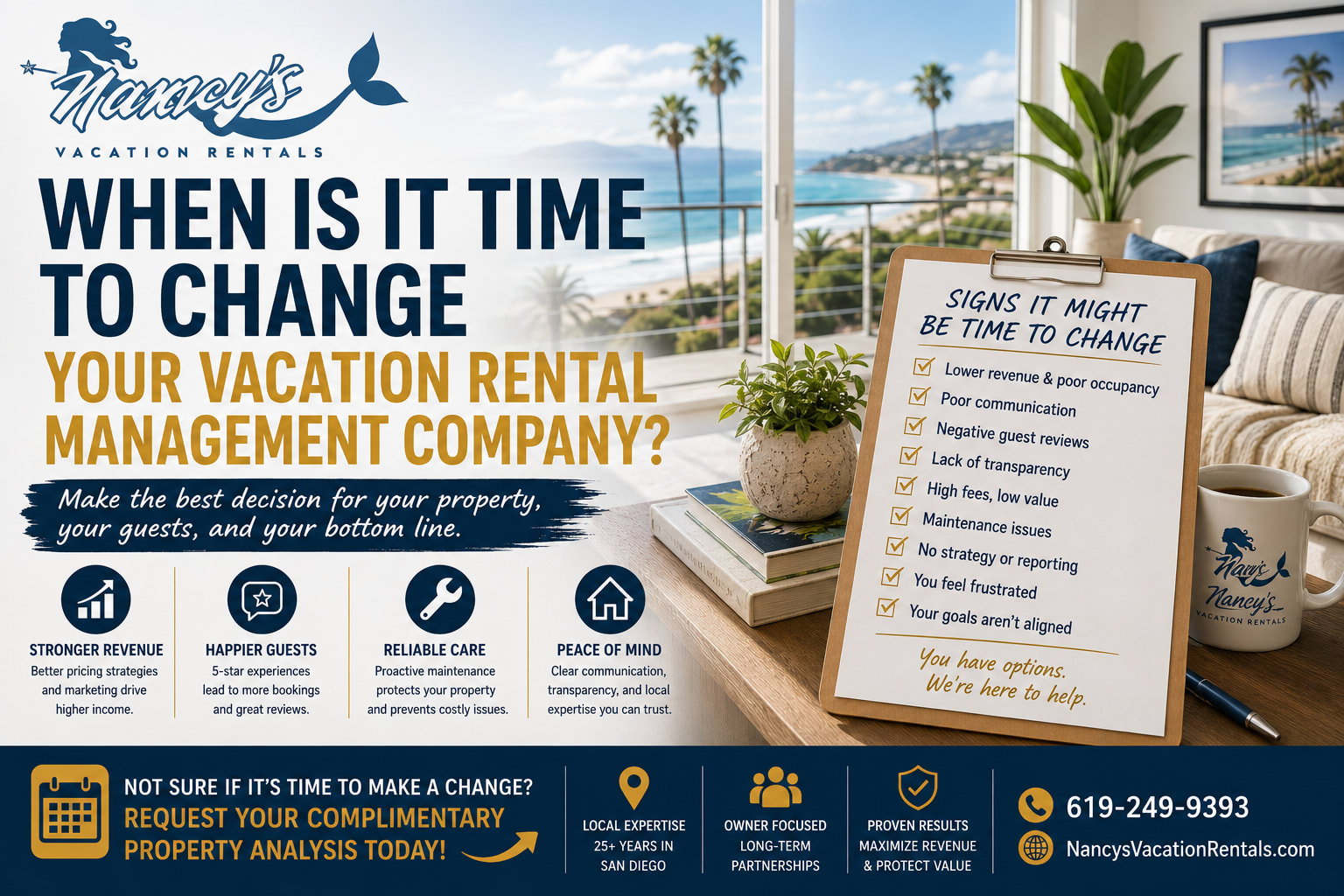
For San Diego Vacation Rental Owners and Investors
Changing vacation rental management companies is a major decision.
Your manager touches nearly every part of the property's performance: pricing, bookings, guest communication, cleaning, maintenance, reviews, accounting, regulatory compliance, and often the overall condition of the home.
That means switching companies can solve real problems, but it can also create disruption if the decision is made too quickly.
One disappointing month is not usually enough reason to leave. One difficult guest is not enough. One maintenance emergency is not enough.
But when several problems begin repeating, and the manager cannot explain or correct them, the situation deserves a closer look.
The right question is not simply, “Am I unhappy?” The better question is, “Is this management relationship still creating enough value for my property?”
After more than 25 years operating vacation rentals in San Diego, Nancy's Vacation Rentals has seen owners change managers for many reasons. Some changes were overdue. Others could probably have been avoided with better communication, clearer expectations, or a realistic understanding of market conditions.
This guide is designed to help owners separate temporary frustration from a genuine management-performance problem.
First: Do Not Change Managers Because of One Bad Month
Vacation rental performance is not perfectly predictable.
Bookings fluctuate. Travel demand changes. Weather affects short-term travel. Economic conditions can influence guest behavior. New competing properties enter the market. Major events change dates. School calendars move. Airlines adjust routes and fares.
Even the best management company cannot guarantee that every month will outperform the same month last year.
Before blaming management, ask whether the decline is:
- Market-wide
- Seasonal
- Property-specific
- Pricing-related
- Review-related
- Operational
- Temporary
A good manager should be able to help answer those questions.
The Strongest Reason to Consider a Change: Problems Become Patterns
Every vacation rental operation will occasionally have problems.
The real warning sign is repetition.
One-Time Problem Concerning Pattern One cleaning complaint Guests repeatedly mention cleanliness One repair takes longer than expected Maintenance routinely takes days to resolve One slow revenue month Revenue declines for several months without explanation One accounting correction Statements regularly contain errors or unexplained adjustments One delayed owner response You routinely have to chase your manager for answersIf the same problem continues after the manager has been made aware of it, the issue may be structural rather than accidental.
1. Revenue Is Underperforming and There Is No Clear Strategy
Revenue is one of the most common reasons owners begin questioning a management relationship.
But comparing revenue is more complicated than simply looking at last year's gross total.
A professional manager should be able to explain changes in:
- Occupancy
- Average nightly rate
- Revenue per available night
- Booking pace
- Lead time
- Minimum-stay strategy
- Competing inventory
- Guest review trends
If revenue is down but the entire competitive market is down, changing managers may not solve the problem.
If similar properties are outperforming yours and your manager cannot explain why, that is more concerning.
The issue is not always the decline itself. The issue is whether there is a credible plan to respond to it.
2. Pricing Appears Passive Rather Than Managed
Vacation rental pricing should change constantly.
Rates should respond to seasonality, day of week, local events, booking pace, lead time, competing supply, calendar gaps, and how close each date is to arrival.
If your rates barely change, or your manager seems to simply accept whatever a pricing algorithm recommends, you may not be receiving true revenue management.
Technology is extremely useful, but pricing software is still a tool.
A strong manager should understand when to override the software and why.
Questions to Ask
- Who actually reviews my pricing?
- How often?
- What causes you to raise rates?
- What causes you to lower rates?
- How are minimum stays managed?
- How do you handle orphan or gap nights?
- How are major local events incorporated?
3. Reviews Are Declining and the Same Complaints Keep Appearing
Guest reviews are one of the most valuable operating reports an owner has.
A negative review can happen even when a property is well managed.
But repeated complaints about the same issue should trigger action.
Examples include:
- Property not clean enough
- Slow response from management
- Unreliable Wi-Fi
- Smart-lock or access problems
- Missing amenities
- Broken furniture
- Maintenance issues
- Inaccurate listing information
If three guests complain about the same mattress, the solution is probably not a better apology.
The mattress may need to be replaced.
Strong managers use reviews to improve the property rather than treating reviews only as customer-service problems.
4. Maintenance Is Mostly Reactive
Every vacation rental requires maintenance.
Beach properties in particular face heavy use, salt air, sand, moisture, frequent turnovers, and guests who may not treat the home as carefully as an owner would.
A good management company should handle emergencies quickly.
But the better test is whether the company prevents avoidable emergencies.
Consider:
- Are drains inspected before they become clogged?
- Are batteries replaced before locks fail?
- Are HVAC systems serviced?
- Are leaks investigated early?
- Are worn items identified before guests complain?
- Are recurring repairs being permanently corrected?
If your manager is excellent at putting out fires but poor at preventing them, your operating costs may be higher than necessary.
5. You Are Managing the Management Company
This is one of the clearest signs that a relationship may no longer be working.
If you regularly have to:
- Remind the manager to follow up on repairs
- Check whether pricing has been adjusted
- Review guest complaints yourself
- Chase answers about owner statements
- Coordinate vendors directly
- Correct listing details
- Monitor whether important tasks were completed
you may not be receiving the level of management you are paying for.
Owners should remain informed and involved in major decisions.
But there is a difference between being involved and becoming the manager's supervisor.
6. Communication Has Become Consistently Poor
Not every owner needs constant communication.
In fact, too many routine emails can become noise.
Good owner communication is about relevance rather than volume.
You should know about significant issues involving:
- Revenue performance
- Major maintenance
- Property damage
- Recurring guest complaints
- Important regulatory changes
- Major listing changes
- Significant unexpected expenses
If you repeatedly learn about problems after the fact, communication may have broken down.
7. Accounting Problems Are Becoming Routine
Vacation rental accounting is complicated, particularly when multiple booking channels, taxes, fees, refunds, cleaning charges, maintenance expenses, and owner-use dates are involved.
Occasional questions are normal.
Recurring errors are not.
Watch for:
- Missing reservations
- Unexplained charges
- Incorrect commissions
- Duplicate expenses
- Late statements
- Statements that repeatedly need correction
Financial reporting is one of the basic responsibilities of professional management.
8. Your Property Is Becoming Dated and Nobody Is Saying Anything
A successful vacation rental needs reinvestment.
Furniture wears out. Mattresses age. Bedding gets tired. Technology becomes outdated. Paint gets marked. Kitchen inventory disappears. Outdoor furniture deteriorates.
A proactive management company should help owners understand what improvements are likely to matter to guests.
This does not mean recommending expensive renovations every year.
Sometimes the highest-return improvement may be:
- New bedding
- Better lighting
- A fresh coat of paint
- Faster Wi-Fi
- Better patio furniture
- New photography
If your manager never recommends improvements, the property may slowly become less competitive.
9. Your Listing Has Not Been Meaningfully Updated
Your online listing is your storefront.
It should accurately represent the current property and highlight what makes the home desirable.
Photos, descriptions, amenities, sleeping arrangements, captions, policies, and headlines should be reviewed periodically.
A stale listing can reduce conversion even when the property itself is excellent.
Ask your manager when the listing was last reviewed and what was changed.
10. The Company Is Constantly Blaming Someone Else
Vacation rental management involves many outside systems and vendors.
Problems can genuinely be caused by:
- Booking platforms
- Software vendors
- Internet providers
- Cleaning vendors
- Maintenance vendors
- HOAs
- Utilities
But the manager's role is to coordinate those systems on behalf of the owner.
A company that continually explains why problems are someone else's responsibility may be missing the point.
The owner hired the manager to manage the entire operating system.
11. Your Management Fee Is Low but Your Total Cost Is High
A low headline management fee can be attractive.
But owners should examine the full economics.
Ask about:
- Maintenance markups
- Vendor coordination fees
- Inspection fees
- Administrative charges
- Photography fees
- Technology fees
- Supply charges
- Guest-service fees
The cheapest management percentage is not necessarily the lowest-cost management relationship.
More importantly, the lowest-cost manager may not produce the highest net owner income.
12. The Manager Cannot Explain What Makes Your Property Different
Vacation rental properties are not commodities.
A Mission Beach house with parking, air conditioning, ocean views, and a large patio should not necessarily be managed like a basic inland condo.
Your manager should understand your property's:
- Best selling features
- Competitive weaknesses
- Ideal guest profile
- Relevant competing properties
- Price ceiling
- Operational challenges
If your property is treated exactly like every other home in the portfolio, performance may suffer.
13. You No Longer Trust the Information You Receive
Trust is critical.
An owner does not need to agree with every management decision.
But the owner should trust that the information being provided is accurate.
Once owners begin independently checking every statement, reservation, pricing decision, or maintenance charge because they no longer believe the information they are receiving, the relationship has a serious problem.
14. Problems Have Been Discussed Repeatedly but Nothing Changes
Most management relationships deserve an opportunity to improve.
If there is a legitimate concern, explain it clearly and give the company an opportunity to respond.
Ask for specific corrective actions.
For example:
- “Please review pricing weekly for the next 60 days.”
- “Please replace the recurring Wi-Fi issue rather than rebooting the router again.”
- “Please provide photos with maintenance invoices.”
- “Please review the listing and send recommended changes.”
If the same issues remain unresolved after multiple conversations, a change becomes easier to justify.
15. The Relationship No Longer Feels Like a Partnership
A professional manager should represent the owner's interests while also balancing guest experience and the long-term needs of the property.
Owners should feel comfortable asking questions and challenging decisions.
Managers should feel comfortable telling owners when an improvement is needed, when an owner's pricing expectation is unrealistic, or when a policy may hurt bookings.
The healthiest relationships involve honest communication in both directions.
Before You Change Managers, Ask for a Formal Performance Review
Before terminating your current company, request a comprehensive review.
Ask the manager to explain:
- Current annual revenue
- Year-over-year revenue change
- Occupancy
- Average nightly rate
- Booking pace
- Lead time
- Current pricing strategy
- Review trends
- Maintenance history
- Listing conversion or visibility
- Recommended property improvements
- Specific opportunities for the next 90 days
A capable manager should welcome the opportunity to explain the strategy.
Give the Current Manager a Defined Opportunity to Improve
If the relationship still has value, consider creating a short improvement period.
For example, agree on three to five specific issues that need to improve over the next 60 or 90 days.
Issue Possible Improvement Goal Slow owner communication Major owner questions acknowledged within one business day Recurring maintenance issue Permanent repair completed and documented Weak pricing strategy Regular documented revenue review Stale listing Complete listing and photography review Accounting confusion Clear reconciliation of monthly statementsThe point is not to create an adversarial scorecard.
It is to make expectations measurable.
When You Probably Should Not Wait
Some situations may justify faster action.
Examples can include:
- Serious financial irregularities
- Repeated unapproved spending
- Failure to remit owner funds
- Major regulatory or licensing failures
- Repeated safety problems
- Serious property damage caused by poor oversight
- Persistent dishonesty
These are different from ordinary performance disagreements.
If the issue involves legal, tax, licensing, or financial obligations, professional legal or accounting advice may also be appropriate.
Check Your Management Agreement Before You Make a Move
Before changing companies, read the management agreement carefully.
Pay particular attention to:
- Termination notice requirements
- Early termination fees
- Existing reservation obligations
- Who controls listing content
- Who owns photography
- Guest communication during transition
- Transfer of security deposits or damage claims
- Final owner statement timing
- Maintenance balances
- Access codes and smart-home systems
Do not assume that listings, reviews, photos, or future reservations automatically transfer.
The actual transition depends on the contract and the booking platform.
Protect Existing Reservations
The most important transition principle is simple:
Do not make guests pay the price for an owner-management dispute.
Future guests may have booked airfare, rental cars, activities, and family plans around the reservation.
A transition should clearly determine:
- Who communicates with existing guests
- Who receives final payment
- Who handles cleaning
- Who responds during the stay
- How access instructions are transferred
- Who handles refunds or damage claims
Do Not Choose the New Manager Based Only on Price
Owners sometimes leave one manager because of poor performance and immediately choose the cheapest replacement.
That can recreate the same problem.
Compare:
- Revenue-management process
- Guest-service coverage
- Local staffing
- Maintenance capabilities
- Cleaning quality control
- Property inspections
- Owner accounting
- Local regulatory knowledge
- Contract terms
- All fees and markups
The management percentage is only one part of the economics.
Ask the New Manager for a Transition Plan
A professional management company should be able to explain exactly how it will take over the property.
A good transition plan may include:
- Property inspection
- Inventory review
- Listing review
- New photography if needed
- Pricing setup
- Smart-lock setup
- Wi-Fi verification
- Cleaning standards
- Maintenance inspection
- Guest communication procedures
- Owner accounting setup
- Review of current regulations and building requirements
Local Knowledge Can Make a Transition Easier
San Diego vacation rentals can vary dramatically by neighborhood and building.
Mission Beach, Pacific Beach, Ocean Beach, La Jolla, downtown, and bayfront properties all have different operating realities.
Parking, noise sensitivity, beach access, building rules, guest demographics, views, and property layout can materially affect performance.
Nancy's Vacation Rentals has operated in San Diego's coastal vacation rental market for more than 25 years.
That local experience can be especially useful during a management transition because the new company needs to quickly understand both the property's strengths and its operational weaknesses.
A Simple Decision Test
If you are considering changing managers, ask yourself five questions:
- Do I understand why the property is performing the way it is?
- Does my manager have a credible strategy for improving weak areas?
- Are recurring problems actually being fixed?
- Do I trust the information and financial reporting I receive?
- Is the manager making my ownership experience easier or harder?
If the answer to several of those questions is consistently “no,” it may be time to explore alternatives.
Frequently Asked Questions
How do I know when to fire my vacation rental property manager?
Look for repeated patterns rather than isolated problems. Persistent revenue underperformance without explanation, recurring maintenance failures, declining reviews, accounting issues, poor communication, and a lack of corrective action are stronger reasons to consider a change.
Should I change managers because revenue is down?
Not automatically. Determine whether the decline is market-wide or property-specific. Ask your manager to explain changes in occupancy, average nightly rate, booking pace, lead time, and competition before deciding.
How long should I give a vacation rental manager to improve?
It depends on the issue. Many operational or communication problems can be evaluated over 60 to 90 days if clear improvement goals are established. Serious financial, safety, or compliance issues may require faster action.
Can I transfer my Airbnb listing to a new management company?
Listing ownership, reviews, reservations, photos, and account access can depend on how the original listing was created and the applicable platform rules. Owners should review their management agreement and platform requirements before assuming everything will transfer.
What happens to existing guests if I change management companies?
Existing reservations need a clear transition plan. Owners should determine who will communicate with guests, collect payments, provide access, coordinate cleaning, manage the stay, and handle any post-stay issues.
What should I compare when selecting a new vacation rental manager?
Compare revenue management, guest service, maintenance, inspections, cleaning, accounting, local experience, regulatory knowledge, contract terms, technology, all fees, and how much owner involvement will still be required.
Thinking About Changing Vacation Rental Management Companies?
If you are unsure whether your current management company is underperforming or whether the market itself has changed, a second opinion can help.
Nancy's Vacation Rentals can review your property's pricing, listing, revenue performance, reviews, maintenance approach, competitive positioning, and overall operating setup.
The goal is not to tell every owner to change management companies.
Sometimes the analysis shows that the current manager is doing a reasonable job in a difficult market. Other times, it reveals clear opportunities for improvement.
Request a complimentary property analysis from Nancy's Vacation Rentals.
SEO Title: When Is It Time to Change Vacation Rental Management Companies?
Meta Description: Learn when it may be time to change vacation rental management companies, what warning signs matter most, and how San Diego owners can evaluate a transition.
Suggested URL Slug: when-to-change-vacation-rental-management-company
Primary Keyword: When Is It Time to Change Vacation Rental Management Companies
Secondary Keywords: change vacation rental management company, fire Airbnb property manager, switch vacation rental managers, bad vacation rental manager, San Diego vacation rental management, property management transition
Search Intent: Commercial / Educational
Suggested Internal Links: 15 red flags your vacation rental management company may not be performing; why the cheapest vacation rental manager can be the most expensive; vacation rental pricing explained; local vs. national vacation rental management companies; how to choose a vacation rental management company in San Diego; Nancy's Vacation Rentals property management services.
Featured Image Concept: A San Diego coastal vacation rental with a crossroads graphic. One direction reads “Stay With Current Manager” and the other reads “Make a Change.” Add subtle icons for revenue, reviews, communication, maintenance, and accounting. Suggested headline: “Is It Time to Change Vacation Rental Managers?” Use Nancy's official blue logo and clean navy, white, and gold branding.
Keep reading

10 of San Diego’s Newest Restaurants You Need to Try in 2026

The 1803 Gunfight at the Entrance to San Diego Bay
In 1803, an American trading brig trying to escape San Diego exchanged cannon fire with a Spanish fort at Ballast Point. Discover the strange true story of the Battle of San Diego Bay.

Top Gun Was Born in San Diego
The Incredible History Behind Miramar's Fighter Jets